


Chapter VII. Window-Seats
Description
This section is from the book "It's Fun To Build Things", by W. T. R. Price. Also available from Amazon: It's Fun To Build Things.
Chapter VII. Window-Seats
The window-seat is no thing you are likely to build in an apartment, even if the landlord would let you. You would hesitate to tie up that much labor and material in building something you may have to leave behind, because no window-seat would ever fit some other window. Moreover, a properly built window-seat is built in to stay. As the idea of a window-seat is that you sit on it, it needs to be substantially built, and this means figuring on some 2"x 4" lumber, preferably surfaced (it's pleasanter to handle that way, and you can mark it up more accurately for cutting).
There is no standard height for a window-seat, but usually it looks best if the cushion seat is almost on a level with the window sill, even if that is considerably higher than the height of a chair seat.
The first dimension you will want to know will be the height to cut the 2"x 4" piece marked "A" in the drawing (page 70). Not knowing the height of your window sill, the only figure that can be given is to take this height and subtract from it 33/4" (3" for the cushion, which will be made to size by an upholsterer, plus 3/4" for the seat).

A scheme for building window seats.
With this dimension, cut as many pieces of 2"x 4" for the uprights, "A," as you will need, cutting notches in the ends, as shown. If the window-seat is five or six feet long, it will need a support at each end and one in the center.
The depth of the seat, vertically, or its projection from the wall to the face is entirely optional. About two feet is normal, but of course you may make it 1' 6", or even 3' 0", the last, in case you are figuring it as a possible place to sleep some wayfarer.
At a height exactly right for a rest for the horizontal 2"x 4" ("B"), nail a 3" strip ("C") to the wall, very securely, using long nails and getting some of them into a stud. Some of these nails, that is, should engage the frame of the house, right through the plaster, because it is important for this rest to be strongly fixed.
The 2"x 4" horizontal supports may now be placed, carefully spaced, and set exactly at right angles to the wall. They are toenailed into the cleat rest, "C," making an absolutely rigid and firm structural frame for the whole job. The uprights ("A") are toenailed into the floor and nailed to the horizontals, as shown.
Now a paneled face, or front is made, with construction the same as the cupboard work.
The front of a window-seat does not, of course, have to be boxed in. When it is, you will probably hinge the top, to open like a lid if you want to use the space inside for anything.
The alternative is to nail the top down permanently and hinge the front, on its bottom rail, to let down, fastening it with a spring latch on the upper rail. An alternative to this, again, is to make the front of cupboard doors, as many as the total length requires.
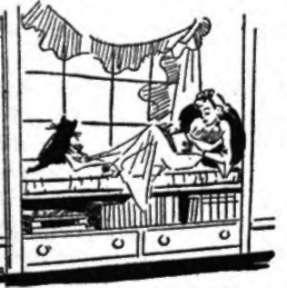
More unusual-there's the possibility of drawers (the making of which is explained in Chapter XI (Getting Ambitious)), or a combination of drawers and bookshelf. This last seems never to occur to anybody, but it is very good-looking.
Moreover, by providing a loose board over the space behind the bookshelf, you get yourself a handy hideaway for the family silver, as may also be had with the space in any corner window-seat, or a corner seat anywhere else.
The base, as in the usual technique for this detail, is cut to the full length, to conceal the ends of the side-pieces of the base, into which it is nailed. A carpenter miters this corner, so that no ends show-but this is no easy trick to do, particularly on a base-board 4* to 6" deep. It is possible, of course, to make the base flush with the sides and front of the window-seat, though a projecting base is the type usually adopted.
Now for the top. There will need to be a strip, which may be 3/4"x 2" or x 3", nailed the whole length of the seat. This is to take the hinges of the lid, and three, or even four hinges (especially if the seat is as long as 6' 0"), should be used. Or, it is possible to put the seat in loose, with two 1" finger holes (bored with brace and bit) to lift it.
The lid should be made to fit easily between the back hinge-cleat ("D") and the front strip ("E"), which is also nailed in place, directly on the 2"x 4" supports. This strip is continued around the ends, with the corners mitered (if you can do it accurately enough)-and it may be given a 1/4" or 3/8" bevel, or rounded off with the plane and sandpapered. This is called a "nosing," and isn't as easy to do perfectly evenly as you might think. Better experiment before you destroy the front edge of your seat.
The cover-board may be either a piece of 3/4" plywood, which will be amply strong, or a wide pine board, or even two boards. In either of the last two, it is important to put cleats on the underside to prevent warping-also in the case of two boards to hold them together. The cleats should be beveled, and if they are placed so as to exactly meet the 2"x 4" supports ("B"), with a cleat on each side of the center "B," the lid will stay in place snugly without needing to be hinged.
Continue to:


My Books

