


What You Do It With. Part 3
Description
This section is from the book "It's Fun To Build Things", by W. T. R. Price. Also available from Amazon: It's Fun To Build Things.
What You Do It With. Part 3
The hardwoods are ash, maple, plain oak, mahogany and walnut. These woods are not as easily obtained as the softwoods, and are much more difficult to work. You may find them fairly easy to cut up, but driving nails in them is no fun at all. All nail-holes should be started with a drill and the nails rubbed in a cake of soap. Otherwise five out of six nails will bend over flat when you try to drive them. Nails don't seem to like hardwoods, and neither will you, unless you have a lot of character and like to do difficult things.
All hardwoods have a tendency to split when nailed, and all working operations are more difficult. The amateur does well to confine himself to the softwoods, at least until he has mastered the elementary techniques of tools and methods.
The advantages of hardwoods (though you may doubt they have any after splitting a few carefully cut pieces and bending a few dozen nails) lie in their greater strength for certain kinds of work, and in the variety of beautiful furniture finishes they will take.
If nothing else, any work you might be tempted to do in oak or walnut will make you appreciate, with a feeling akin to awe, the skill, not to say sheer wizardry, of the cabinet-makers and craftsmen who make fine furniture of such resistant material.
Lumber Sizes
The softwood lumber you are most likely to use (after this friendly warning anent hardwoods) is usually carried by mill or lumberyards in certain "stock" sizes. These will vary in different localities, and as turned out by different mills, but in general the following dimensions are standard.
Standard thicknesses:
Rough, 1",11/4",11/2",2",4" Dressed, 1/2", 3/4", 11/8", 13/4",33/4" (approxi-mately)
Standard widths:
2" and wider, up to a maximum of about 10", and stock that wide, or even 10", in clear grades, comes fairly high in cost.
Standard lengths: 4', 6', 8', 10', 12', 14', 16'
The common "2x4," used in any stout structural work, is actually about 13/4"x33/4", and so with all dressed lumber, which is a little under-size, naturally, as compared with rough lumber.
How Lumber Is Sold
Lumber is sold by the piece, by the linear, or running foot (meaning length) or by the board-foot measure, which is the cubic content, or volume, equal to 1"x 12", or 144 cubic inches.
When lumber comes all the same size (dimension stock) it is customary to sell it by the piece. Example: 50 pieces 2x9x13 spruce, rough.
When the stock is cut into strips, or is dressed to a uniform thickness and width, it is customary to sell it by the linear or running foot. Example: 100 lin. feet. 1x3 white pine No. 1.
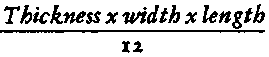
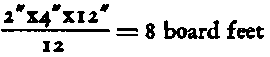
When lumber comes in random widths and lengths it is sold by board-foot measures. This takes into consideration all three dimensions of the material. Thus, to find the number of "board feet" in a piece of lumber the following formula is used:
Example
But let's not go into this any further. It is too suggestive of higher mathematics and headaches for the fun of building things, and it will be much easier to figure quantities and costs from your drawings if you stick to linear or running feet, or buying by the piece. Fortunately the board-foot measure is more often used in buying large quantities of lumber, and this you are unlikely to do.
The board-foot formula is given mainly in case a lumberyard insists on figuring it this way, in which circumstance you would not be completely baffled.
Always try to figure your lumber with as little waste as possible, but be sure to allow enough over the actual linear total for squaring up all ends and making your cuts.
Fabricated Building Boards
One of the most useful aids in building things is plywood, which may be had in thicknesses from 1/16" to 3/4" and in various woods. The thicker, and consequently the stronger plywood is laminated, or made up of several thicknesses, pressed together with the grain running in different directions so that it does not warp or split.
Plywood is a very convenient material for the tops of tables and desks, for panels and sides, or any situation where a thin, wide board with no seams is needed. It comes in small panels, or in large sheets up to 3' or 4' wide and 8' long.
White pine plywood is often as cheap as clear pine lumber, and is more suitable for certain purposes. Thin plywood makes good backs for standing bookshelves.
You must use a reasonable amount of care in sawing plywood in order not to splinter the edge you are sawing.
Beaver Board and Upson Board, 3/16" thick, are similar, but made by different companies. They are in the nature of thick cardboard, and, as they cost only about four cents a square foot they are useful for backs of bookcases. They should be put on with plenty of small flat-head nails, as under certain conditions they may warp.
"Masonite" Pressed Wood, a little over 1/8" thick, is an excellent material, dark tobacco-brown in color, and with a hard, smooth surface on one side. It is a good material for table or desk-tops (when properly supported underneath) and makes good panels or backs. It does not shrink or warp, and may be stained, painted or lacquered.
Continue to:


My Books

