


Effect Of Mouldings
Description
This section is from the book "Furniture Designing And Draughting", by Alvan Crocker Nye. Also available from Amazon: Furniture Designing and Draughting.
Effect Of Mouldings
The position of the moulding in relation to the eye may also apparently increase or diminish its members. If it is placed above or below the eye so the moulding ascends or descends, respectively, and recedes from the eye the member will diminish in size, appearing thinner than it is. On the other hand, if the moulding descends or ascends respectively the member will appear thicker than it really is.
When a moulded member is composed of two or more of the simple forms described above, it owes its charm somewhat to the introduction of a fillet which, separates each moulding from that adjoining. An important combination of mouldings is their use in the crown members of cabinets. We have already called attention to having this proportioned to the size of the body below; in addition, it should not project too much. If its overhang is not greater than its depth it will usually look well, but in many instances it will be found desirable to keep somewhat within this limit.
Mouldings may be ornamented by carving and when so treated care must be taken to preserve their general form. It is usual on architectural members to employ the profile of the moulding as the leading line of the ornaments upon it. Thus, the fillet may be decorated by vertical lines as flutes, fret, or dentils; the bead, by "pearls," bead and spindle; the torus by the guilloche; the ovolo, by an egg and dart; and the cymas, by the heart ornament, etc.
Plate XIII. CASE CONSTRUCTION.
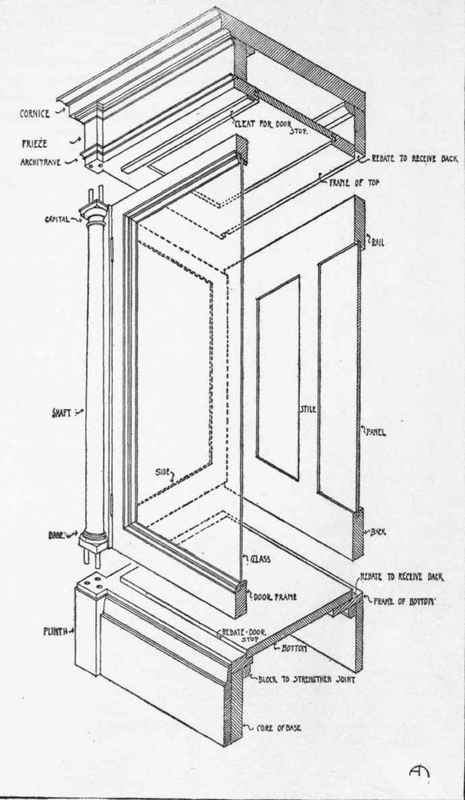
Cases are composed of a top, a bottom, and uprights between which are panels of wood or glass. Plate XIII shows a section of a cabinet with the parts separated so as to illustrate how it is constructed. The column forming the corner post is doweled to the base and cornice. The sides and back are paneled and are either doweled or rebated to the other parts. The bottom and top is composed of a frame surrounding a panel. In order to build all parts together use is made of several kinds of joints. Though these are not always shown on the drawings it is desirable that the draughtsman be familiar with them. They may be arranged in three groups, comprising those commonly used in furniture construction; the butt, the angle, and the framing joint.
Continue to:


My Books

