


Joints. Part 2
Description
This section is from the book "Furniture Designing And Draughting", by Alvan Crocker Nye. Also available from Amazon: Furniture Designing and Draughting.
Joints. Part 2
The cabinetmaker avoids these difficulties. First he cuts a rebate in the frame on the finish side. In this the moulding is glued solidly so it becomes a part of the frame itself. When the glue is dry the varnished panel is set in from the back and held in place by plain mouldings nailed to the frame. This leaves the panel loose and free to move should shrinkage take place. The object in varnishing the panel before setting it is that if any movement does occur it will not be seen by the exposure of a line of unfinished wood.
Flush panels are so named because their surface is level with the surrounding frame. They are set in a rebate from the back and secured by a nailed moulding. In most cases a bead is run all around the edge of the panel, so as to hide the joint between it and the frame. Such panels are used for the back of cases and in places where no decorative effect is wanted.
Panels may have the edges beveled or rebated below their surface, so as to produce a sort of border around the panel itself. Such panels are sometimes spoken of as raised panels, to distinguish them from a flat, even surface.
The surface of a panel is made of more carefully selected wood than that used for mouldings and rails, with the intention of having a handsome grain. Veneers are chosen that have been cut from a portion of a log furnishing strong markings, or "figures," when polished, and these are sometimes cut in smaller pieces, either half or quarter the size of the panel, and placed together so the lines of the grain will form a pattern, or a "picture." At other times a design is inlaid on the panel or it is carved. The simplest form of carved panel is that with the surface moulded to resemble, more or less, the folds of drapery, and called linen or parchment panels.
PLATE XIV. MOULDINGS AND PANELS.

By arranging the mouldings around flat panels, so as to produce forms with a broken outline, the stiff rectangular panel is avoided. Three varieties are shown on Plate XIV.
Bookcases, china cabinets and others of the same class of casework have portions of their sides glazed either with clear glass or mirrors.
In the best of glazed work plate-glass is used, but where something less expensive is wanted the best quality of double-thick sheet glass is used. Anything poorer than this should not be placed in good work. Mirrors should always be of plate-glass. Glass set in doors or substituted for panel work is cut the full size of the rebate opening in the frame, and is held in place by a loose moulding, the same as a panel. Plate XIV. It is only when some special condition requires it that the glass is secured in place by putty and glaziers' points instead of the loose moulding.
Mirrors are not often cut to the full size, but are a trifle smaller than the rebate measure, and the glass is held in place by a number of triangular blocks, about three inches long, placed at intervals in the rebate. These blocks serve to wedge the glass securely in place, that it may not slide in the rebate, and they also reduce to a minimum the surface of wood in contact with the coating on the back of the mirror.
The silvering is protected from injury by a paneled backboard, screwed to the frame after the glass is fastened in. This backboard must not touch the mirror at any point.
The glass is held in front by a moulding set in a rebate, as we have described for paneling.
Doors are composed of a framework enclosing panels. The uprights of the frame are the stiles, and the horizontal parts are the rails. They are hung either with hinges or pivots. The former are more or less visible, but the latter are concealed. Plate XV. illustrates various applications of these methods. No. I shows the door hung with butts and without a rebate for the door to shut against. Such a door would be used in cabinets where the uninterrupted joint between the edge of the door and the side of the case is not objectionable. Notice also that unless the door can swing through an arc of 180 degrees the width of the opening is reduced by about the thickness of the door, or A in the illustration. In most instances a rebate to receive the door is desirable; and still the door hung with butts would reduce the size of the opening, as at A, No. 2, unless the rebate is as deep as the door is thick, No. 3.
Doors for cabinets having drawers within are hung this latter way, as it enables one to pull out the drawer, though the door is open at the right angle only. No. 4 shows how a door may be hung when the design calls for a pilaster on the corner of the case and yet the conditions require that a maximum width be given to the interior. An article having the door hung in this manner must stand sufficiently away from the wall or other pieces of furniture to permit the pilaster to turn on the axis of the hinge.
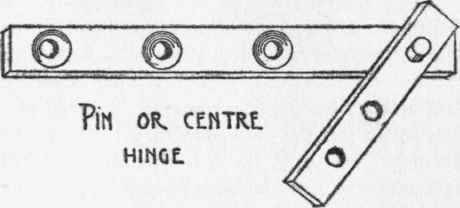
The pivot, pin, or center hinge, is invisible, and in high-class work this is an advantage. It is also strong, and is screwed to the upper edge of the top rail and the lower edge of the bottom rail of the door in a position such that a strain does not start the screws. The illustration shows what it is like. There are two bars of metal, narrow enough to be entirely concealed by the thickness of the door. In one of these bars is a hole receiving a pin on the other bar. One of the bars, that with the socket, is set in the frame receiving the door; the other is on the door itself, and when complete the door turns on the pin as an axis.
It is well to set the pivot on a line through the middle of the thickness of the door and about half the thickness of the door, plus an eighth of an inch, away from the post against which the door turns; that is, C =B +1/8 inch. No. 5 shows a pivoted door in a position where it reduces the width of the door opening, and No. 6 shows the pivoted edge of the door turning in a hollow prepared for it and provided with stops, against which the edge of the door strikes either when open or shut.
Continue to:


My Books

