


Turnings. Part 2
Description
This section is from the book "Furniture Designing And Draughting", by Alvan Crocker Nye. Also available from Amazon: Furniture Designing and Draughting.
Turnings. Part 2
When the design calls for the edge of the top to appear thick, it is a needless waste of material to construct it of wood the full thickness, besides making an unnecessarily heavy piece of furniture. To avoid this and yet obtain the appearance wanted, a frame of wood is fastened to the underside of the otherwise thin top, giving the thickness required. This frame is called the lining piece, and the top is said to be lined up.
The method of fastening the top to the frame of the table varies with the class of work and the size. If it is a small table, no special care is taken, the fastening consisting of screws driven through the rail into the underside of the top. If the rail is narrow and thick enough, the screw is set straight through it. If, however, it is a wide rail, the screws are driven in recesses cut for them on the inner side. Most tables are too large to admit of this method. A top fastened as just described is held fast to the frame, so if shrinkage takes place there is a strain somewhere that may result in a cracked top. To allow for any movement that may occur, short blocks having a tongue that fits securely in a groove cut on the inner side of the table frame are screwed to the underside of the top. These blocks hold the top firmly in position, and yet if a shrinkage takes place they are free to move in the grooved frame.
PLATE IV. DROP LEAF TABLES.

Tables are frequently provided with a drawer either in the frame or hung beneath the top on cleats. How drawers are made, and the different kinds, are described in Chapter V (The Drawer).
There are occasions that require a table larger than it is convenient to keep standing continually in a room. In early times, when tables were nothing more than boards resting on trestles, if they were not needed the board was turned up against the wall and the trestles stowed away. When the top and the supports became fastened together, methods were invented for reducing the size of the table, that it might not take up too much space, or for enlarging it for special purposes. One of these methods is the use of leaves or flaps that fold down against the side of the legs. Two things are to be observed in such tables-the way the leaves are hinged, and how they are supported when raised.
In cheap work the edges of the leaves and top, where they meet, are cut straight and square, forming a plain joint, and the leaf is hung with a hinge on the underside. Plate IV., No. 1. When hung in this way a small crack is seen between the top and the leaf as the latter hangs down, and the hinge also shows.
In better work both these things are considered faults, and to avoid them the rule joint is used. Plate IV., No. 2. This joint is made by moulding both the edge of the leaf and the top where they meet, the moulding on the leaf being the reverse of that on the top. The top is cut with a projecting tongue, rounded like a quarter cylinder, and the leaf is hollowed to receive it. The hinges are sunk into the underside of the top and leaf, with their center corresponding with the center of the quarter round moulding of the meeting edges. Then as the leaf swings up or down its rebated edge fits snugly against the moulded edge of the top. The hinge is practically concealed and there is no open joint.
There are small tables made with two leaves hinged in a similar way to that just described, so when both are down the table is no wider than the cylinder plus the thickness of the leaves.
Leaves may be supported by brackets attached to the frame and swinging out under them. The brackets may be hung with metal hinges, but better ways are illustrated in Plate IV., Nos. 3 and 4. These drawings show folding brackets somewhat similar in construction made by fastening to the side rail of the table frame a block with one end cut so as to interlock with one end of the bracket. A metal pin through the two pieces where they interlock serves as an axis on which the bracket turns. In No. 3, the finger joint, the corners of the working parts are beveled off, that the bracket may turn. In No. 4, the knuckle joint, they are rounded so the parts fit clearly and are in contact in whatever position the bracket may be. The finger joint can be made the strongest, as more wood may be left between the pin axis and the ends of the tongues than in the other. The knuckle joint is considered the neatest, but it is more difficult to construct, and as the bracket is hidden from view the difference in appearance does not warrant its use.
Sometimes, when the depth of the frame will permit, a portion of it may be cut so as swing on a pin at the middle, and, thus, when turned at right angles to the frame, one half is beneath the top, the rest acting as a support to the leaf. Plate IV., No. 5.
Bracket supports are not strong, and a table with a large leaf is unstable. To obviate this, tables are made with a leg that swings out under the leaf, giving it support, and stability to the table. When such a table has a stretcher, the movable leg is strengthened by fastening it to a hinged bracket at the stretcher level, in addition to the one on the frame. Another way of supporting drop leaves is to arrange slides that may be pulled out from the table frame beneath the leaves when they are raised.
The tables described thus far have the top fixed, but there are those with the tops pivoted, so when they are turned about the pivot a quarter way round, the leaves will be supported by the frame of the table, which in the revolved position of the top lies beneath them. Two varieties of this style are illustrated on Plate V. The first is an old-style drop-leaf table pivoted at the middle of the top. By raising both leaves and turning the top on its pivot the ends of the frame are brought beneath the leaves to support them. The second table is in more common use. The top is of two parts, of the same size and shape, hinged together so one part folds over on the other. When folded the top is but half the size it is when open, and can be turned on the pivot to a position over one end of the frame with the hinged edges directly across the middle. The upper leaf may then be unfolded and will rest on the other end of the frame. Such tables are usually square when open, and are spoken of as card tables.
PLATE V. PIVOTED TOP TABLES.

Drop Leaf Table.
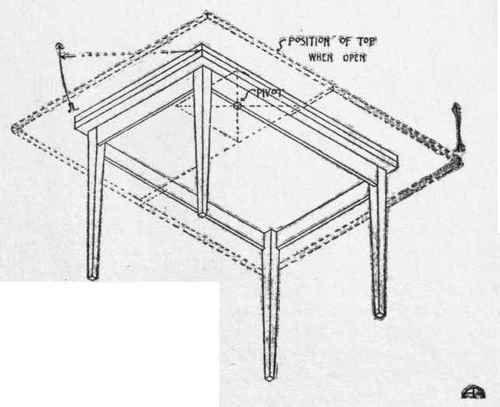
Folding Top.
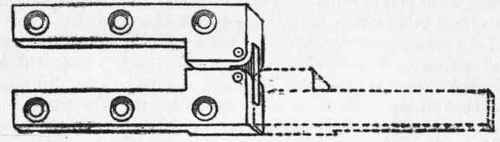
Card-Table Hinge.
Continue to:


My Books

