


St. Mary's Porch, Oxford
Description
This section is from the book "English Furniture", by Frederick S. Robinson. Also available from Amazon: English Furniture.
St. Mary's Porch, Oxford
He uses cartouche shapes in the centre of broken pediments or under the mantelshelf. The large upper panel of the chimneypiece is sometimes diversified by jutting or ' returning' angles at the top, and supported by scrolls on the outside, at the bottom, in the manner of a merely ornamental buttress. The hanging bell-flower appears sometimes in his carvings, and has been repeated by furniture designers over and over again. Terminal shapes and busts are found very often on each side of the fireplace, not so often perhaps above. His chimneypieces generally have two, occasionally three, tiers, and resemble his outside porches. Italian workmen were brought over to carve them and other work, but amongst his many pupils one at least, Nicholas Stone, was a native, and famous as the carver of the porch of St. Mary's at Oxford. This porch is worth considering by the student of furniture. First, above the round arch of the doorway are to be seen the great rolling curves of the pediment, a shape which in a lighter form was used most freely in the eighteenth-century bookcases and cupboards and cabinets.
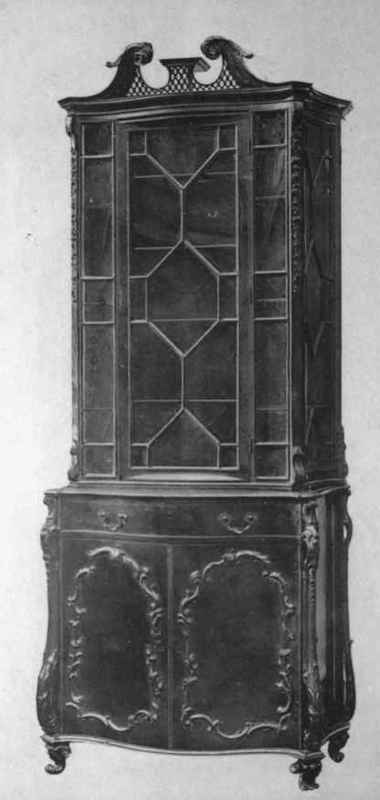
Plate XC. Bookcase, Mahogany, Chippendale
XC. Bookcase, mahogany. Chippendale. Henry Willett, Esq. (the late).
Secondly, the niche which fills the centre of the pediment, and contains the statue of the Virgin and Child, has a scallop-shell domed top, copied no doubt from the niches of such Italian sculptors as Sansovino.1 This we find at the end of the seventeenth and beginning of the eighteenth century is a favourite form not only for outside porches but also for those elaborate open or closed corner cupboards, with shelves for china, which were called buffets or 'beaufaits,' and were the precursors of the sideboard. On a smaller scale it will be found to grace the tops of chairs, the upper ends of chair legs, and the centre of the front of the seat in chairs as late as those of the early mahogany period. Lastly, we are again reminded of a chair shape by the great twisted columns at the sides of the porch. It will be easy to conclude - even if Raphael's cartoons and Italian chairs, with spiral-turned shapes, did not exist to prove it - that this spiral turning which we associate with the reign of Charles II. is of Italian origin.
The influence of Inigo Jones on a great carver who, as we shall see, did make furniture, seems apparent if we consider the panelling of the double-cube room at Wilton, which was made to receive the portraits by Vandyke. The huge hanging masses of fruit and flowers slung from riband bows, and with drapery shapes attached, most certainly suggest the boldly relieved bird and fruit and flower carvings of Grinling Gibbons. Still more do the cherubs' heads in cartouches, or between swags, remind us of the exquisite handiwork of Evelyn's protege.
1 For ultimate sources of this shape, the S-curve, rosette, acanthus, etc., see such works as Mr. Percy Gardner's Sculptured Tombs of Hellas.
As regards the shape and size of panels, Inigo Jones introduced a change. We no longer find small and numerous panels all of the same shape, but a larger and more varied design. A doorway by him may or may not have a pediment of the same character as the chimneypieces. There is often a large ovolo or cushion moulding below the cornice, sometimes plain, but often highly carved. The panelling which the doorway frames with its double doors is generally in three tiers. Either there is a small panel at the top and two long upright ones below, or else there is a long upright above and below, with a square panel in the centre. The edgings of them have changed from the early half-moulded, half-chamfered fashion, and are now a regular classical ovolo or an ogee.
Continue to:


My Books

