


Queen Anne Period. Part 3
Description
This section is from the book "French And English Furniture", by Esther Singleton. Also available from Amazon: French And English Furniture.
Queen Anne Period. Part 3
"The very sound of a Lady's Library gave me a great Curiosity to see it; and as it was some time before the Lady came to me, I had an opportunity of turning over a great many of her Books, which were ranged together in very beautiful Order. At the End of her Folios (which were very finely bound and gilt) were great jars of China, placed one above another in a very noble piece of Architecture. The Quartos were separated from the Octavos by a Pile of smaller Vessels which rose in a delightful Pyramid. The Octavos were bounded by Ten dishes of all Shapes, Colours and Sizes, which were so disposed on a wooden Frame, that they looked like one continued Pillar indented with the finest Strokes of Sculpture, and stained with the greatest variety of Dyes. That Part of the Library which was designed for the Reception of Plays and pamphlets and other loose Papers, was enclosed in a kind of Square consisting of one of the prettiest grotesque Works that I ever saw, and made up of Scaramouches, Lions, Monkies, Mandarines, Trees, Shells, and a thousand other odd Figures in China Ware. In the midst of the Room was a little Japan Table with a quire of gilt Paper upon it, and on the Paper a Silver Snuff-box made in the shape of a little Book. I found there were several Counterfeit Books upon the upper Shelves, which were carved in wood, and several only to fill up the number."
As an example of the decorative use made of china by arranging it on brackets even above mirror or panel, the reader is referred to Plate XXIIL, No. 2.
The Queen Anne room had its walls sometimes covered with tapestry and sometimes decorated with painted or carved panels. In accordance with the French and Dutch custom also, pictures were used with a conscious decorative effect. Sometimes they were hung on the tapestry, also, though not when the latter depicted a story of itself. In 1710, D'Aviler defines the word picture (tableau) as a subject of painting, usually in oil on canvas or wood, and contained in a frame or border. "Pictures greatly contribute to the decoration of the interior of buildings. The big ones figure in churches, drawing-rooms, galleries and other big places. Those of medium size called easel-pictures are placed in the spaces above the chimney-piece, above the doors and in the panels of the walls, or else on the tapestry against the walls. The small ones are symmetrically arranged in the chambers and cabinets of the curious."
In the ordinary house, in the reign of Queen Anne, there was a strange jumble of the old and the new. The late Jacobean carved oak, or walnut, cane-bottom chair had not yet gone entirely out of use, but the new styles were varieties of the chair and stool on Plate XXI., Nos. 1 and 4. These were usually of walnut, but mahogany was just coming into fashion as a cabinet wood, and Queen Anne chairs with the frames made of that wood still exist. The characteristics of this chair consist of the cabriole leg, with and sometimes even without stretchers, the club foot, and solid curved splat which very frequently assumes the jar shape. Later in the period, the stretchers were discarded altogether. There was very little carving except on the spring of the knee. The claw-and-ball foot was rapidly coming into favour, and the tendency was constantly towards increased lightness of frame. Even where the characteristic square tapering lee of the Louis XIV. style is preserved, increased lightness is noticeable. The turned stretchers, both or chairs and settees, are shown on Plate XIX., Nos. 5, 6 and 7, and Plate XXI., Nos. 1, 4 and 10. Marot clung to the flat curved stretchers of the Louis XIV. style, and his chairs are very large and heavy.
The reason of this is that he paid great attention to the upholstery, and his large and brilliant designs required a correspondingly large surface for adequate display. Many of his plates are devoted entirely to patterns for materials for upholstery, and the geometrical flower-bed is the apparent inspiration of much of his work of this nature. Some of Marot's chairs and stools are shown on Plate XXI, Nos. 2, 3, 5, 8 and 9. The chairs on either side of the bed on Plate XXII. are also Marot's. No. 7 on Plate No. XXI. shows the lighter form of frame of this class of chair. The settees, numbered 5, 6 and 7, on Plate XIX. should also be carefully studied as types of this style. They are taken from contemporary prints of court ladies. On one of them, Anne herself is sitting in the original. No. 6, Plate XXL, represents the top of a chair back which is very characteristic of the Marot school. One of the favourite ornaments of this period was the urn in some form or other. The acorn was also largely used for feet, and the flattened bulb was not entirely superseded. The effect produced by the above-mentioned detail is found in several other pieces of furniture of the day, clocks and mirrors particularly.
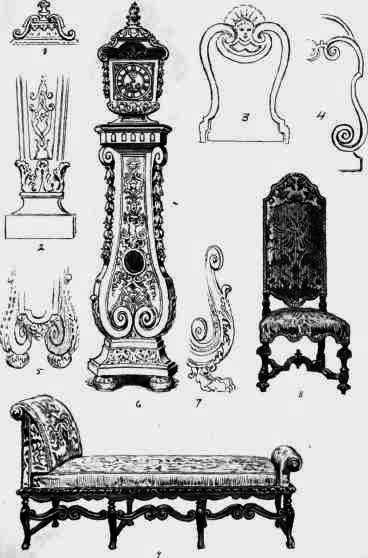
The urn is seen in No. 5, Plate XXIII, and the effect is repeated in Nos. 1 and 6, Plate XX. Nos. 5 and 6 on that Plate also show the combination acorn and flattened bulb employed as feet. No. 6 also shows another decorative feature of the period in the heavy chutes of bell-flowers. The handsome clock, No. 6, Plate XX., from Marot's design, shows many Louis XIV. features. The sun in splendour is noticeable and the winged cherub above the dial. The latter was made great use of in the Queen Anne style. The mascaron also was largely adopted. Another decorative feature which was carved on the centre lower rim of so many chests-of-drawers, and dressing-tables was the shell. The cabinet-makers were never tired of using the latter, and its constant appearance may perhaps be accounted for by the fact that it was the principal charge in the arms of the English company of cabinet-makers. It is seen on top of the mirror in No. 2, Plate XIX., and the mascaron is used to beautiful effect in the mirror No. 3 on the same plate.
Continue to:


My Books

