


The Jacobean Period
Description
This section is from the book "French And English Furniture", by Esther Singleton. Also available from Amazon: French And English Furniture.
The Jacobean Period

THE Jacobean Period covers almost a century (1603 - 1690). In its earlier stages, therefore, it is still Elizabethan in spirit, and in its old age it is largely influenced by the taste of the dominant French court. During the reign of James I., the styles of furniture and interior decoration are still strongly Tudor in character, but the .intimate connection with the Low Countries, and the friction with Spain and her Western possessions have their effect in making the wealthy classes of England thoroughly acquainted with the best products of Spanish, Dutch, and Flemish workmanship. The Tudor mixture of Gothic and Renaissance styles was gradually modified under the influence of Inigo Jones, "the English Pal-ladio." The political ties between England and the Low Countries, based on mutual interests of a mercantile and religious nature, were still further strengthened by dynastic alliances. In Norfolk and Suffolk, the population was largely composed of natives or descendants of natives of the Low Countries. Flemish and Dutch art and manufactures, therefore, were extremely influential in forming what is known as the Jacobean style.
This period covers, of course, a portion of the reigns of Louis XIII. and Louis XIV.; and much of the furniture fashionable in France at this period was imported into England; but with the exception of the wealthiest homes sumptuous articles are not common. There is, indeed, a massive set of superbly carved silver furniture at Knole, Sevenoaks, Kent, but such luxury is rare.
Oak and walnut are the woods chiefly used at this period, but we also find lime, cherry, and cypress (the latter especially for chests). Sometimes, as even happened in Tudor days, the carving was gilded, and, in many instances, we find the wood painted. Pear-wood stained black to imitate ebony is also popular. Mahogany is almost unknown in these days; but exotic woods are used in the construction of cabinets. Towards the end of the Seventeenth Century a great deal of ebony was imported, and even carved ebony furniture from India and Ceylon found its way into many rich English homes. Shakespeare gives us a hint of the generous use of rich articles from various parts of the world, showing what a cosmopolitan atmosphere a Tudor home presented:
Gremio says:
"My house within the city Is richly furnished with plate and gold; Basins, and ewers, to lave her dainty hands; My hangings all of Tyrian tapestry: In ivory coffers I have stuff'd my crowns;
In cypress chests my arras counterpoints, Costly apparel, tents, and canopies, Fine linen, Turkey cushions boss'd with pearl, Valance of Venice gold in needlework, Pewter and brass, and all things that belong To house or housekeeping." *
It is not unfitting that we should first recall a few of the distinguishing features of Elizabethan ornament, so frequently met with in the Jacobean home.
The carving was characterized by bold and deep cuttings, leaving the design in high relief. The panels of the chests, cabinets, cupboards, beds, etc., present a rich variety of subject. Figures taken from Biblical or mythological lore, grotesque monsters, animals and floral forms are met with; and of the latter we particularly find the rose, vine, carnation, lily, marigold, sunflower and tulip predominating. A typical floral panel is shown on Plate X., No. 7. Then we often see a diaper pattern, and, occasionally, the "linen fold."
The cornices of cabinets, bedsteads, etc., are often adorned with the "egg and tongue" pattern; and the backs of settees, cornices of overmantels, etc., are often enriched with rather grotesque dolphins, placed back to back, forming a kind of scroll the outline of which is shown on the table on Plate X., No. 2.
Another typical ornament is the swelling acorn-bulb. It appears on the legs of tables, posts of bedsteads, and supports of cabinets, cupboards, etc., as shown on Plate X., No. 2. A variety of this bulb occurs on Plate XI., No. 1, showing the black ebony balls connected by plain stretchers, or straining-rails. The bulb also appears, but somewhat smaller and connected by straight stretchers, on the table on Plate V. The baluster legs of the court cupboard on Plate X. exhibit another kind of swelling leg. This leg becomes slenderer until it dwindles into the type shown on Plate X., No. 1.
* Taming of the Shrew, Act II., Scene I.
Other ornamental devices consist of interlaced bands, strapwork, shells, lyres, bell-flowers, the acanthus, arch panels, branches and leaves in large flowing designs, besides a great variety of mouldings, panels and pierced scrolls. Turned work is rapidly superseding carving, which, however, is never quite driven away.
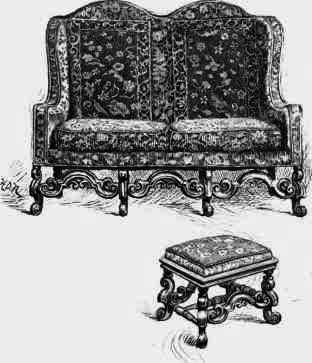
The newest decoration is the "spindle" ornament which seems to have been introduced from England from the Low Countries about the middle of the Seventeenth Century. This was made of ebony, or of pear-wood stained black, turned, of course, cut in half and applied. Eggs and lozenges were likewise made, stained black and applied. These ornaments decorate the cabinet on Plate X., No. 1, and the "spindle" is shown separately as No. 4 on the same plate. The scroll is an excessively popular device: it not only occurs upon mouldings and cornices, but it also decorates the feet, frames of panels and straining-rails of chairs and settees.
During this period, the hall was the most important room in the house. Guests were always received here, and here meals were generally served. In the baronial homes, therefore, of past generations, the hall was used as both drawing-room and dining-room. The table was set on a dais", or platform, and a screen cut off the entrance from the kitchen. At the other end of the hall was the minstrels' gallery. In the course of time, a bay-window was added at the dais end of the hall, which formed a private retiring-place for conversation while the table was being cleared. This paved the way for the small "privee parlour," a little room built at the end, or side of the hall. The next addition was the "Great Chamber," a larger room than the "parlour," to which the lord of the household often retired, leaving the hall to his retainers and to such guests as were not of equal rank with himself. The "Great Chamber" was used as a bed-room by night and as a living-room by day. Here, of course, there was a sumptuous bed; and a bed with rich furniture also stood frequently in both parlour and hall.
Continue to:


My Books

