


The Louis XV. Period. Part 2
Description
This section is from the book "French And English Furniture", by Esther Singleton. Also available from Amazon: French And English Furniture.
The Louis XV. Period. Part 2
Meissonier began by destroying all the straight lines that were used of old; he curved the cornices and made them bulge in every way; he curved them above and below, before and behind, gave curves to all, even to the mouldings that seemed least susceptible of them; he invented contrasts; - that is to say, he banished symmetry, and made no two sides of the panels alike. On the contrary, these two sides seem to be trying which could deviate most, and most oddly, from the straight line that till then they had been subject to."
As Oppenord may be said to have presided at the opening of the Regency style, so Meissonier inaugurated that of Louis XV. His rocaille escaped the exaggerations of the contemporary foreign masters, and kept within the bounds of good taste.
Among other decorators, less inventive but of charming taste, who followed in the traces of Meissonier were Michel, Rene Stoldz or La Jotie, Chevillon, etc. The Print Room of the Bibliotheque Nationale possesses a collection of the beautiful designs of the two last-named artists in water-colour and gouache. These designers used many of the same motives as Meissonier, the shell, the cabbage-leaf, the shrimp (of course, the forms derived from these objects), but they added to their decorations still more fleeting and vague elements, such as falling water, the ostrich plume, etc. La Joue is a real past master in the art of introducing into a decorative panel a cascade which sometimes falls from nowhere and loses itself in pearly foam: for him everything serves as a pretext for a cascade: neighing horses plunging in the water, an open-jawed dragon clinging to the base of a column, a hunted stag vomiting a jet of water into a fount whose marble rim is full of twists and contortions.
The list of artists who contributed to interior decorations during the Louis XV. period is a long one. It includes: Boffrand, Le Roux, Oudry, Brisseux, Hu-quier, Pineau, Mondon, Cuvillies, Gravelot, Boucher, Blondel, Babel, Germain, Marvye, Chedel, Jombert, Babin, Cochin, Pillement, Peyrotte, Eisen, Demarteau and Martinet. These are the great masters of the style. The principal smaller ones are: Aubert, Crepy, Vassy, Bachelier, Roumier, Vervien, Caylus, Lassurance, Lange, La Collombe, Dubois, Bouchardon, Prevost, Le Grand, Fraisse, Blanchard, Marsenois, De La Cour, Canuc, Poul-leau, Mollet, Mansart, De Jouy, Perault, Dumont, Ave-line, Cornille, Chamblin, Bellay, Vanerve, Pellctier, Paty, Chopart, Borch, La Datte, Lamour, Girard, Bal-lechou, Herisset, Hubert, Metayer, Servandoni, Slo-iste, Caque, L'Hermitais, Roy, Duval, Francois, Char-pentier, Lebas, Radel, De Lorme, Courtelle, Viriclix, Tessier, Lattre, De Laborde and Harpin.
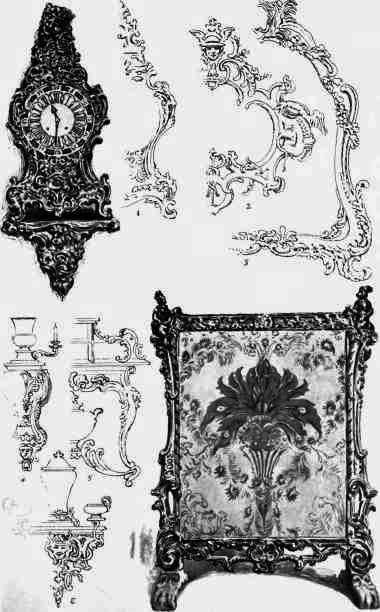
One of the cabinet-makers who best produced the ideas of Meissonier was Jacques Carfieri (b. 1678), who was "sculpteur,fondeur et ciseleur du roi." Even if he did not himself manufacture, he directed the production of splendid cabinet-work. His work is distinguished by grace and aristocratic elegance. He executed a great quantity of bronze for the famous cabinet-maker, Œben. Many extant works bear the mark of a C surmounted by fleur-de-lis, and these are usually attributed to this master, but the great inequality of excellence makes many critics doubtful. Œben was a pupil of Boulle, and devoted himself exclusively to the branch of marquetry in cabinet-making, leaving the metal decoration to his assistants, Caffieri and Duplessis. His work was in the greatest favour with Madame de Pompadour, who bought it through the merchant Duvaux, one of whose best customers was the king himself. Œben died about 1756, and his works helped to furnish all the mansions and castles of the Marquise and King in Paris, Fontaine-bleau, Compiegne, Versailles, Bellevue, Crecy, Champs, Saint-Ouen, and la Celle Saint-Cloud. His widow married his foreman, J. Henri Riesener. The other great cabinet-makers of this period whose works are to be found in the Rothschild, Wallace, South Kensington, and other famous collections, are Bernard, Boudin, Ollivier, Dubois and Cremer, who worked principally in artificially coloured marquetry, and Gamier, Pafrat and Roubo. The latter wrote a very valuable treatise called L' Art du menuisier.
The taste for Chinese and Japanese art was very insistent, but at the same time only skin-deep. There was no true feeling for the profundity of the wonderful art in the patient work that produced the Chinese and Japanese lacquer. It was regarded as a toy. However, progress is noticeable, and fashion gladly welcomed the art products of the Far East. In Angola, a novel within the period, we read: "Upon my word!" says the Count to the Countess, "you have a splendid chimney-furnishing, and those Chinese cabinets are charming. Is this the rue du Roule? * I am simply crazy about that little man. Everything that he sells is so expensive and scarce." "Oh," says the Countess, "it is a pretty good selection." "Well," replies the Marquis, "there is simply a divine taste in everything there. There are little divinities in the most wonderful forms. This one, for instance; this and your fool of a husband are as like as two peas." Another description from the same work and in the same tone tells us a "lit de repos, in a niche of damask, coloured rose and silver, looked like an altar consecrated to delight; an immense screen surrounded it, and the rest of the furniture was in perfect accord with it; consoles, jasper corner-shelves, China cabinets loaded with the most rare pieces of porcelain, and the chimney-piece was decorated with corpulent gods of the most wonderful and clownish shapes."
* A street where Eastern goods were specially on sale.
These Chinese cabinets were principally of lacquer, more or less adapted to French demand. Just as soon as the French taste required Oriental goods, orders were sent abroad and the "Heathen Chinee" was quick to supply the foreign market. The native art was gladly modified by the merchants in accordance with the demands of foreign trade. Sometimes even French and other goods were transported to China to have the finishing touches added there. Of course, the time came when native craftsmen tried to meet the demands of fashion by imitations of the Eastern ware. The trouble was that for a long time the home workmen could not produce the proper varnish and make a satisfactory lacquer. Some workmen boldly used native varnishes without attempting to imitate the Chinese and Japanese, and produced charming work of the most delicate finish; but these, unfortunately, scarcely outlasted the special entertainment for which they were manufactured. The undoubted chiefs of these varnishers were the Martins. In 1744, a decree of the Council allowed "au Sieur Etienne Martin le cadet exclusivement a tous autres, a l'exception du Sieur Guillaume Martin" the privilege of manufacturing for twenty years all kinds of relief-work in the Japanese and Chinese taste.
Continue to:


My Books

