


How To Make A Traveling Clock Case
Description
This section is from the book "Furniture A Girl Can Make", by William W. Klenke. Also available from Amazon: Furniture A Girl Can Make.
How To Make A Traveling Clock Case
A folding clock case will be found to be very convenient to possess when you make trips by automobile or otherwise, since it collapses into so small a space and when open, the clock sets at a convenient angle for reading the time of day.
This project can be made either of wood or heavy cardboard such as bookbinders' board.
Procure a cheap watch, in the event that you do not have one; get one with an alarm attachment. You will find this feature very desirable to have when you wish to arise at a special hour during your trips.
The size you will make this model will depend upon the size of the watch; allow a margin on the outside of the watch of about top and two sides, and a little more at the bottom. The average cheap watch measures about 21/4" in diameter, so make this folding case about 4" square, outside measurements to allow for an easy fit.
Method Of Procedure
Step No. 1: Make the bottom and back sections alike, that is the same size and with a 1/4" 1/4" strip of wood glued to all sides. This will give depth to the case for the watch to set in when closed. These two sections are hinged together along the back edge which is explained further on in this article.
Step No. 2: Cut out the front piece for holding the watch. This piece must be of such size as to fit inside the other two sections just made and it is hinged to the top edge of the back section.
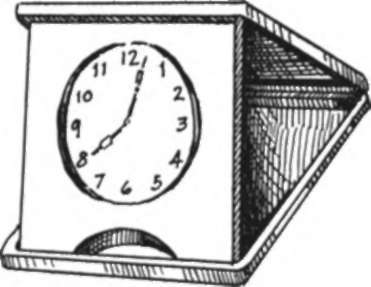
Step No. 3: The watch is held in place on the front piece by cutting out a piece of wood the thickness of the watch; glue this in place and then glue a small strip of leather from an old belt across the watch. Be sure that this strip does not interfere with the winding of the watch.
Step No. 4: The entire outside of the case, including the front section holding the watch, can be attractively finished by gluing on some covering material such as imitation leather, cretonne or other upholstery fabric. By carrying the covering from one section to another, a satisfactory hinge joint can be made.
Step No. 5: A simple catch can be put on this case by using a piece of the covering material in which you have made a buttonhole; then fasten this in place along the front edge. Fasten on a button to correspond with the buttonhole, or use the common dress snappers for this catch.
Instead of making this case as explained above, you can use some choice cabinet wood, such as richly figured mahogany, walnut, etc. and then finish the case without any covering material by bringing out the beauty of the grain of the wood. This is accomplished in the following manner:
Stain the wood if you desire a certain color finish; then apply a coat of paste wood filler (follow the directions given on the can) and follow this when dry, with at least three thin coats of shellac (thin with alcohol); lightly rub down each coat with No. 00 sandpaper and the final coat with fine steel wool.
Continue to:


My Books

