


Ivory in The East
Description
This section is from the book "A History Of Furniture", by Albert Jacquemart. Also available from Amazon: A History Of Furniture.
This section is from the "" book, by .
Ivory in The East
There is nothing very wonderful in the fact that the peoples of the remotest parts of Asia employed ivory for the more costly objects of art. With the raw material at hand, there was every inducement for these laborious and artistic races to make use of it. Hence it is not surprising that they have pursued well-nigh the same course as the western nations in developing the art of ivory carving. Caskets, plaques, fans, round boxes, mortars, and even cabinets with a multiplicity of compartments just as in Europe, but however used, they have always shown the most exquisite taste and ingenuity in its application.
First in the field is India, ancient and still mysterious, with its singularly picturesque mythology. Thanks to its changeless character, it has handed down, from age to age, the traditions of its pre-historic civilisation, so that its works, even when not many centuries old, arc at least the faithful reflection of those remote times. Nor is it one of the least charms of such objects, when mellowed by age, and polished by the countless hands through which they have passed since their original production, that they give no clue to their actual date, leaving the mind in suspense between epochs possibly stretching back far beyond the beginnings of history in the west.
Nay more; boundless in extent as in time, if its history remains un-fathomed in the midst of the countless waifs, helping to explain it, yet often mutually contradictory, it is, at all events, certain, that several distinct races and civilisations have come in contact on Indian soil, each of them leaving the trace of its religious thought and social progress on its artistic productions. Thus India, properly so called, occupied by the oldest and most civilised of races, enlightened by contact with its Greek conquerors, possibly also by previous relations with Assyria, shows a tendency towards the most lofty conceptions. Its religious representations have a grandeur not devoid of grace, while its ornamentation, idealised in a spirit closely resembling that of the Greeks, displays a delicacy and a taste that later on was probably not without influence on its Mohammedan conquerors, thus developing, as we shall presently see, a special branch of Arabian art.
The still more eastern races associated with this great Hindu stock are those we meet with in Java, in the Malay peninsula, in Siam, and even in other parts of transgangetic India. Here also decorative art is an outcome of the Hindu principles; but the religious types, influenced by local myths, assume barbarous and monstrous forms. Owing to a singular coincidence between the frightful mythologies of the extreme north and the extreme south, we shall find the ideas associated with Odin, almost re-echoed in the Javanese fables. Amidst the intricate ornamental patterns and preternatural vegetable decorations, there spring up threatening monsters rushing against each other or struggling in extravagant contortions. Scaly dragons and impossible birds move about in these meanders, faint reminiscences of gigantic contests between the first occupiers of those lands, and the exuberant vegetation peopled by formidable wild beasts.
A glance at the open-worked hilts of the Burmese or Javanese poignards will enable us to realise the full vigour of these overflowing and gloomy conceptions, the barbarous character of which is blended with an incredible perfection of workmanship.
Returning to India proper, some of its bas-reliefs might seem to have been conceived by our mediaeval artists. They reveal the same simplicity of lines, and artless elegance, the natural blossoms of civilisations still young. Even the monstrous associations of gods with elephant heads cease to be repulsive, so exquisite is the art that has presided at their conception. We know how poetically the Indians have realised the image of the sensuous fancies of their theogony, and who does not remember that graceful elephant formed by the nymphs or Gopis intended to carry the god Krishna. Here is something similar, a pretty ivory box, in which at first we distinguished nothing but a tangled mass of busts, arms and legs, but which soon exhibits the most exquisite composition, thoroughly thought out. Nymphs hovering in the air with outstretched arms, and grouped in couples, form so many animated palanquins, beneath which, crouching and impassable, crushed as it were under the weight of contemplation, the god reposes, crowned with the sacred tiara. The out-stretched arms of the nymphs grouped in a semi-circle, represent the pole of the palanquin, and seems as if about to be placed on the shoulders of bearers, amongst whom appear some vegetable motives. And if we give this type it is because a selection must be made from a thousand such, in which the human figure is made to adapt itself to the exigencies of the local theogony, as well as of a rich and exuberant style of ornamentation.
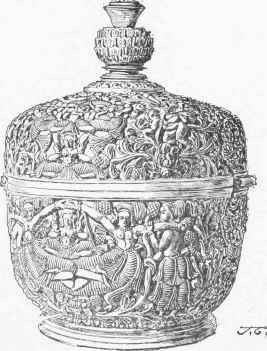
Ivory box with gold clasp and hinge; old Indian work. (Baron do Monville"s Collection.).
We have already remarked that in the ideal treatment of the vegetable kingdom, the Indians know no rivals except the Greeks. Like these, they understood how to train and bend the acanthus to the most graceful forms, and ornamental flowers are strewn over their works with a rare tact. The bird most affected by them is the peacock, now represented in full, and as it were in a nimbus, formed by his outspread tail, now in profile, proudly bearing the golden crest crowning his delicate head.
Hence, however overladen, Indian ornamentation is never wearying. The eye delights in unravelling the endless intricacies of these ingenious conceptions; it fondly lingers over these female figures in impossible attitudes, because the artist has contrived to allow the sense of the supernatural to pervade the composition, so that all becomes easy to deified beings.
Continue to:


My Books

