


Draperies For Bungalows. Continued
Description
This section is from the book "Home Furnishing", by George Leland Hunter. Also available from Amazon: Home Furnishing.
Draperies For Bungalows. Continued
Scrims, both plain and with drawn-work effects, are useful in bungalow draping - not white scrims but those in cream and ecru. Sometimes the stringing of a bright-colored ribbon through the open path left by the drawn-work adds to the gayety of the environment. Sometimes the gayety is secured by draping back with bright-colored ribbons.
The printed scrims - mostly border patterns - 40 inches wide, range in price from 12 1/2 to 40 cents a yard. The open nature of the texture and the hardness of the threads make the printed effect particularly agreeable. The borders are used also horizontally as valances and headings.
Where the size and importance of the windows makes two sets of draperies necessary, the rough basket-weave cotton cloths called cloister, and friars', and druid, make splendid overdra-peries. The warps and wefts of the coarsest are in groups over a quarter of an inch wide, producing a texture that is "bungalowy" to the limit. It contrasts wonderfully well with scrim curtains beneath.
Of all the fabrics that can be suggested for bungalow draping, however, I know of none more generally useful in the living-rooms than madras and crete. In the chambers there is reason for seeking the lighter color and smoother surface effects of nets and scrims. But for the living-rooms the rich colors of the fuzzy figures of crete and madras are exactly fit.
Cream-colored madras, 36 to 50 inches wide, costs from 25 cents a yard up; chintz-colored madras from 40 cents a yard up; crete, 45 to 50 inches wide, $ 1 to $ 1.75. Crete has an etamine ground (like scrim) with inserted figures that are cut on the wrong side of the fabric. Madras not only has figures that are cut on the right side of the fabric, but also a most interesting gauze ground formed by the twisting of the warp threads in pairs around the weft threads. Both madras and crete should be treated with the greatest simplicity, merely hemmed with a broad hem, without galoons and figures by which I have sometimes seen them disfigured.
Among the coarse linens, agra cloth, 50 inches wide at $ 1.25 a yard, stands first. It is as coarse as burlap but soft and agreeable to the touch and no end durable. Sometimes it is ornamented in a manner appropriate to bungalows, with border and edging in coarse, bright-colored embroidery. Like all of the very coarse weaves, agra cloth is suited for large rather than small windows.
Among the imported prints none are better for bungalow use than those from Holland and Japan. There is a quaintness and unconventionally about them that goes straight to the heart. The Dutch prints, 32 inches wide at 90 cents a yard, excel not only in quaint effects but also in the all-over fruit and flower patterns. Among the best of the plain fabrics on the market are the Japanese cotton crepes, 30 inches wide at 50 cents a yard. The mulberry is a particularly pleasing color.
The tour de force from Holland is a sampler print - a print reproducing an old embroidered sampler pattern. It is the most different print I have seen for several years and comes 32 inches wide at 90 cents a yard.
The draperies illustrated in connection with this article were designed and sketched from the actual fabrics. They suggest the possibilities not only of the goods selected but also of all kinds of similar stuffs, and should be useful to decorators and dealers as well as to the public. Above all they are practical and do not set problems impossible to solve, which so often cause men in the trade to lament the ignorance of writers on decorative subjects, and assume an attitude of opposition toward publicity.
The valances in my illustrations are tacked to the under side of cornice or molding made to match the trim of the room. The side and glass curtains hang on small brass rods, over which they draw easily, draw cords being added when desirable. In some cases the glass curtains are hung from an extension rod with rubber ends that snap fast into position against the inside of the casings. In No. 5 each of the overdraperies is on its separate short rod that swings free on a hinged bracket attached to the casing. This enables casement windows that open in, to be opened without drawing back the draperies. Valances can also be divided in the middle and treated in the same way.
In Fig. 1 the window is framed in a rich orange-brown and gold all-over Dutch print, 32 inches wide at 90 cents a yard. It is pleasingly translucent It tacks to the inside of the improvised cornice, and behind it are the rods carrying the square-mesh lattice net that costs only 20 cents a yard. Notice the simple paneling outlined on the net in machine or hand stitching. Notice also the transparent and translucent effect of this and all the other schemes that will tone and soften and cool the hot light of summer, without introducing closeness or stuffiness or gloom.
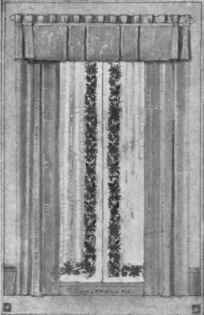
3. Next the glass is scrim, with printed border.

4. Valance and side curtains in silk golden-brown net.

5- Arranged to let casement window open in, without drawing curtains back.

6. Side curtains in Colonial printed silk.
Next the glass in Fig. 3, scrim with a printed border is suggested, and for valance and side draperies, cloister or druid cloths with their coarse basket weaves at from 60 to 75 cents a yard, 50 inches wide, or linen agra cloth at $ 1.25 a yard. The narrow band across the valance just under the heading is a plain galloon.
In Fig. 4, plain net or nothing next the glass. Valance and draped curtains in golden-brown net with tiny open mesh formed by warp threads twisting in pairs around pairs of weft threads. The two pairs of lines across the valance are simple stitching, while plain ruffles of the same material head the skirts of the side draperies.
The glass curtains of Fig. 6 are in lattice net, with diagonal mesh, 43 inches wide at 32 cents a yard, with applique edging in woven lace. The overdraperies, the knotted valances hiding and tacked to the wooden rod, and the loops, are all in the printed silk known as Colonial. It is exquisitely soft in texture as well as in color. The lower part of the curtains should be shirred on a wire or metal tape to hold in the position illustrated.
The overdraperies in Fig. 5 are in Kaneko cloth. The rough and contrasting textures of stripes and ground, and the open translucency of the stuff, tone the light marvelously. The ornamental medallions and stripes at the top can be either embroidered, or applique of cut-outs from cretonne or muslin prints. So, too, the edgings. This is the only one of the six schemes in which the rod shows, but here it shows boldly and obviously and is a definite and recognized part of the plan. Next the glass, plain net.
Fig. 2 is in monk's cloth, a wonderful silk weave almost as coarse and rough as burlap, but soft and clingy and drapy to an extraordinary degree, more so than any other fabric with which I am acquainted. Valance and draped curtains carry a simple silk fringe on the bottom. The windows are leaded in glass not quite transparent and full of texture. Between the glass and the overdraperies are draw curtains in striped lattice net with diagonal mesh.
All of the fabrics recommended in this chapter are suitable for use in much simpler schemes than those illustrated. Often the only draperies desirable will be next the glass, shirred loosely at the top on rod or wire or tape or cord attached to the sash, so as to permit of easy drawing back. If the windows are comparatively small, sometimes half-sash curtains only will be enough, with roller shade to cover the upper sash when necessary. If the windows are very large and high (whether guillotine or casement), two sets of curtains, one above the other, are usually best. Again, if the windows are very small or the glass is leaded in small panes or only semi-transparent, the glass curtains can be omitted, and the work of excluding and toning the light entrusted to side overdraperies with draw cords that pull them easily along the brass rod. Some of the very light stuffs will need to be weighted at the bottom with shot, or, in the case of sash curtains, held fast by a second rod or tape or cord.
Continue to:


My Books

