


Real Tapestries. Continued
Description
This section is from the book "Home Furnishing", by George Leland Hunter. Also available from Amazon: Home Furnishing.
Real Tapestries. Continued
Herein lies a lesson that the amateur of tapestries should take to heart. Mere age counts for little. The value of an inferior work of art does not increase as the generations pass, although the price paid by ignoramuses sometimes does. It is the tapestry, or rug, or chair, or table, that artistically excels which multiplies in value more rapidly than the interest on money, and at last is enshrined in the palace of a collector, in the museum of a great city or nation.
The only museum in the United States that contains an important collection of fine tapestries is the Metropolitan Museum of Art, New York. Compared with the forty splendid pieces now displayed on its walls, the collections of the Boston and Chicago art museums - as well as of the Metropolitan Museum itself five years ago - are insignificant. The collection of books on tapestry in the library of the Metropolitan Museum is also large and important.
The prize tapestry in the Metropolitan collection is one in the Gothic style, lent by the late Mr. J. Pierpont Morgan and called the Mazarin tapestry, because tradition says that it once belonged to the famous French Cardinal who chastened the youthful haughtiness of Louis XIV. The subject of this tapestry, which is partitioned like a three-fold screen, with Gothic columns between the leaves, is "The Triumph of Christ and of the New Dispensation." Christ is seated on a throne in the upper part of the middle panel, with angels on each side of Him, one bearing a long branch with lilies, symbolic of the Church; the other a sword, symbolic of the State. Below are two groups of worshipers, the Church group headed by the Pope and the State group by the Emperor. A figure representing the Synagogue of the Old Dispensation appears on the right, blinded, with broken scepter and shattered tablets of the Mosaic law, while the State of the New Dispensation is represented by the Persian King Ahasuerus (Xerxes) and Esther. A figure representing the Holy Catholic Church of the New Dispensation appears on the left with crozier and chalice, while the State of the New Dispensation is represented by Emperor Augustus, to whom the Tiburtine Sibyl announces the coming of the Messiah. Technically, this is one of the most wonderful, perhaps the most wonderful, tapestry ever woven. Certainly the flesh tones of faces and hands and of the tiny nude figures of Adam and Eve, and the silver tones of hair and beards, and the gold and jewels of the costumes are marvelously expressed. Almost in the same class as regards excellence of weave are two Renaissance tapestries illustrating the "Story of Herse," lent by Mr. George Blumenthal. They were woven in Brussels by Willem van Pannemaker, whose woven signature, together with the Brussels monogram, appears in the border. The borders are rich with gold in basket weave, and the one of the two tapestries that shows the "Bridal Chamber of Herse" is almost equal to the great Gothic tapestries as regards the suitability of the design for interpretation on the loom. Tapestries like these, however, are beyond the reach, even at present prices, of all but the greatest collectors, and therefore the writer would call attention to other tapestries, excellent duplicates of which can be bought or reproduced at prices that make them available more generally for adorning the home. At this point I should like to remark that the nouveau riche dog-in-the-manger spirit which locks up many famous paintings in private galleries, without affording the public an opportunity to see them, is manifested to a much less extent by those Americans whose good fortune it is to possess fine tapestries. Perhaps they are influenced by the example of Leo X, who left with the weaver, Pieter van Aelst, in Brussels, the cartoons of the tapestries designed for him by Raphael, with the result that duplicate sets were woven for all who had the taste to select and the money to pay. It is important for the revival of the art of tapestry weaving that every opportunity should be afforded by owners of Gothic tapestries to those who wish to copy them on the loom, and the writer is glad to note the tendency of American collectors who possess historic examples to be very substantially generous in this respect.
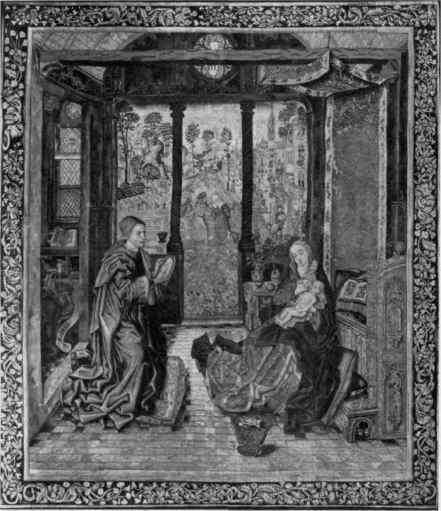
Saint Luke painting the Virgin, a Late Gothic tapestry in the Louvre.
Among the Gothic tapestries at the Metropolitan Muesum especially suited for reproduction to-day are two from the famous Hoentschel collection, lent to the museum by Morgan. One of these, that pictures "Jesus Among the Doctors" and the "Marriage at Cana," is 5 feet 3 inches high and 12 feet 6 inches long. It is the "Marriage at Cana" that I suggest as affording the best opportunity for the modern weaver to attempt to emulate his Fifteenth Century forebears. The composition of this scene is most interesting. The coloring of the tapestry is extremely simple, and the weave is masterful without being intricate. In copying a tapestry like this a weaver would learn more than most weavers now know. This dates from the age when tapestries were still line drawings, with long slender vertical hatchings (spires of color) that combined with the cross-ribbed weave to produce the most interesting and unique texture that the world has even known.
Also interesting for the purpose of modern reproduction would be the Gothic "Departure for the Hunt," likewise lent to the museum from the Hoentschel collection. It is 10 feet high by 3 feet 11 inches wide, and pictures a forest of oaks with floriated ground. A page and three valets lead the way. Two of the valets carry hooded falcons. On the right a white horse, above whose head appear the busts of a lord and a lady half hidden in the foliage. Other figures on the left. In the foreground there are dogs. A tapestry like this is a thing of beauty and a joy forever, and deserves reproduction not only for the training in technique it would give the weaver of to-day, but also, and especially, for its intrinsic merit. It is worth a multitude of "counterfeit arrases," which is what they called painted imitations of tapestry in the Fifteenth Century, real arras being, of course, real tapestries, called arras from the now French, but then Flemish, city of Arras, that was long the center of production of high-warp picture tapestries.
The oldest, and on the whole the most interesting, tapestries at the Metropolitan Museum are the five fragments containing seven scenes from an early Fifteenth Century tapestry, originally containing fourteen scenes, illustrating the Seven Sacraments in their origin and also as celebrated contemporaneously. These tapestries, given to the Museum by Mr. Morgan, were correctly named and described for the first time in my article in the Burlington Magazine of December, 1907. Though much repaired, they are splendid examples of technical perfection in tapestry weaving, and point out the path that weavers should follow in attempting to revive the glories of the past.
A large proportion of the real tapestries that one finds in the shops are from Aubusson looms, and whether antique or modern, they are usually in the style of the Eighteenth Century - rustic and pastoral scenes with verdure or landscape backgrounds, and with narrow verdure or woven-frame borders. One reason for their popularity is their size, which is comparatively small and adapted for display on the walls of houses as they are built to-day. Another reason is that the styles of Louis XV and of Louis XVI, as expressed in tapestry, harmonize with most modern English as well as French interiors - Louis XV being preferable with Chippendale chairs and Baroque or Rococo backgrounds; Louis XVI with Hepplewhite and Sheraton and Adam designs. A third reason is the price, which is less, because these are the tapestries that Aubusson weavers understand best how to produce. Not that I would decry the art of the Aubusson weavers. From time immemorial this little city of Aubusson, in France, two hundred and seven miles by rail south of Paris, has been noted as a center of tapestry weaving. Tradition says that the industry was established there in 732 A.D., by stragglers from the great Saracen army, defeated nears Tours by Charles Martel, grandfather of Charlemagne. As late as 1585 the weavers were called tappiciers sarrazinois (Saracen tapestry-makers). The Aubusson product is by no means confined to furniture coverings. At the Paris Exposition of 1900 two Aubusson manufacturers received the grand prize, displaying among the reproductions two of Le Brun's Seventeenth Century "Royal Residences," of which the jury said, "They are so like the originals as to be mistaken for them." The so-called Aubusson rugs are real tapestry in heavy weave, and in designs suitable for the floor.
Of Eighteenth Century tapestries in general, it may be said that they are vastly inferior to the Baroque ones of the Seventeenth Century, just as these are inferior to the Renaissance ones of the Sixteenth Century, and the Renaissance ones to the Gothic tapestries of the Fifteenth Century and earlier.
Among Renaissance tapestries especially desirable for reproduction are the Grotesque ones that have ornament pure and simple - ornament often incorrectly called arabesque and consisting of arbors and foliage and flowers, and occasional human and animal forms - and that get their name "Grotesque" from the Roman excavations (crypts or grottoes) that at the beginning of the Sixteenth Century disclosed the Golden House of Nero. Photographs and color sketches are easily accessible, from which the reproductions can be woven with finished effect.
Continue to:


My Books

