


XX. European Hand-Blocked Draperies
Description
This section is from the book "Home Furnishing", by George Leland Hunter. Also available from Amazon: Home Furnishing.
XX. European Hand-Blocked Draperies
IN my chapter on "European Hand-Blocked Papers" I pointed out some of the reasons why hand-blocks produce better results than machine-rollers. This applies not only to wall papers but also to the linen and cotton drapery cloths that form the subject of the present chapter. Those illustrated are fifty inches wide, except as otherwise noted, were made in France and England, and range in price from $3 to $5 a yard. The designs and colorings are of extraordinary excellence, and should be studied even by persons who cannot afford the best. Noteworthy is the size of the design units, in most cases larger than would be practicable with machine-rollers. These large-figured patterns are especially suitable for window and door draperies, but must be handled with unusual skill and taste when applied to walls and furniture. Anybody can manage papers and cloths that show tiny figures and small repeats.
The most famous name in the history of handblocked prints is Jouy. Now Jouy was not a man, as one of our American decorators seemed to think who asked Mr. Harry Wearne if he could help him locate that Parisian cretonne manufacturer named Chouy. (Almost as bad as the lady from Kansas City who besought a salesman in a New York shop to direct her to Mr. Chippendale's shop, and when the salesman managed to respond without smiling that he believed Mr. Chippendale was dead some years since, went on to inquire about Mr. Sheraton and his shop.) Jouy is a little village near Versailles, famous for the printed linens made there from 1768 to 1815 by Christophe Philippe Ober-kampf, a naturalized Frenchman, born at Weiss-bach in Bavaria in 1738.
Oberkampf, however, was by no means the first to establish this industry in France. The manufacturers of upper Normandy preceded him by nearly ten years in the production of persiennes, indiennes, and siamoises (Persians, Indians, and Siamese), as the first French domestic prints were called in imitation of those imported from the Orient. The earlier development of the industry in France had been forbidden by law and the manufacture was not authorized until the publication of the Royal Decree of Louis XV, dated November 9, 1759.

1. The Tulip, a characteristic Morris pattern.

2. A auaint and curious Chinoiserie.

3. From an old Rhode Island wallpaper.

4. From one of Grinling Gibbon's famous carvings.
By that time much had been accomplished in other countries, notably by Koechlin, who in 1746 started to make indiennes in the small Republic of Mulhouse in Alsace.
Oberkampf was late in starting, but he soon surpassed all his competitors. In 1768, with a total capital of 600 francs, he hired an abandoned building in Jouy, built his equipment and tools with his own hands, and was designer, dyer, engraver, and printer, all in one. Success was almost immediate, and his goods soon became so fashionable that he was able to send men to England, Germany, and even Persia to study processes, especially dyeing, in which the East surpassed. In 1787, by an edict of Louis XVI, his works became a royal factory. The destruction of the plant in 1815 by the invading allies, ruined him and he died that year of a broken heart.
Oberkampf produced not only patterned stuffs, some of which we illustrate, but also large scenic designs with personages and landscapes, such as the "Fables of La Fontaine" after J. B. Oudry; "The Village Festival"; "The Balloon Ascension"; "Paul and Virginia." Among designers whose reputation is linked indissolubly with Jouy is J. B. Huet, of whose designs the Musee des Arts Decoratifs in Paris has a wonderful collection.
Of the cloths illustrated by us, No. 2 is an exact reproduction of an old toile de Jouy. It is 34 inches wide and is also exceptional because printed in several colors, most of these old chinoiseries being monochromes. Quaint and certainly interesting and most decorative are the Chinamen shown, one with parasol walking up a tight rope, another swinging, another skipping a rope as he juggles, while a squirrel on a branch adds comical gravity to the situation.
No. 3 is on linen, though not a toile de Jouy. The design was taken from an old wall paper in a house near Providence, R. I. Another with delightfully soft and smudgy tones was taken from an old Cordova leather, and another reproduces an ancient piece of Jacobean needlework.
No. 4, on linen, is of unusual origin, being modeled from a carving by Grinling Gibbons, whose skill was utilized to such happy advantage by Sir Christopher Wren, the famous English architect. The colorings are dull and rich, quite unlike the carving that was in limewood without color.
No. 5 is a French linen, 31 inches wide, whose intricate tones of soft orange and green required many blocks for the printing. It is full of the exuberant richness that characterized the Italian Renaissance, and reminds one of some of the work of Primaticcio. No. 6, a 32-inch linen with Chinese groupings on a gray stripe, is French and distinctly of the toile de Jouy type.

5. A rich French Renaissance pattern.
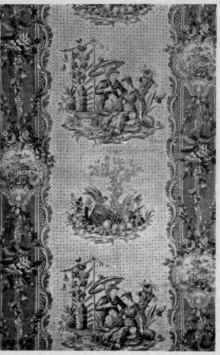
6. An eighteenth-century Chinese effect.

7. The Compton, by Morris and Dearie.

8. The Strawberry Thief, by Morris.
One very rich design was suggested by an ancient Portuguese embroidery. It is especially recommended for the main floor of a country house or for a man's bedroom. Another on cotton, was recently originated for the English Royal Family, and the large leaves and flowers rest against a black ground.
Among English chintzes not illustrated here is a collection 30 inches wide with very small figures, flowers, peacocks, cashmere designs, etc., at from $ 1.25 to $ 1.50 a yard. These also are printed from ancient English blocks. They can be had glazed or unglazed, and cost a little more when glazed.
Among the old English blocks that have been preserved are also many with very large figures that are now printed on cotton 54 inches wide. The reassembling of these blocks to form the various patterns was no easy task and only the fortunate discovery of certain written documents made it possible. It was with blocks like these that the ancient printers flattered the pride of local magnates and provincial nobles, using the same background for a dozen families, but changing the bird or some especially significant feature in order to produce a cloth individual to the user.
A modern English pattern that delights me shows birds and flowers and winding branches in tones of rose and blue green and mauve on a white ground of cotton 32 inches wide. The fact that the shades and furniture coverings in the drawing room of the Duke of Westminster's home in London, Grosvenor House, are made of it, will also commend it to many. Of course Westminster used it glazed in the English fashion.
The late nineteenth century revival of block printing in England was due to William Morris, who not only made the designs but also worked out the processes at Merton Abbey, a quaint little village not far from London, where the same prints are still made in the same way to-day, with the same blocks, and the same dyes, and sent to art lovers in different parts of the world. Several of the patterns I am permitted to reproduce. All of them come 36 inches wide on cotton or linen or wool. A print that in cotton would sell for about $3, would bring $3.50 in linen, and $4.50 in wool.
To these "wool challets" I want to call particular attention. They have a far more interesting fine twill surface than either the cotton or the linen, and possess the crisp and clinging qualities so uniquely characteristic of wool. Very grateful, too, is the way in which the wool takes the colors.
No. 8, the Strawberry Thief, is produced by discharging, that is to say by printing dark blue cloth with acid-wet blocks that eat part or all of the color out where the pattern indicates. No. 7, Compton, only 25 inches wide, shows the influence of John W. Dearie, who for many years rendered important assistance to Morris in designing and coloring, and who still carries on the work of the master at Merton. No. 1, the Tulip, is a characteristic Morris pattern, and like all his others splendid for use in many interiors that are not at all "in the Morris style."
Among the two-tone prints at from $ 1 to $ 1.25 are Bird and Anemone, Rose and Thistle, and Brother Rabbit.
As the illustrations show, Morris's idea of a drapery print was something gay, something made up of "the naivest flowers (and birds, too, or animals), with which you may do anything that is not ugly." He would tell designers, wrote Lewis Day years ago in the Art Journal, that they could not well go wrong so long as they avoided the commonplace and kept "somewhat on the daylight side of nightmare."
Frank color Morris always insisted on. He said a "right-minded" colorist would make his work as bright as possible and as "full of color," and if he did not bring it out "pure and clear" he had not learned his trade. To be prejudiced against a particular hue, he thought indicated "disease in an artist." But yellow he himself found "not a color that can be used in masses"; red "a difficult" one; purple a color "no one in his senses would think of using in bright masses." Green, on the other hand, he described as being "so useful and so restful to the eyes, that in this matter also we are bound to follow Nature, and make large use of it." Most of all he loved blue, the "holiday" color as he calls it by way of distinction from "workaday green." He was against all rules of color. His experience taught him "the paler the color, the purer it may be."
Continue to:


My Books

