


Venue
Description
This section is from the book "How To Collect Old Furniture", by Frederick Litchfield. Also available from Amazon: How To Collect Old Furniture.
Venue
Venice, too, may be said to have had a particular school of its own. The merchants of this important commercial city were in the sixteenth century trading extensively with the East, and the rich textiles they imported were admirably suited for covering carved and gilt furniture. In some of the sumptuous furniture at Knole, and in the rather dilapidated settees which are still to be seen at Holyrood Palace, also in the Duke of Buccleuch's Palace of Dalkeith, and other mansions containing seventeenth-century furniture, one can trace the influence of Venetian carving and gilding in the X-frame chairs and stools, covered in costly materials which either came from the Levant or from the looms of Genoa, Venice, and other 'manufacturing Italian or Flemish cities. Venice, too, was the great centre of ornamental glass manufacture, the glass makers of Murano were the possessors of valued and coveted secrets for producing the most beautiful and delicate polychromatic glass, and this was made into mirror frames, chandeliers and candelabra. As the century advanced the old-fashioned reflecting portion of the mirror, which had formerly been made of polished metal, came to be of silvered glass, and when, later on, these plates were able to be produced in larger sizes, they required carved and gilt frames to hold and embellish them. Decoration by engraving the centres and borders of the more ornamental class of mirrors, was also a Venetian invention, the design engraved being fitted with a block and silvered by a process which produced a "frosted silver" effect, and made a telling relief to the rest of the mirror, silvered in the ordinary manner. Frames became more fanciful and rococo; eccentric designs, with the heads and bodies of mermaids, tritons, and grotesques, terminating in foliated scrolls, are characteristic features of Venetian ornament of the seventeenth century.
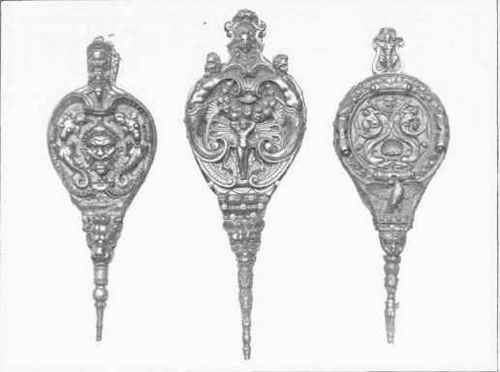
VENETIAN CARVED BELLOWS IN WALNUT LATE SIXTEENTH CENTURY.
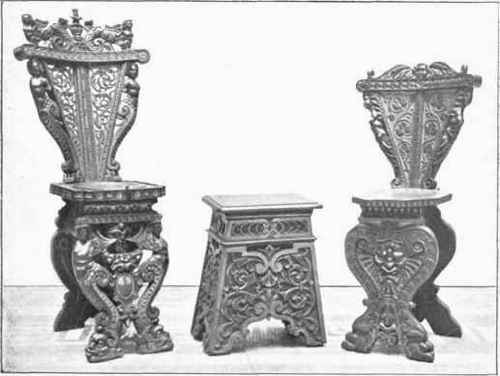
VENETIAN CHAIRS AND STOOL LATER SIXTEENTH CENTURY.
Figure carving of the Venetian school has always been free and vigorous, the supports for console tables, the torcheres or lamp-holders of the late sixteenth and of the following century, gave the wood-carver ample scope for his skill. Sometimes a male or female figure holds a scroll-formed support, or a couple of amorini in playful combination with scrolls, perform a similar duty. Walnut wood was in much favour, but willow, lime, and sycamore were extensively used, and when the work was to be gilt, the softer texture of these woods allowed the carver more freedom.
Another characteristic Venetian production of the seventeenth century was that of the richly-decorated negro figures, modern copies of which we have been familiarized with at recent Italian exhibitions. Doubtless the idea was taken from the antique busts at the Vatican, and in many other public and private collections, where the head of the figure is of one marble, black, of course, if the bust be that of a negro, and the draperies are formed of such variegated and rich marbles as Siena, Breccia, or other suitable varieties.
The Venetian negro figure was of two kinds, one having the head, arms and legs in black, and the draperies of polished walnut, while the more highly-decorative ones had the Eastern costume of the negro page slightly carved on the surface, to represent the pattern of the material of his costume, and this was picked out in vivid reds, blues and greens, further enriched by gilding.
The old carved cassoni alluded to in the chapter on Renaissance, the elaborate bellows and buffets and other furniture usually made of walnut wood and decorated by figure carving, are all generally recognized as the work of Venice of the seventeenth century.
Continue to:


My Books

