


Bedsteads And Cradles. Part 2
Description
This section is from the book "Old Oak Furniture", by Fred Roe. Also available from Amazon: Old Oak Furniture.
Bedsteads And Cradles. Part 2
The leaf-covered bulbs which form part of each bed-post rest upon a sort of open temple-shaped structure, supported by five small pillars - a form of construction which, from an architectural point of view, is absolutely without excuse. It may be mentioned that the remains of very old colouring are visible on parts of the carving, and that on the surface of the posts may be seen the impressions of ancient seals and wax, which report says - however truly or falsely - to be those of the noted people who slept in this bed. This wonderful relic of a past age is not cared for so well as it should be, and damp and time are only too surely carrying out their natural effects upon it.
* 'Twelfth Night,' Act III., Scene 2.
An Elizabethan bedstead of very similar character to the monstrous piece of furniture just described may be seen in the Bethnal Green Museum. This bedstead, were it in its original state, would doubtless be considered the finer specimen of the two, for every part of it is richly carved in the style typical of the Elizabethan period, and the form, though of considerably smaller proportions, is more compact and graceful than that of the Great Bed of Ware. It is known to have been bought from Turton Tower, in Lancashire, the ancient seat of the Chethams, and is said locally to have been made abroad, and presented by a King of France to one of the Earls of Devon. The arms of the Courtenay family may certainly be seen carved on more than one part of the bedstead; but, sad to relate, this fine piece of furniture has not escaped the attacks of the restorer, and it is difficult to say now what process of renovation it has passed through, saving only that a good deal of the carving at the foot is of modern date. The vague local tradition which attaches to this wonderful wreck of a fine thing is certainly apocryphal.
It is indisputably English work of Elizabeth's time, and the story of the French King and Edward, Earl of Devon, receives a nasty jar when one finds that the Earl died in 1566, while the date 1593 appears on the footboard. This particular bedstead possesses the little secret cupboard at the foot of its posts which is described in the chapter on 'Furniture with Hiding-places.' The floriated bulbs and upper parts of the two bed-posts should be carefully compared, for they present an instance of the casual workmanship which characterized the olden times. Although approximately of the same outline, they do not agree in the length and diameter of the various members. The old practice of copying merely by eye, which was responsible for the irregularity here referred to, though it resulted in deviations from truth, really gave a charm to carved work which mechanical reproduction lacks. A careful engraving of the bedstead in its original home in Turton Tower was published some years ago by Wright in his'Archaeological Album.' There are a great many fine bedsteads of the Elizabethan period in different parts of the kingdom - such, for instance, as the great 'Percy bedstead' at Alnwick Castle, the 'Hathaway bedstead' at Shottery, some fine specimens at Ockwells Manor, and two beautiful examples in the Victoria and Albert Museum. Contemporary evidence also exists in certainly one case in which a bedstead is represented on a brass.
This remarkable piece of work is in St. Nicholas Church, Hurst, near Twyford, Berks, placed there to the memory of Alice Harison, who died between 1574 and 1580. This lady was wife of 'Thomas Harison Esqvier, co-oferer to Queene Elizabeth, who died in childbed of her first sonn Richd. Harison Esqvier, the father of Sir Richard Harison Knight.' The bedstead in which the lady is represented as lying serves a double purpose, having four drawers with locks in its substructure:
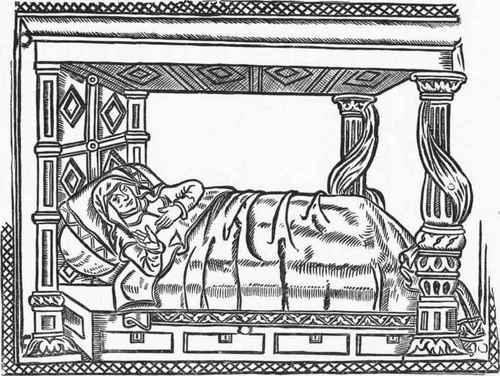
THE HARISON BRASS IN ST. NICHOLAS CHURCH, HURST, BERKS, SHOWING REPRESENTATION OF A LOCKER BEDSTEAD OF THE TUDOR PERIOD.
'A chest contrived a double debt to pay - A bed by night, a chest of drawers by day.'
The bed-posts are of the classic pillar variety, and have curtains twined round them. There is some doubt as to the exact date of the decease of Alice Harison, but, from certain circumstances in the pedigree, it could not possibly be much later than l580. Bedsteads of the kind we have been describing were held in such high estimation that it is not uncommon to find them specified in the last wills and testaments of substantial people of the period. To go no further, it is well known that Shakespeare bequeathed his second-best bedstead to his wife - a somewhat doubtful compliment on the face of it, but one which has been explained away by the critics - at any rate, to their own satisfaction - their theory being that the bedstead was the property of the heir-in-chief (in this case the widow), in accordance with the custom of the period. It is a question which cannot now be satisfactorily answered as to whether the magnificent bedstead which still remains in the Hathaway cottage at Shottery represents either of these articles. This venerable relic has 'jewelled' posts and panelled back, and is ornamented with caryatides. It may be said that, quite apart from its associations, it merits attention as being one of the most typically English specimens now remaining of its time.
Another bedstead, which formerly existed at Clopton Hall, and is said to have been given by Henry VII. to Sir Hugh Clopton, Lord Mayor of London, who built the stone bridge over the Avon at Stratford, was at one time an object of great interest in the Shakespeare country.
How far the legend is true it is now impossible to say, but we have an interesting description of the bedstead given in connection with a remarkable series of forgeries perpetrated at the end of the eighteenth century. In the year 1792 Clopton Hall was visited by a respectable publisher named Samuel Ireland, accompanied by his son. The father had produced, not long before, those well-known volumes, 'A Picturesque Tour through Holland, etc., and 'Picturesque Views of the River Thames,' illustrated by plates in aquatint, and was planning a new work, the subject of which was to be the Warwickshire Avon. The son, William Henry, at that time a youth of sixteen, was so fired by his visit to Shakespeareland, and by his father's enthusiasm for the poet, that he subsequently entered upon one of the most remarkable, and, for the time, successful, frauds that have ever been perpetrated. The audacity of his pretended discovery of a letter from Shakespeare to Ann Hathaway, enclosing a lock of his hair; of leases and deeds bearing the poet's signature; and, finally, of a complete play, is only to be equalled by the calm conceit with which, after exposure by Malone, he owned up to their fabrication.
Continue to:


My Books

