


Coffers And Chests After The Renaissance. Part 4
Description
This section is from the book "Old Oak Furniture", by Fred Roe. Also available from Amazon: Old Oak Furniture.
Coffers And Chests After The Renaissance. Part 4
Chests of an architectural type, both as regards design and inlaid embellishment, were very much in vogue during the reign of Charles I. The inlaid views of mansions, such as Nonsuch House, were also perpetuated, these being mere elevations and not perspective views, as in the Dutch fashion, of the second Charles's reign. Such chests are for the most part indifferent in construction and design, and not to be compared in any way with the magnificent earlier example in St. Saviour's Church, Southwark. It is sometimes difficult to differentiate between the Elizabethan chest, decorated with caryatides and inlay, and a similar article of fine quality produced about the middle of the seventeenth century; but a narrow inspection will occasionally discover slight indications of changes in the architectural style of these buildings, fanciful as they are. A certain amount of floral embellishment, by means of inlay, continued to be carried out, though this latter form of decoration was not practised so frequently as at the end of the sixteenth and beginning of the seventeenth centuries.
Chests of the Stuart period mainly followed the lines of their Elizabethan predecessors, but with this exception - the mouldings were reduced in size, and the outline, as well as the light and shade effect, was consequently less rich, whilst the carved decoration, such as strapwork, was of poorer design and execution. The panels themselves were often subdivided or quartered up, as in Elizabethan times, but the moulding shows a poverty of design compared with earlier work.
The Kilburne chest, which is dealt with very fully in the chapter on 'Vicissitudes of Old Furniture,' is an excellent specimen of the type of chest which was in use during the Stuart times, and which bore a fanciful resemblance to work produced in the latter part of the sixteenth century. An illustration of the simpler methods employed in the decoration of chests during the Stuart period may be observed in the treatment of the familiar classic arch which adorns their panels. In Elizabethan times these arches were built up piece by piece - plinth, pilaster, capital, and arch - as in an actual building, whereas the corresponding decoration in Charles 1.'s time was generally merely incised into the panel, producing a shallow effect, with infinitely less light and shade than its prototype.
Nevertheless, some of the chests fashioned about Charles I.'s time have architectural fronts, 'built up,' as it were, plain, with but little surface carving, and possessing a well-proportioned classic simplicity which is very picturesque and pleasing, being dearer, in fact, to brethren of the brush than many of the more elaborately-embroidered productions. Mr. E. Barry, of Ockwells Manor, possesses a fine chest of this character, bearing on its top rail the inscription • 16 E.W. 47,' the year being that in which the capture of Charles was effected by Cornet Joyce. A variation from the carved ornamentation of this period may be found in some of the plain panelled boxes which crop up in the Midlands, and which occasionally bear the initials 'C.R.,' accompanied by a date or by the royal crown, studded in brass or gilt headed nails, in the top transom.
During the seventeenth century we find that the decline in the general methods of construction sometimes led to the abandonment of panelling in the ends and backs of chests, plain flat boards being substituted for the framework of joinery filled with panels. This was but one way of saving a little trouble at the expense of niceness of construction. Some of the productions of even as early a time as the reign of James I. have excellently carved fronts, while the ends and back are merely a rough fitting of plain boards.
As the century advanced this method became increasingly common. Such chests as exhibit this debasement are scarcely ever of the same value as their more elaborately-constructed contemporaries.
Bible boxes of the seventeenth century are by no means uncommon, but, whether decorated or not, they almost, without exception, show a return to an early peculiarity. The front edge of the lid is brought flush, or nearly so, with the surface of the box, and does not project as at the sides. During the Cromwellian period, naturally, a great curtailment took place in the decoration of chests, many of them being of a very severe type, and showing a great lack of originality. Some good pieces, however, exhibiting simplicity of design and decoration, were produced.
In Waltham Abbey is a muniment chest, probably dating from the early years of Charles II.'s reign, which exhibits some decorative panelling and the initials 'E. W.,' which is an excellent and graceful specimen of its kind.
Reference has been made elsewhere to the custom, in medieval times, of using chests as seats. This practice still continued in later times. Richard Cromwell, who possessed a chest full of addresses of congratulation and protestations of fidelity from municipal corporations and influential families, often used to remark facetiously, after his retirement, when seated on his chest, that he was sitting on the lives and fortunes of most men in England.
The geometrical inlay on Elizabethan chests has already been mentioned. By the accession of Charles II. this form of inlay had entirely disappeared, though, curiously enough, the shape of the panels themselves assumed more or less complex geometrical outlines. The chest, too, by various additions, was rapidly revolving itself into the modern chest of drawers. Poorly-designed trimmings, sometimes in the shape of a series of connected bulbs, were literally stuck on, adding neither to the strength or beauty of the structure. The styles and transoms of chests during Charles II.'s reign were often grooved, after the manner of the Dutch Renaissance, though we occasionally find instances of this treatment of an earlier date. Such chests as were actually used for the purpose of containing valuables became the plain strong-boxes, such as we see in some of Sir Christopher Wren's City churches. For instance, there is an interesting old coffer with two padlocks in the Church of St. Magnus the Martyr, near London Bridge, bearing on its front nothing more than the incised legend:
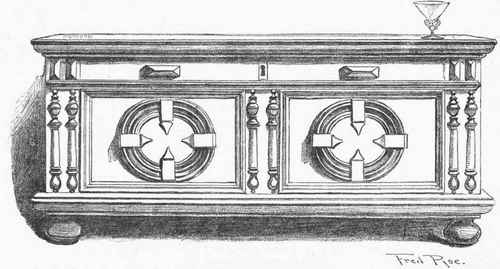
CHEST, TEMP. CHARLES II. 'bridge ward WITH IN 1674.'
This may be taken as a fair type of the muniment coffer placed in Metropolitan churches after the Great Fire of London. Remembering the glorious Gothic boxes at York, Faversham, Brancepeth, Wath, and many another place, one sighs over the degenerate taste of the Restoration. Before modern banking methods were established such coffers as that at St. Magnus were used for safeguarding all manner of valuables, and were much in request by such well-to-do people as Samuel Pepys for the purpose of concealing (or perchance burying), in cases of emergency, their gold, their papers, their wine, or even their parmesan cheese in.
During the seventeenth century the lock-plate on all except the rougher sort of chests disappeared, its place being occupied by a small decorative escutcheon placed over the keyhole. Where the lock-plate was retained it was mostly quite flat, and presented no striking feature of interest.
Very rarely one comes across diminutive models of chests, complete in every detail, but measuring only some 8 or 10 inches in length. These are technically termed "prentices' pieces,' and are supposed to be models constructed by apprentices to the 'coffering' industry who had learned their craft and were desirous of having a portable example of their skill to exhibit when in search of employment. Some beautiful little specimens of this kind may be seen in the Steen Castle Museum at Antwerp.
Although somewhat away from the subject of oak, the cypress or camphor chest should not be altogether overlooked. Boxes of this material were occasionally used during the seventeenth century for the preservation of fabrics which required safeguarding against the attacks of moths. In the 'Taming of the Shrew' Gremio mentions as having placed 'In cypress chests my arras, counterpoints, Costly apparel, tents, and canopies, Fine linen, Turkey cushions boss'd with pearl, Valance of Venice gold in needlework;' and so on. These boxes were mostly ornamented with poker work - that is, with designs burnt in on the surface with a hot iron, the royal coat-of-arms, accompanied by its supporters, being frequently depicted in this manner. The same form of decoration was largely employed throughout Italy at an earlier date, and the custom no doubt made its way hither from that country, but it does not seem to have been taken up very strongly by the English craftsmen.

TREASURE COFFER IN THE PYX CHAPEL, WESTMINSTER, SAID TO HAVE BELONGED TO EDWARD III.
Continue to:


My Books

