


Forgeries In Old Oak. Part 2
Description
This section is from the book "Old Oak Furniture", by Fred Roe. Also available from Amazon: Old Oak Furniture.
Forgeries In Old Oak. Part 2
I once saw in the Midlands a spurious piece of 'old oak,' which had incised upon its front the anachronistic legend, 'God save the King, 1590'! In France these crudities are avoided; there these forgeries have developed into a fine art. It must be understood that these practices are strenuously deprecated by the better class of dealers, who have often been the means of rescuing pieces which would otherwise have been destroyed, and who, when taken in themselves by some clever sharper, do not hesitate to condemn the piece which they have bought from him rather than resell it.
A forgery of a different kind - one, however, which scarcely originated with the intention to deceive - may be seen in certain French and Flemish church chests, imitations of fifteenth-century Flamboyant and linen-panelled work, which were constructed some seventy or eighty years since. These, from their having acquired a certain appearance of age and damage from actual wear, often deceive the uninitiated. Such pieces are mostly accurately and intelligently copied, and, being made of very old wood, their age is difficult to detect. No. 4,907, 1858, in the Victoria and Albert Museum, labelled 'French, 1490, is a good specimen of this class of antique.
Forgeries of another nature than those already enumerated may also be met with, these being instances where the piece itself is genuine enough, but on which a certain portion, such as a date, for instance, has undergone some alteration with a view to enhancing its value in the eyes of the half-fledged collector. An example of this unscrupulous method may be seen in the Victoria and Albert Museum, on a German or Dutch chest, with marquetry of mahogany, walnut, and other woods, and having raised and faceted panels. Along the top transom runs the legend, 'Charles Kroger, 1603,' which is also inlaid. The shape of the chest and its panels suggest late seventeenth-century workmanship to the casual observer. A nearer inspection, however, will show that the horseman who appears beneath the lock wears a costume very suggestive of Morland's pictures, and that the details of the decorative inlay consist partly of classic vases characteristic of the beginning of the nineteenth century. The truth is this: the chest and its inlay are genuine, but the figure '8' in the date has artfully been changed to a '6,' thus making the date appear as 1603 instead of two centuries later.
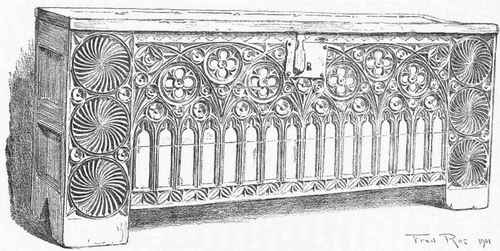
CARVED COFFER OF THIRTEENTH-CENTURY DESIGN IN PETERBOROUGH CATHEDRAL.
The alteration can be distinctly detected on a close examination. It is consoling to the British taxpayer to reflect that this antique was presented to the museum, and not acquired by purchase.
Yet another story in connection with the museum at South Kensington. In the oak gallery, which some wag once christened 'Wardour Street,' used to stand, not many years ago, a chest of ostensibly fifteenth-century French design and workmanship. It was elaborately buttressed and decorated with the carved figures of saints and panels filled with Flamboyant tracery. This chest was regarded for years with admiration and wonder, but its origin, I believe, was at length proclaimed by one of the workmen attached to the institution, who not only declared that he had made it himself, but successfully proved his assertion. The piece has since been removed to Bethnal Green Museum. I do not suggest that this chest was made, or ordered to be made, with intent to deceive in the first instance, but somehow during the course of the last twenty-five or thirty years it has acquired a most remarkable resemblance to a genuine old production, and it was for some years labelled and catalogued by the South Kensington authorities as a piece of veritable antiquity.
I can recommend a careful study of this astonishing chest to lovers of oak who wish to acquire proficiency and become experts in the science. A minute examination of the wood will show a slight burr in certain interstices of the carving, though hardly sufficient to 21 warrant its condemnation. A few other subtle indications may be discovered of its modernity. The whole piece, however, is executed with uncommon skill, the very crudities which appear on the figures forming part of its embellishment only serving to enhance its power of deception.
Forgeries are not unknown on the Continent at the present time, as the following paragraph, published through Dalziel's Agency in March, 1903, fully bears out:
'A singular story of another fraud perpetrated on one of the French national museums has come to light. Some time ago an apprentice in the service of an Orleans wood-carver named Caillot came to Paris, and paid a visit to the Musee de Cluny, and was astonished to find in it a choir-stall which had been made by Caillot.
'He reported his discovery to Caillot, who also visited the museum, and had great difficulty in convincing the authorities that he was really the maker. At last they allowed him to take the stall to pieces. He then showed them his own name and the date on which he had sold it carved inside. The dealer in antiquities who bought the article from Caillot paid £ 24. for it, and left it for some time in the vestibule of an old family house in the Faubourg St. Germain, the dealer having bribed the house-porter for the purpose. The stall was then represented as having belonged to the family for several generations, and the museum authorities paid .£ 360 for it. When the real history of the stall was discovered, the dealer refunded the money, took back the stall, and sold it a few weeks later to a rich American for £ 460.'
In the Victoria and Albert Museum is a huge Gothic armoire of German origin, which should also be carefully studied. This piece, which is decorated on the stiles with Gothic tracery, is furnished with most elaborate ironwork on its doors, or shutters, the panels of which are ornamented with a curious flowing pattern in which the trefoil is multiplied. This armoire, while being a superb thing in itself, has been deplorably tampered with. If the student wishes the truth, let him examine first the panels and then the longitudinal bands of carving on this great German press, and conscientiously pronounce whether they all belong to the same period. These panels are quoted as examples of Gothic work in some books of reference. The actual fact is that they have been 'carved up' during comparatively recent years. The handles which are attached to the doors are probably North Italian work, and have nothing whatever to do with the other ironwork. It is a great pity that so fine a specimen should not have been acquired before it had been subjected to such elaborately cruel treatment.
Continue to:


My Books

