


Some Vicissitudes Of Old Furniture. Part 4
Description
This section is from the book "Old Oak Furniture", by Fred Roe. Also available from Amazon: Old Oak Furniture.
Some Vicissitudes Of Old Furniture. Part 4
Upon the breach being made in the wall by which the workmen entered, a rush of air into this dismal prison chamber caused the rapid disintegration of the figure, which collapsed into a heap of dust mingled with fragments of metal constituting the equipments of his costume. My friend, unfortunately, did not arrive in time to see the actual appearance of this victim of medieval barbarity, but the table, as well as the buttons, buckles, and mountings of his dagger-sheath were all in evidence.
This table, discovered at a time when the knowledge of, and taste for, such antiquities very rarely existed, was doubtless destroyed; but what interest would now attach to a memento with such a history, even apart from its immense antiquarian value !
The brutal indifference which our Georgian ancestors manifested towards furniture of an earlier date cannot better be instanced than by the treatment of the contents of the two finest specimens of medieval fortified dwellings in the Midlands - Haddon Hall and Comp-ton Wynyates to wit. Until within recent years Compton Wynyates, the historic mansion of the Earl of Northampton, remained a mere shell, and the description of its desolate condition given by Howitt is sufficiently pathetic * From Brewer, writing about 1814, we learn that this venerable seat was not at that time used by the then Earl as a residence. He adds: 'The old furniture, pregnant with allusions to former story, was sold by auction during the life of the late Earl. Among the articles was a carved and gilt bedstead, on which, it is said, Henry VIII. reposed when on a visit to the loyal and approved companion of his youth !' †
The fate of much of the contents of Haddon Hall is still more deplorable. The place was abandoned as a residence by the Duke of Rutland in favour of Belvoir Castle about the beginning of the eighteenth century. Such of the furniture as was then thought valuable, and corresponded with the taste of the times, was removed to the Lincolnshire mansion, and 'that which was not wanted was lodged in a barn on the north side of the hall, one end of which extended into what is provincially called "a by-water," being a branch of the river Wye. The whole quantity consigned to this miserable repository amounted to ten waggon-loads. Here the furniture was kept, till the moisture, arising from floods and rain, reduced the woodwork to a state of rottenness and decay, and then it was ordered to be used for fuel. Fifteen bedsteads were put into a long room near the house, which had been a granary, and after being left for a time to fall in pieces, they likewise were ordered to be cut up and burnt.' * Who can say what treasures beyond value were consumed in this astonishing holocaust? Reading between the lines, it is pretty evident that the oldest and rarest pieces perished in this tragedy of water and fire.
The rest of this deplorable story is thus told by Rayner:
* 'Visits to Remarkable Places,'by William Howitt. Longmans, 1840. † 'Beauties of England and Wales,'1814.
'The neglect and consequent destruction to which these relics of antiquity were thus consigned may be imputed to the person who was then agent to the Duke of Rutland, and who made this unfortunate use of the discretionary power with which, it may be presumed, he was entrusted by his noble employer. This agent, also, when the old building required slating, contrived to raise the requisite funds, or a part of them, by disposing of such use/ess lumber (as he no doubt considered it) as was not fit for fuel.'
Amongst other articles which disappeared at this time were 'some singular curtain-rods and carved bed-posts, having " knobs " in the middle, richly carved, a foot and a half in diameter/ There is no doubt, from this description, that the latter relics were part of a magnificent Elizabethan bedstead.
Instances of the degradation of fine pieces of furniture are unfortunately only too numerous. A former Vicar of Badwell Ash, in Suffolk, some few years ago, when first entering the parish, discovered that a pig-stye in the vicinity of his vicarage was composed of Elizabethan oak panelling, elaborately carved with the strap and jewel ornament. The writer, whilst collecting materials for this work, saw a timber outhouse in an outlying part of Essex, which was repaired with antique shutters or doors from a press furnished with iron hinges. It is due, however, to our own generation to say that it does not stand alone in the perpetration of these acts of vandalism. In corroboration of this, I may mention the picture by Teniers (No. 862) in the National Gallery, entitled 'The Surprise.'A couple are interrupted in an amorous conversation by an indignant vrou, who is entering through the door of the wretched shed in which the scene takes place. This building appears to be a lumber-house for miscellaneous rubbish, and is no doubt a true portrait taken from nature.
At the back of the shed can be seen the ill-used remains of an old cabinet of Gothic form, which has outlived the fashion of its time, and been turned adrift from the dwelling-house. * Such cases of vandalism might be multiplied until the catalogue became wearisome. Suffice it to say that, for those who search for old oak in the true spirit of the connoisseur, opportunities occur, even in these latter days, of acquiring specimens in what may be termed the 'rough,'which, after all, perhaps is one of the most desirable states to find them in.
* Rayner's 'History and Antiquities of Haddon Hall,'1839.
* Precisely the same background appears in another picture by Teniers in the National Gallery (No. 805) - an old woman peeling a pear. This spot appears to have been a favourite one for the artist to paint, with its accidental arrangement of unconsidered lumber.
A curious discovery was made in London during the year 1903. In the course of the demolition of Holywell Street, in connection with the Holborn to Strand Improvement Scheme, an old chest was unearthed which, on being opened, was found to contain a quantity of deeds, including documents, mostly in Latin, ranging in date from 1433 to the commencement of the eighteenth century. The documents in this batch all bore on the history of an estate at Taplow, in Buckinghamshire, and comprise quit-claims, copies of Court Rolls, etc.; and the London County Council, in a creditable spirit of courtesy, offered them as a gift to the County Council of Buckinghamshire, by whom they were accepted.
To conclude this chapter, mention may be made of a discovery which happened in the early part of 1899 at the Royal Bull Hotel, Dartford. Beneath the foundations of the hostelry was unearthed an antique oak chest which, on being opened, was found to contain the skeleton of a man. From the vault in which this discovery was made a secret staircase (which had been walled up) formerly led to the upper apartments. Curiosity was set on foot, and it was then remembered that a man was murdered in this house in 1773, and that the mystery of the murder was further heightened by the disappearance of the body soon after its commission. The room in which the crime was committed was said to bear upon its walls marks of three bullets which passed through the victim. On carrying the examination further, a quantity of death-warrants bearing the signature of the Duke of Portland, Minister of George III., was found behind the panelling. This discovery was all the more interesting to the author as he occupied the apartment during the autumn of 1890, little suspecting, of course, that he was slumbering in the midst of such a fine field of historical and antiquarian investigation.
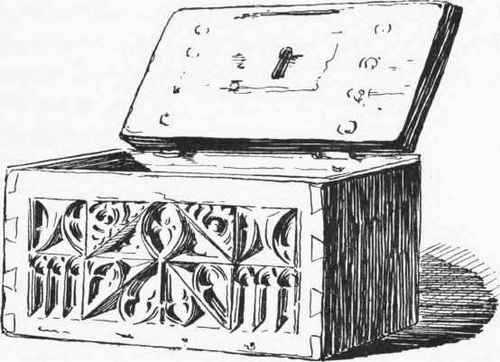
FLEMISH COFFRET, SIXTEENTH CENTURY.
Continue to:


My Books

