


Doorways, Mantels, And Stairs. Part 2
Description
This section is from the book "Furniture Of The Olden Time", by Frances Clary Morse. Also available from Amazon: Furniture of the Olden Time.
Doorways, Mantels, And Stairs. Part 2
In his "Complete Body of Architecture" Isaac Ware says of the chimney-piece : " No common room, plain or elegant, could be constituted without it. No article in a well-finished room is so essential. The eye is immediately cast upon it on entering, and the place of sitting down is naturally near it. By this means it becomes the most eminent thing in the finishing of an apartment."

Illus. 402. - Mantel in Lee Mansion, Marblehead, 1768.

Illus. 403. - Landing and Stairs in Lee Mansion, Marblehead, 1768.
The mantelpiece in Illustration 402 is in the banquet hall of the house built in 1768, upon generous plans, by Col. Jeremiah Lee in Marblehead. The depth of the chimney is in the rear, and the mantel is almost flush with the panelled walls. It is painted white like the other woodwork, and is richly ornamented with hand carving, in rococo designs, with garlands of fruit and flowers in high relief, after the fashion of the time, and has a plain panel over the narrow shelf, which rests upon carved brackets.
Illustration 403 shows the beautiful landing at the head of the stairway in the Lee mansion, with the large window and Corinthian pilasters, and the wonderful old paper, all in tones of gray. The turn of the stairs is seen, and the finely twisted balusters.
Illustration 404 shows the rear of the stairway, with the front door, in the house built in 1795 by Harrison Gray Otis, in Boston. It is now the property and headquarters of the Society for the Preservation of New England Antiquities, having reached that safe haven after the descent from an elegant and fashionable residence to a lodging house. It has now been restored with great care to much of its original appearance. The illustration shows the fine boxing of the stairs and the ornamentation of the stair-ends. The balusters are twisted and end in a turn without a newel post.
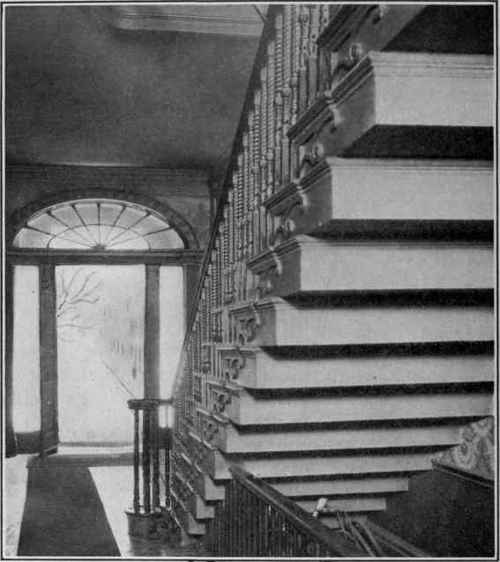
Illus. 404. - Stairs in Harrison Gray Otis House, Boston, 1795.

Illus. 405. - Mantel in Harrison Gray Otis House, Boston, 1795.
Illustration 405 shows a mantel in the Otis house of painted wood, with the space above the shelf taken by two sets of doors, one sham, of wood, and the other of iron, which opens into a safe. It is difficult to imagine why this transparent device was placed in such a conspicuous place.

Illus. 406. - Stairs in Robinson House, Saunderstown.
Illustration 406 shows a very good stairway in the Robinson house in Saunderstown, R. I. It has two turns, and the panelling on the side wall has a mahogany rail which turns with the one above the twisted balusters. The return of the stairs is panelled beneath, and at each corner of the turn of the balusters is a large post like the newel, which extends below the stairs and is finished in a twisted flame-like ornament.

Illus. 407. - Stairs in Allen House, Salem, 1770.
The beautiful stairway with panelled ends and boxing in Illustration 407 is in the Allen house in Salem. The balusters are particularly good.
A section of the fine stairway at "Oak Hill," Peabody, Massachusetts, in Illustration 408, gives the detail of the twisted balusters and newel so often seen in the old seaport towns. Each one of the balusters, of which there are three upon a stair, has a different twist, and the newel is a twist within a twist, the outer spiral being detached from the inner one. The balusters are painted white, and the rail and newel are of mahogany. Illustration 409 shows the staircase in the Sargent-Murray-Gilman house in Gloucester, and Illustration 410 shows a mantel in the same house, which was built in 1768, by Winthrop Sargent, for his daughter when she married Rev. John Murray, who was the founder of the Universalist church in America. Later, the house was occupied by the father of Rev. Samuel Gilman, the author of "Fair Harvard." The mantel is of wood, hand carved, with a broken pediment supported by plain columns with Corinthian capitals, while those below the shelf have Ionic capitals. The stairway is very fine, with panelled boxing and ends, and twisted balusters and newel. There is a good window upon the landing, with fluted pilasters at each side.

Illus. 408. - Balusters and Newel of Stairs at "Oak Hill," Peabody.

Illus. 409. - Stairs in Sargent-Murray-Gilman House, Gloucester, 1768.

Illus. 410. - Mantel in Sargent-Murray-Gilman House, 1768.
Continue to:


My Books

