


Musical Instruments. Part 2
Description
This section is from the book "Furniture Of The Olden Time", by Frances Clary Morse. Also available from Amazon: Furniture of the Olden Time.
Musical Instruments. Part 2
In the Essex Institute of Salem is a spinet made by Samuel Blythe of Salem, the bill for which, dated 1786, amounts to eighteen pounds.
The harpsichord, so named from its shape, was the most important of the group of contemporary instruments, the virginal, spinet, and harpsichord, the tone of which was produced with the quill and jack. The harpsichord had two strings to each key, and the instrument occupied the relative position that the grand piano does to-day, being much larger and having more tone than the spinet. Like the spinet, its manufacture ceased with the eighteenth century. Illustration 283 shows a harpsichord formerly owned by Charles Carroll, who was so eager to identify himself as a patriot, that he signed his name to the Declaration of Independence as Charles Carroll of Carrollton. This harpsichord was discovered twenty-five years ago in the loft of an old college building in Annapolis, where it had lain for fifty years. The Carroll coat of arms, painted upon porcelain and framed in gold, is fastened above the keyboard. The inscription upon this instrument is "Burkat Shudi et Johannes Broadwood, patent No. 955 Londini, Fecerant 1789, Great Poulteney Street, Golden Square."
There are two banks of keys, with a range of five octaves, and three stops, which were intended to change the tone, two of them being marked harp and lute. The case is quite plain, of mahogany, with a few lines of inlaying above the keyboard and a line around the body and top. It is owned by William Knabe & Co. of Baltimore, and is one of fourteen Broadwood harpsichords known to exist.
That the harpsichord was not an uncommon instrument in this country during the latter half of the eighteenth century is shown by the number of advertisements of the harpsichord and its teachers.
Illustration 284 shows a clavichord or clavier, made about 1745. It is owned by Mr. John Orth of Boston. The clavichord, like its successor, the square piano, was of oblong shape. The musical tone was produced in a different manner from that of either the spinet or piano. Each key had at the back an upright "tangent" or wedge-shaped piece of brass, which, as the front of the key was depressed, rose and set the string of twisted brass wire in vibration, by pressing upon it, instead of picking it like the quill of the spinet and harpsichord. This pressure divided the string into two different lengths, the shorter length being prevented from vibrating by a band of cloth interlaced with the strings. The same interlaced cloth stopped the vibration of the longer division of the string, as soon as the pressure was taken from the key, thus allowing the tangent to fall. In the earlier clavichords one string had to serve to produce the tone for two or three different keys. These instruments were called "gebunden," or fretted. Later instruments are "bund frei" or free, having a string for each key. The clavichord player could feel the elasticity of the wire string, and could produce a sort of vibration of tone by employing the same method as that used in playing the violin, a pressure and vibration of the fleshy end of the finger while the note was held.
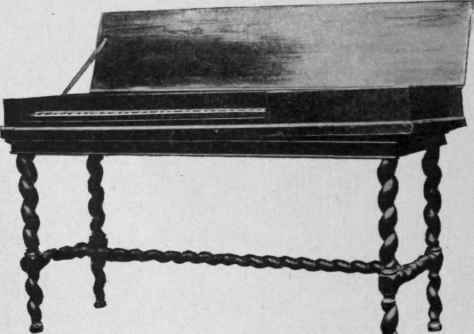
Illus. 284. - Clavichord. 1745.
The tone of the clavichord was very delicate, and it afforded far more power of expression than the spinet or harpsichord, which, however, were more brilliant, and entirely superseded the weaker clavichord in England. In Germany the clavichord has always been a favorite instrument, even into the nineteenth century. It is probable that but few clavichords came to this country.
The piano e forte - soft and loud - was invented about 1720. The strings of the piano are struck by hammers instead of being picked by quills, and the force of the hammer strokes made a stronger frame necessary than that of the spinet or harpsichord, in order to hold the heavier strings.
Brissot de Warville wrote in 1788 that in Boston "one sometimes hears the forte piano, though the art is in its infancy." He then soulfully bursts forth, "God grant that the Bostonian women may never, like those of France, acquire the malady of perfection in this art. It is never attained but at the expense of the domestic virtues." According to this the domestic virtues must be a scarce quality in Boston at the present time.
In 1792 Messrs. Dodd & Claus, musical instrument manufacturers, 66 Queen Street, New York, announced that "the forte piano is become so fashionable in Europe that few polite families are without it." As this country kept pace with Europe in the fashions, we can assume that the forte piano formed at the close of the eighteenth century a part of the furniture of the polite families of the United States.
The date of a piano can be approximately determined by its legs. The earliest pianos had four slender legs similar to the legs of the spinet or harpsichord. The next instruments had six legs, increased in size and fluted or carved. Then the number was reduced to four, and the legs were still larger, and more elaborately carved, until by 1840 the ugly legs found commonly upon the square piano were the only styles employed.
Continue to:


My Books

