


XII. The Guest's Room
Description
This section is from the book "Home Furnishing, Practical And Artistic", by Alice M. Kellogg. Also available from Amazon: Home Furnishings, Practical And Artistic.
XII. The Guest's Room
A perfection of details is the high-water mark in a room devoted to visitors. In the other rooms of the house any deviation from comfort receives compensation by the individualising charm of ownership. The guest's room, however, has no plea of this kind to sustain any failure to meet the requirements of its successive occupants.
The guest's room, to be a success, must be fitted up with the best that modern art and ingenuity provides in house furnishings. It must be treated, too, with an intelligence that will cover a diversity of needs; with taste to make every selection an artistic one, and with sympathy to invest the transient character of the room with some touch of homelikeness.
In building a new house the location of the guest's room should receive consideration. Not being in constant use like the family apartments, a north, east or west exposure may be accepted, provided the lack of sunshine be requited with an open fireplace and warm-hued decorations.
The ideal arrangements for a guest are a bedroom with an adjoining bath and dressing room; but when plumbing facilities are out of the question a small room for bathing and dressing may still be possible.
In country homes where space permits the luxury of more than one room for visitors, it is convenient to give up a room on the first floor to men. For such a room a college man devised a colour scheme from the colours of his Alma Mater, with decorations from trophies and pictures of student days.
The blue-and-white or pink-and-white pretti-ness of the traditional guest's room may be entirely discarded in fitting up one for a man's use. For the latter, one may begin with the woodwork and furniture and make the selections for both of these important items in a rich-toned brown oak. The bed requires neither canopy nor frill, but if an interesting counter pane is sought, it can be found among the cotton Japanese prints, Italian or Oriental embroidered goods, hand-printed French linens or English chintzes. An oak chest may be stationed at the foot of the bed to hold a reserve of bedclothes for cold nights, and this article may also do service as a slipper chair.
A new style of chiffonier for a man's clothing, with a sliding shaving glass, does away with the two pieces for clothes and shaving, neither of which has as yet been created on very graceful lines.
A table that is firm enough to hold a reading lamp and a comfortable armchair are needed in this room. If a carpet is chosen for the floor the pattern may be in a Persian rug in deep, quiet colours. In place of lace curtains some coloured net may be hung on brass rings that are slipped over a small brass rod.
In covering the wall the ordinary bedroom paper in floral design may be set aside for a plain or a two-toned English paper, or some conventional design in three colours. Or, a border may be made, in a room where a high ceiling seems too formal, with a figured paper, and a two-toned paper may fill the lower wall. Some of the new poster borders are suitable for the guest room of a man.
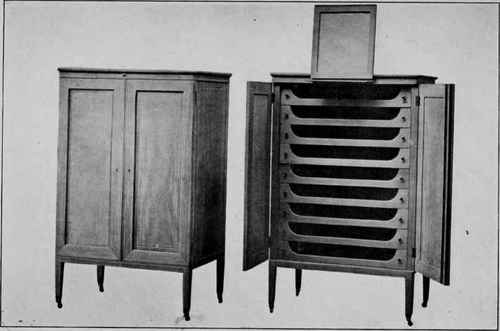
A Man's Chiffonier.
In a room that is expected to be occupied by two visitors two single beds may be installed instead of one double bed. White iron or brass, oak, maple or mahogany may be selected, but any curtailment of expense should be given to the bed frame rather than the fittings of the bed itself. The pieces of furniture should comprise, besides the bed, a lounge for day use, a bureau or dresser, a chiffonier, a night stand, a dressing mirror, a folding screen, an easy chair and rocker, a trunk stand, slipper chair and two side chairs. In supplying the small articles of toilet that may be called into use for guests whose luggage fails to arrive, the preference may be given to simple, substantial qualities without useless or perfunctory ornament.
Matting is often used For a floor covering when the boards will not permit the use of rugs; but an objection to matting is the odour it emits in damp weather or when the room is not thoroughly aired. A cotton filling in a neu il colour may be substituted for the matting if a wool filling cannot be afforded.
Lace or net curtains to screen the windows may hag to the floor for only to the sill, according to the shape of the casement and the furnishing of the room. Short muslin curtains may be held back by cotton loops if the sash does not require screening. In winter a second pair of long curtains of cretonne, sateen, linen taffeta or chintz may be added.
An opportunity for using a wall paper with a striking design is at hand in the guest's room, where such a choice gives better results than the admission of inconsequent pictures that are hung merely to fill up the walls. With a paper of this character the walls may be balanced by plain window hangings and plain or two-toned furniture coverings.
Family photographs and all personal souvenirs belonging to the household should not be admitted as decorations or furnishings in the guest's room, but the expression of the hostess's taste can find an outlet in the small belongings for the dressing table - broken and comb, hand mirror, powder box, manicue tools, pin tray, hair receiver, glove and boot fasener.
A set of sewing materials on a sm scale may be a part of the equipments for the quest's room, and these may be kept in orderly fashion in a Martha Washington stand. A tea stand for serving "the cup that cheers" to a visitor arriving between meal hours makes another pretty equipment and odd pieces of china may be selected for it.
Bookshelves and writing desk or table never accomplish their full mission of usefulness unless they receive intelligent care. The secret of their success is in their being kept up-to-date, one with its fresh volumes and new magazines, the other with clean pens and supplies of stationery.
As certain perfumes are the cause of great discomfort to some persons, the rule in the guest's room may be to keep everything of this kind outside its walls. Instead of closing the room when not in use, it is better to let it partake of the atmosphere of the house, taking care to give a thorough ventilation before and after it is occupied.
The interest in collecting antique furniture is often directed to the fittings of the guest's room, and when this is done the most picturesque effects will be obtained by carrying the idea through all of the furnishings and decorations. As these "real old things" are becoming very scarce and, in consequence, too precious for the wear-and-tear of every-day use, the room reserved for visitors will be a place for their safe keeping, where they will fill a utilitarian office outside of their value as a collection.
Continue to:


My Books

