


Other Georgeian Types
Description
This section is from the book "Style In Furniture", by R. Davis Benn. Also available from Amazon: Style In Furniture.
Other Georgeian Types
After reading the three preceding chapters, and before dismissing the subject of Georgeian types in order to proceed to the consideration of those which come next on our list, the reader will naturally wonder what was being done during the period with which we have just dealt by designers other than those whose names have been accorded prominence in these pages. It will be readily understood that Chippendale, Heppel-white, and Sheraton were not by any means the only men employed in designing and making furniture during the time of the Georges, and, on that account, some may assume that other distinct and historic styles may have risen in this country under the earlier rulers of the House of Hanover, and call for our attention; but I may say at once that such is not the case.
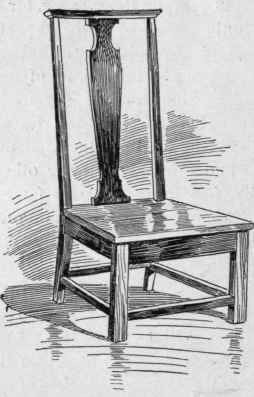
Early Georgeian Chair (Of the cheaper class, with " Queen-Anne" baluster or "splat" in back)
We must, of course, recognise the fact that all the models which we now classify as "Chippendale," "Heppelwhite," and "Sheraton," were not really the creations of the designers whose names they bear, but were either borrowed by them from contemporary makers - I am not referring now to the French inspiration already discussed at length - or were borrowed in part by contemporary makers from them.
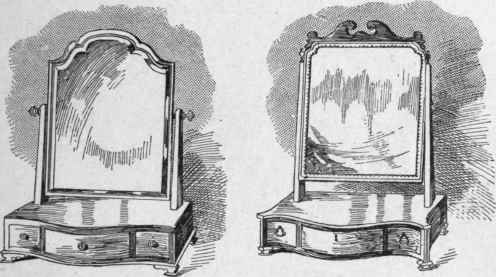
Georgeian Toilet-Glasses (Of the "Heppelwhite" or "Sheraton" type in lower part, but revealing "Queen-Anne " influence in the shaping of the tops of mirror frames)
As the three designers of whom I have written so much brought together the scattered fragments of style, so to speak, harmonised them, and included them in their systems, their names have become associated with them, and, doubtless, will continue to be so associated until the end of the story. It would, therefore, serve but little purpose to analyse here, even did space permit, the designs of such men as Ince, May-hew, Lock, Manwaring, Hope, Johnson, and other contemporary cabinet makers and chair makers, which resembled, in a greater or less degree, those we have studied. The names, however, of the men themselves, who helped to attain the end towards which the great trio were working, each in his own way, must needs be placed on record; and a list of their principal publications is given at the end of this chapter for the information and guidance of those who desire to go further into the matter.
With so many brains active, many variations in style naturally occur, and it is my duty to refer briefly to some of them. As regards classification, we cannot do better than fall back upon the "heads" we already have in our minds. The chair illustrated in Fig. I, Plate I., is of a type common in the more modest homes of the "Queen-Anne" period, and was, by the way, selected more than once by Hogarth for presentation in his renderings of interiors of the humbler class. It is generally found with the plain wooden seat, with simpler turning in the legs, and sometimes without under-framing. The particular example shown looks rather like a more modern rendering of the original, but whether it is so or not I am unable to say with any degree of certainty, not having seen the piece itself. Fig. 2 may be classed either as late "Queen-Anne" or early "Chippendale," for though the frame as a whole is in the former style, the "splat" in the back distinctly heralds the advent of the latter. Precisely the same remark applies to the back, Fig. 6, Plate II. Fig. 3, Plate I., is, of course, "Queen-Anne," and we can fix its date pretty well, as it was the property of the great Hogarth himself; but Fig. 4 carries us on to much later in the century. The arms and lower part of this are to all intents and purposes "Chippendale," but the back has much of the grace, and all the delicacy, of "Heppelwhite." Most probably it was made somewhere between 1770 and 1790, or possibly earlier; the later estimate appears to me to be the more likely. We cannot go far wrong in describing Figs. 3, 4, 5, and 8, Plate II., as early "Chippendale," for they are unmistakably in that style, though they are not from the pencil of that designer. Fig. 7 I should prefer to regard rather as early or inexpensive "Heppelwhite," if a definite name must be attached to it. Fig. 9 is a rather curious and unusual study, for, while the greater part is "Chippendale," the graceful interlaced "splat" might have been the idea of either Heppelwhite or Sheraton, or of one of their followers. Fig. 1, Plate III., also has the "Heppelwhite" feeling, while I need not say at this stage that Fig. 2 may be definitely and without fear of dispute classified under that heading. Fig. 3 is an exceptional example, of which it is impossible now to obtain the history; but it was evidently specially designed and made for some ceremonial purpose, and dates from about 1770 or 1780, as indicated by the tapered legs and form of the arms. With Fig. 4, and all the types on Plate IV., we come to clearly defined " Chippendale" again, though they are not taken from "The Gentleman's and Cabinet Maker's Director." In Fig. 4 particularly we have a fine example of the clustered turned legs, to which I have previously referred as a characteristic of "Chippendale."
For permission to illustrate the fine old cylinder-fall "secretary" shown overleaf, I am indebted to my brother, Mr. Julius Benn, from whose collection also comes the wall-mirror pictured on Plate II., "Jacobean." This "secretary" was probably made about the middle of the century; while the chair standing by it is, of course, early "Chippendale."
Should an objection be raised on the part of anyone to the description by the names "Chippendale," "Heppelwhite," or "Sheraton" of pieces which do not appear in the published works of the founders of those styles, or whose origin cannot be traced directly to them, the difficulty may easily be surmounted by employing the terms "Early Georgeian" or "Late Georgeian," as occasion may require; and, indeed, in my opinion, in many cases it is far preferable to adopt that course, though some people will not remain satisfied with it, demanding something more definite, even though not absolutely correct.
Continue to:


My Books

