


Quaint Furniture. Continued
Description
This section is from the book "Style In Furniture", by R. Davis Benn. Also available from Amazon: Style In Furniture.
Quaint Furniture. Continued
Notwithstanding the fact that the task which they set themselves seemed, and still seems, to be a hopeless one, the Society have gone bravely on; have perpetrated many absurdities - as we all do at one time or another - and have accomplished an incalculable amount of good. And it is for us to see now in what respect they have exercised an influence upon British furniture. Most of these artists, though from the first they assumed an affectation which would have been mirth-inspiring had it not been painful; and though, in many cases, their views regarding art are of the narrowest; were, and are, men of high attainments; their views, therefore, are entitled to respect. In considering what should be done to bring about the reformation of furniture, they took, in the first place, one important stand. They determined to emphasise the fact that the cabinet maker, in common with everybody else, should "cut his coat according to his cloth," and, at the same time, they endeavoured to impress this lesson upon the minds of the public. They argued, and, of course, correctly, that the majority of people cannot afford to spend very much money on their furniture; and endeavoured to teach them that they should be content with comparative simplicity, since elaborate forms, if well made, with carving, inlay, painting, and metal enrichments, if good, are more or less costly. It was their aim to persuade the purchaser, who is able only to spend a few hundreds on the furnishing of his home, not to ape the schemes of those who may be in the position to spend thousands. And, in order to demonstrate their meaning more fully, they set about the production of types of furniture which should serve as models of what ought to be. These were placed on view at the periodical exhibitions held at the New Gallery under the auspices of the Society; the exhibitions themselves soon became almost as popular as the annual displays of the "R.A."; they were visited extensively by the "upper ten," who were struck by the novelty they found there; so, before long, everything a, la "Arts and Crafts" became the craze. In this way the ball was set rolling.
But what of the types referred to themselves? I have said that they were brought forward as a practical protest against the cheap and nasty over-elaboration that had for so long been rampant, and of which we still see far too much; and, naturally perhaps, they went to the other extreme. The ideas which underlay them were indisputably admirable, but in too many instances they were carried into effect by men who, skilled as they were in other departments of art, had not taken the trouble to master even the A B C of furniture design or manufacture. As an inevitable result, they were endowed with much of the comic element. This furniture was made by primitive methods of construction, and was accordingly costly; in some cases it was so badly-put together that it came to pieces in the Gallery. Yet, with all this, the idea was there, and was destined to bear remarkably rich fruit.
The professional furniture designer, and the manufacturer - in fact, the much - abused "trade" - saw that the Arts and Crafts Exhibitions had done much towards the creation of a genuine demand for simple and quaint furniture; so they - who were trained to the business - set to work in that direction, and, with the aid of all the most modern, and most perfect, facilities and manufacturing appliances that money can command, produced their own designs upon commercial lines, and found that they met with the heartiest welcome. Thus, these simple forms found their way into the greater number of the furnishers' showrooms of any importance up and down the country; and, as they were unusual, comparatively inexpensive, and far superior in construction and design to much that was already there, their popularity became assured.
Of this "Quaint," in its best phases, it may be said that comparative simplicity is the keynote; that, in cultivating it, the designer is free to give his own fancies full play, so far as considerations of price, and limitations imposed by method and material, will permit; that in it the value of broad effects in carving, inlay, and metallic enrichment is more fully appreciated than it was before the cultivation of this vein of thought; and that, as a matter of fact, it is, to all intents and purposes, the "New Art" of the British furnisher - a "New Art," withal, which had its inception here long before "L'Art Nouveau" made its appearance in France.
"Quaint." III. Plate 101
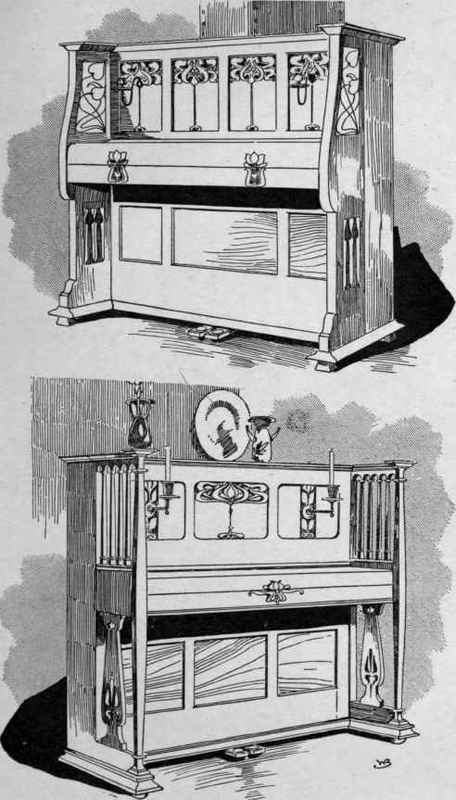
Reference in Text. See pages 327, 328
The Arts and Crafts Society, however, must not be permitted to monopolise all the credit for the inception of this new movement; for, even during the earlier years of that organisation, some furniture designers and manufacturers were working quietly towards the same goal, though they were not enrolled under the Morrisean banner, and would, most likely, not have been acknowledged as confreres by those who were. Indeed, they are not accorded that honour even yet; but they manage to survive somehow. We must, however, accord the Society all the honour that is its due; and hope that the day may not be far distant when it will throw down many of the barriers it has raised; when its views may be broadened; when many of its absurdities and mannerisms may be abjured; and when it may become more thoroughly representative of British art and craftsmanship than it has been. Then, the good work it has already accomplished may be increased ten thousand-fold.
Although it is not my intention to illustrate much modern British work here, one or two examples demonstrating certain points raised will not be out of place. For instance, we have on Plate I. four pieces of furniture which the "Arts and Crafts " Society deemed worthy of being placed on view at one of their exhibitions at the New Gallery, held not so very long ago, and these will serve to justify some of my remarks with regard to that body's advocacy of severe simplicity. Exactly the same spirit inspired the designs which are presented on pages 322 and 323, and on Plate III.; but it is that spirit interpreted by one who has made a lifelong study of the task in hand, and who is, therefore, able to avoid the pitfalls that beset the simple amateur. The last Plate (II.) that calls for notice illustrates a number of suggestions for dining-room furniture in which natural forms, skilfully and tastefully conventionalised, constitute the sole enrichment. This series of studies in what might almost be described as English "New Art," is from the pencil of Mr. Henry Pringuer, an artist in writing of whose work I could, with the greatest enjoyment, fill many pages did circumstances permit, but unfortunately they do not.
In conclusion, it must be pointed out that, side by side with this cultivation of the "Quaint," designers have studied more and more deeply the best work of the past, learned its lessons, and adapted the cardinal principles of historic styles with such rare skill as to bring them into harmony with present-day requirements. The result has been that, in addition to the faithful copying of old models, the most tasteful novel renderings of old styles have, for many years past, been produced, and continue to be produced, on every hand. To sum up the situation, if I were asked to give my opinion upon the work of the modern British cabinet maker as a whole, I should unhesitatingly affirm that there never was a time in the history of our country when so great a degree of good taste was to be found in the furnishing showrooms as is to be seen there to-day; and that there is not the slightest excuse for anyone, however limited may be his resources, to admit into the home ugliness in the form of furniture.

An Illustrated Table Of Technical Terms Unavoidably Employed Frequently In The Text - Plate 102
Continue to:


My Books

