


Queen-Anne. Part 2
Description
This section is from the book "Style In Furniture", by R. Davis Benn. Also available from Amazon: Style In Furniture.
Queen-Anne. Part 2
Before marking the characteristics of this new style, which was making its way so steadily and surely, we shall be fully repaid if we review, for a brief space, the changes that were taking place in the attitude of mind - if I may so express it - of the times; and if we notice, as clearly as we can, the type of patron to whom the furnisher had to look for his support. We may thus account in some measure for the steady growth of that spirit of refinement which then characterised our household gods, and reached its zenith at the close of the century the earlier years of which included the reign of Anne.
"Queen-Anne." II. Plate 23

Reference In Text
Page | ||||||
Fig. | 1. | See | 78, | 85 | ||
" | 2. | " | 78, | 85 | ||
" | 3. | " | 77, | 78, | 79. | 85 |
Page | ||||
Fig. | 4. | See | 78, | 81 |
" | 5. | " | 77. | 85 |
" | 6. | " | 77, | 81 |
What, in the first place, were the political conditions of the times in relation to the cultivation of the arts? Were they favourable or otherwise? Let us see.
So far as national affairs were concerned, Queen Anne had cause to be thankful enough. The country was practically at peace, and such disturbances, slight or otherwise, as occurred might with confidence be left for settlement in the hands of the hero of Maestricht, Blenheim, Ramilies, and Mal-plaquet. "Mrs. Morley" could write her historic letters in peace to "Mrs. Freeman "; "The Family" were looking after the affairs of state - and themselves at the same time; and, at last, the cultivation of the graces of life commenced to supersede the spirit of militarism which had for so long kept them in abeyance. Apostles of those graces, too, were coming to the fore on every hand, and, furthermore, their genius was not only encouraged by public approbation, but won the appreciation, and, of greater importance to them, the financial support, of the State. It is both curious and interesting to recall the personnel of many of the public departments of those days. What we find there is most significant; it indicates clearly that men who attained to greatness in art, science, or literature were deemed worthy of their salt, and, as I have said, that something besides martial conquest occupied the thoughts of those who were placed at the head of affairs. A few illustrations of this will help us to form in our own minds a more complete conception of the times which are now our particular study, and to call up visions of those great ones amidst their proper domestic surroundings.
John Locke had completed his "Essay on the Human Understanding" in the intervals permitted by the performance of his duties as Secretary of Presentations, and Secretary to the Board of Trade; Ray had laid the foundation for the classification of the vegetable and animal kingdoms, by which he won the unstinted admiration of Cuvier himself; Con-greve was delighting the playgoing public with his "Double Dealer," "Love for Love," and similar conceits, and had been rewarded by a post in the Hackney Coach Office; Farquhar was competing successfully with him on his own ground by the production of "The Beau's Stratagem," "Love in a Bottle," and like extravagances; while Pope was, at one and the same time, accumulating the wisdom and the gall which gave to the world the "Essay on Man " and the "Dunciad." Matthew Prior had served successively as Gentleman of the Bedchamber to King William, Secretary to the Congress at the Hague, Secretary of State, and Secretary to the Embassy in France, the while he was delighting all people of culture by his writings and poems, and notably by his "History of our own Times." Addison had completed his "Rosamund" and "The Campaign," and was alternating the duties of Commissioner of Appeals and Under-Secretary of State by penning his literary gems for the Spectator, Tatler, and Guardian, and preparing his reproofs for "Little Dickey"; while that gentleman himself - "the most agreeable and most innocent rake that entered the round of dissipation" - was editing his papers, spending a certain number of hours daily in the Stamp Office, suffering expulsion from Parliament for his "Englishman" and "Critic," and bowing the knee for knighthood. Handel was busy fighting duels, writing his "Te Deums" and "Jubilates," and drawing his pension of "four hundred a year"; Walpole was looking after the Exchequer and exports and collecting his art treasures; Lord Chesterfield - friend of Addison, Pope, Swift, Arbuthnot, Gay, Voltaire, and Montesquieu - was writing his far-famed "Letters," and, at intervals, guiding State affairs in Ireland and Holland. Garrick was sitting at the feet of Dr. Johnson preparatory to trying his chances in the wine trade, and winning his laurels on the stage - curious that our own Toole should have passed from one to the other in the same way; Hogarth was storing up that knowledge of human nature which afterwards, guided by his genius, made him the most powerful pictorial satirist of his or any other age - and striving to win the favour of Sir James Thornhill's daughter; "Peg" Woffington was sending the beaux of the town mad with her "Sir Harry Wildair," and Joshua Reynolds was just entering upon his studies. Looming over all, we see, through the eyes of Boswell, the ponderous figure of Samuel Johnson himself, struggling for eight years over his Dictionary - which was due in three! - and spending his £1575 long before the completion of his task; preparing his Parliamentary reports for the Gentleman's Magazine; dodging the bailiffs; and writing "Rasselas" to pay the expenses of his mother's funeral! That remarkable genius, with "his coat, his wig, his scrofula, his St. Vitus's dance, his rolling walk, his blinking eye, the outward signs which too clearly marked the approbation of his dinner; his insatiable appetite for fish sauce and veal pie with plums; his inextinguishable thirst for tea; his trick of touching the posts as he walked; his mysterious practice of treasuring up scraps of orange-peel; his morning slumbers, his midnight disputations, his contortions, his mutterings, his gruntings, his puffings; his vigorous, acute, and ready eloquence; his sarcastic wit, his vehemence, his insolence, his fits of tempestuous rage, his queer inmates - old Mr. Levett and blind Mrs. Williams, the cat Hodge, and the negro Frank."
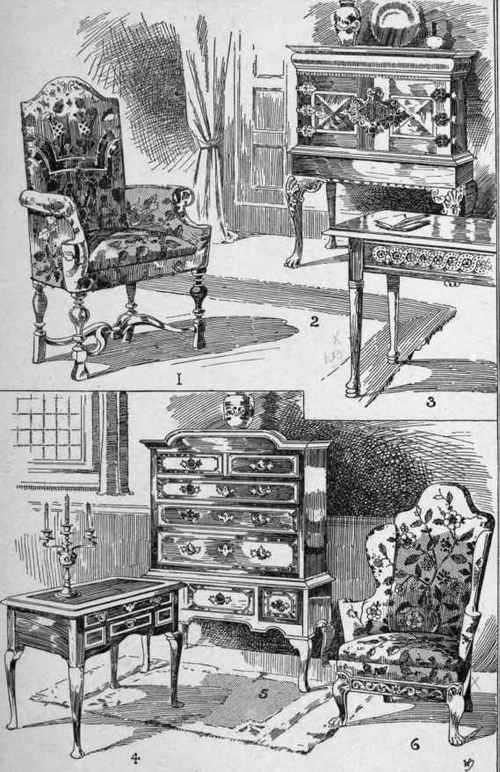
"Queen-Anne." III. Plate 24
Reference In Text
Page | ||||
Fig. | 1. | See | 77, | 83 |
" | 2. | " | 78, | 88 |
" | 3. | " | 79 | |
Page | |||||
Fig. | 4. | See | 77 | 85 | |
" | 5. | " | 77. | 88 | |
" | 6. | " | 78 | 83 | 85 |
It is with such figures as these, then, that we may, if we be so disposed, people our interiors in imagination when we have fitted them up from the material provided in these pages; and their presence in our memories cannot but enhance the interest of our study of their silent companions. Is it surprising that, in the midst of so notable a revival of culture and refinement in almost every walk of life, domestic furnishings should throw off much of the clumsiness that had characterised them for so long, and take to themselves forms in greater harmony with the higher tastes of the time?
Continue to:


My Books

