


Queen-Anne. Part 5
Description
This section is from the book "Style In Furniture", by R. Davis Benn. Also available from Amazon: Style In Furniture.
Queen-Anne. Part 5
The foregoing remarks exhaust, I think, the subject of "Queen-Anne" legs, and we must now see what there is to be noted in the chair seats and backs. The seats, as will be observed, assume a variety of forms, but are seldom, it ever, rectangular, being almost invariably narrower at the back than at the front. Sometimes the line of the side-framing is straight, though springing at an angle from the back; but frequently the form of the seat is completely curvilinear. This can be better explained by the assistance of illustrations, and in the outline plans that appear on the opposite page, we see the principal shapes of the "Queen-Anne" chair seat at a glance.

Queen-Anne Dresser, of a Type Common in Lancashire, Yorkshire, and Wales (See page 79 for reference)
We may now proceed to the consideration of the backs which generally accompany them. The forms of back most favoured were those of the type represented by Figs, 1 and 3, Plate II.; and those illustrated on the plate of Dutch examples. In these a "baluster," or broad "splat," of pleasing outline, is framed-in by gracefully shaped top and sides, the lines of which generally follow right round in one unbroken and more or less sinuous "sweep." Variations of this will be found in Fig. 4, Plate II., Fig. 3, Plate IV., and Figs. 2 and 6, Plate V.; but these are somewhat exceptional. The two first-named are probably actually Dutch, while Fig. 6, Plate V., is a curious mixture of "Dutch" and "French," although it would almost come under our description "Queen-Anne," so all-embracing is that title.
Figure 6, Plate II., was doubtless specially designed and made for some ceremonial purpose, and cannot be regarded as a type, though it is interesting nevertheless. The fleur-de-lis and knotted cord in the heraldic device seem to indicate that this chair was designed for some family of French extraction; but the toes of the front legs are decidedly "Spanish," as rendered in Flanders.

Plans of Typical Queen-Anne Chair Seats(See page 80 for reference)
It was at this period that the "easy chair" commenced to come into vogue, and greater provision was made for the support and comfort of the head and shoulders of the occupant. Backs were constructed higher and of more generous proportion; and, among other innovations, the form which we now know as the "Windsor" put in an appearance. In this the centre baluster was not at first abandoned; it was supported on each side by simple turned rods or members, the whole being surmounted by a shaped piece, after the manner shown in Fig. 5, Plate IV. Few more serviceable, sensible, or, for the matter of that, comfortable, wooden chair forms have ever been devised; and it is not at all surprising that this type, with its numerous variations, should have remained popular even down to the present time.
With the taste for luxury and refinement steadily growing on every hand, a degree of ease and comfort was demanded greater than that which the woodworker alone could provide; and it was apparent that something further must be done. It is most curious, almost inexplicable indeed, that that something was not done long before. For many a long year, in Italy, Spain, France, Germany, and the Netherlands, the chair maker had found an invaluable coadjutor in the upholsterer, who had done wonders to render his productions kindly and inviting to the body; but, unless seats were imported from abroad, the physical frames of our countrymen and countrywomen had been compelled to extract what comfort they could, by the aid of loose cushions, from the hardest of oak, uncomfortable enough in itself, but rendered far worse by the vigorous ministrations of the carver, with his crude embellishments.
Eventually a change came about; and the English chair maker argued to himself that if "the foreigner" could upholster so could he, and he set to work to master the craft. The success with which he met is shown by such models as Fig. 1, Plate I., and Fig. 6, Plate III. In the last we have one of the earliest ancestors of our now beloved "Grandfather," or "Wing," chair, in which many a weary head has found comfort, repose, and immunity from draughts. The backs of these, it will be noticed, are of a sensible height, and fully upholstered; there is no suggestion of the more modern "pin stuffing" about them. The arms, with their comfortable "rolls," open out invitingly, tempting one to yield to their embrace. But there are embraces which have disastrous results, particularly where ladies' dresses are concerned, so most of the arms in question were constructed with that fact in view, and were set-back from the front of the seat in such a way as to permit of the satisfactory disposition of the "fulness" of the Queen-Anne and early Georgeian skirt. This will be apparent in Fig. 1, Plate I.; and more especially so in Fig. 6, Plate III. In Fig. 1, Plate III., which is not a very characteristic type, the same consideration is not quite so noticeable, though there are signs of it.
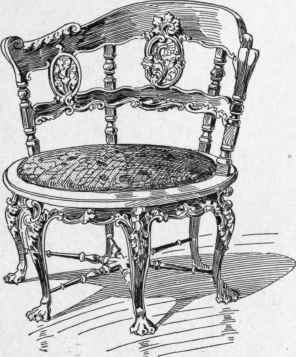
Arm-Chair (Said to have belonged to Josiah Wedgwood)
The materials employed by the upholsterer for covering included all those produced by the loom and any other which could possibly be pressed into service for such a purpose, in addition, of course, to leather; while the deft needle of the embroideress was frequently set going for the beautification of such pieces as those illustrated. This was the case, indeed, with Fig. 1, Plate I. This fine old double seat is the property of Mrs. J. Seymour Lucas - whose brush work has been so constant a delight to all of us - and, in its present condition, has some interesting associations. When it was first secured by its gifted possessor, the covering of old English needlework was in a condition that might have been deemed altogether hopeless; but H.R.H. Princess Louise, upon examining it, saw the possibility of its restoration, and displayed her keen interest in all that appertains to the art of the needle by undertaking to have the work carried through successfully. The result is a triumph of stitchery, and is naturally treasured by Mrs. Lucas as a practical and tangible proof of the great and cultured encouragement accorded by Her Royal Highness to the cultivation of the applied arts in this country.
Continue to:


My Books

