


Queen-Anne. Part 7
Description
This section is from the book "Style In Furniture", by R. Davis Benn. Also available from Amazon: Style In Furniture.
Queen-Anne. Part 7
Furthermore, these were the early days of the cabinet as a distinct article of furniture for the display and protection of valuable knick-knacks and objets d'art et vertu generally, some "small beginnings" of which we find in Fig. 2, Plate III., and in Fig. 4, Plate IV. The former may have been used in the drawing-room for the purpose already specified, or in the dining-room as a successor to the old "bread-and-cheese cupboard" - the sideboard had not been invented at the time of which I am writing.
The woods employed in the manufacture of the earlier "Queen-Anne" furniture in this country were chiefly oak, walnut, chestnut, beech, lime, and others of the softer species; but after 1742, when mahogany was first used here in the making of furniture, that wood was freely requisitioned. We sometimes find, also, inlay of satinwood and "canary," as in Fig. 5, Plate III., and Fig. 1, Plate IV.
There still remains one article of no inconsiderable importance of which I have not yet spoken, and that is the mirror as an independent object, and distinct from its use as an integral part of another piece of furniture. Wall mirrors were very common in the Queen-Anne and early Georgeian days; but those belonging to that period, numerous as they were, present no difficulty in regard to identification, as all bear a very close resemblance to one another, and were much on the lines indicated by Fig. 2, Plate IV., on Plate VI., and by other illustrations in this chapter. The frame usually consisted of flat wood, cut to various shapes - some of them most fantastic - on which were "planted" enriched mouldings (the old "egg - and -tongue" rendered yeoman's service in this direction), somewhat heavy festoons of fruit, leaves, and flowers, and other detail of a character more or less decorative, and which, by-the-bye, was usually gilt. It was not uncommon for the glass to be surmounted by a carved-and-gilt semblance of some strange and wonderful bird, of a species certainly not known to our old friend John Ray, and the classification of which would, I am sure, have defied the powers of even Cuvier himself.
Queen-Anne." VIII. Plate 29

Mantelpiece Of The Queen-Anne Period (With Heavy Carving Of Leaves, Fruit, And Flowers After The Style Favoured By Grinling Gibbons)
But I must not linger longer over the work of this period - call it "Queen-Anne," "Anglo - Dutch," "Early-Georgeian," or what you will. Great as would be the pleasure in dwelling further upon the memories of those days, so full of fascination, enough has been written and shown to indicate fully the fact that, with the dawn of the eighteenth-century, a new spirit - a spirit of grace and refinement - was infused into the domestic surroundings of our forefathers. Having once recognised its presence - and who could fail to do so in the face of testimony so convincing? - it remains for us to follow it through many successive stages of development; to note how it swept away old and worn-out traditions, and substituted new ones in their place, whose introduction was destined to work wonders.
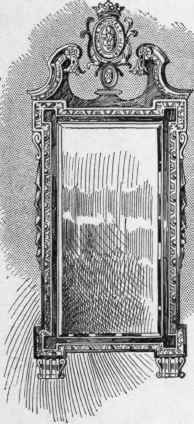
Georgeian Wall Mirror (See above for reference')
Chambers. I. Plate 30
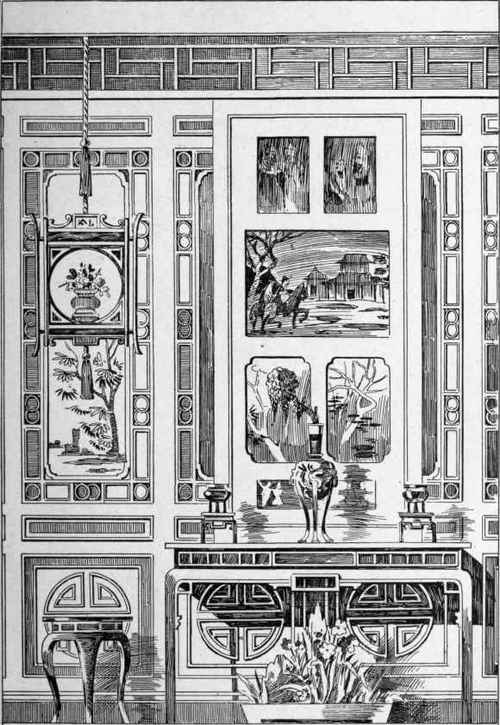
Reference in Text. See pages 91-93
Continue to:


My Books

