


The Seventeenth Century. Introductory
Description
This section is from the book "Style In Furniture", by R. Davis Benn. Also available from Amazon: Style In Furniture.
The Seventeenth Century. Introductory
The task of tracing, identifying, arranging in chronological order, and placing on record the scattered fragments now available of the history of such English furniture and woodwork as was designed and manufactured prior to the commencement of the seventeenth century, is, for many reasons, beset with difficulties; indeed, it is greatly to be feared that the story, in absolute entirety, will never be told, for the requisite material upon which to base it is no longer available. In the first place, the cabinet makers of the earlier times did not cultivate the practice of publishing design books, or illustrated sheets; if they did, none has survived to tell the tale. Later on, when we arrive at the "Chippendale" period, all is delightfully plain sailing for the historian, but when dealing with work of an earlier date we have to grope about, so to speak, in greater or less obscurity; piecing together as well as may be fragments of the story gathered here and there, so far as circumstances will permit, in order to arrive at an approach to the truth, and be in a position to form a fairly just estimate of the whole. These fragments are comparatively few and far between, particularly when we get back to the reign of Elizabeth - as is, of course, only natural; for it needs good craftsmanship indeed to survive the wear and tear of over three centuries. Yet, to the lasting credit of the old woodworkers be it said, much not only has remained even to the present day, but still appears to be "good" for a few centuries more. Only the "fittest," of course, has survived. This aspect of the question must be emphasised, as not a few people seem to lose sight of the fact altogether, and draw erroneous conclusions, which they express loudly, in consequence. Critics from whom better things might reasonably be expected are frequently heard comparing the work of the so-called "good old days " with that of the modern craftsman, greatly to the disparagement of the latter.
The favourite plan adopted by these "superior" people is, in the first place, to take some of the masterpieces of days gone by, upon the execution of which neither loving labour nor expense was spared, and place them side by side with commercial productions of the present day, designed and made under modern conditions, and for a totally inadequate rate of remuneration. Having done this, they wag their heads, and enquire: - "Where is your modern craftsman now?" Personally I think that he comes out of the comparison very brilliantly indeed. If the greatly-belauded cabinet maker of the sixteenth, seventeenth, or even eighteenth century were placed in the position of his twentieth-century successor, compelled to "cut prices," as the trade term it, and to hold his own against the keenest competition on every hand, which will allow him but the barest living; what would be the result?
In the name of all that is just and fair, let us be honest enough to look the situation squarely in the face. As a matter of fact, I have no hesitation in contending that many a piece of furniture which may be purchased nowadays for a few sovereigns in the showrooms of, shall I say, the much-abused and extensively patronised Tottenham Court Road, is in very truth, considering the money expended, of far greater value than some of the most beautiful and costly creations of earlier times. And let it be recognised and remembered that we have in our midst now designers and craftsmen as gifted in all respects as any the world has ever seen. Given the opportunity, these men are fully capable of designing and executing work which would rival, and probably surpass, the finest productions of any age or country, but - and there is that awful "but" - it is the opportunity, and not the genius, which is wanting. The days when artists - I am speaking now of those who devote themselves to the applied arts - enjoyed the generous, indeed lavish, patronage of such men as Lorenzo di Medici, or the recognition and support of the State, as in France during the reign of Louis the Fourteenth, are past and gone - it would almost seem for ever; and both artist and craftsman, as well as art and craftsmanship, suffer as a natural consequence.
It will be well for us, then, always to bear in mind the fact that, with very few and unimportant exceptions, it is only the best and therefore most expensive work of the past which has survived for so long a time; and that such furniture as adorned the homes of the poorer, and a considerable percentage of the middle, classes has gone to the wall long ago.
With regard to the sixteenth and seventeenth century furniture of our own land especially, it must not be forgotten that the history of the times during which it was designed and manufactured literally teems with records of wars and rumours of wars. This makes it perfectly clear to the thoughtful student that the condition of affairs then generally obtaining, was not conducive to the cultivation of the arts of peace. Indeed it is astonishing that so much has survived as is now to be found in our national museums and private collections. How far the existence of this state of continual political and social unrest is reflected in the forms arid general character of the furniture and woodwork of the period concerned we shall discover later, when we come to consider individually the pieces illustrated by way of example.
Of furniture proper, that is to say portable articles such as tables and chairs, dating from the reign of Henry the Eighth, actual and authentic specimens are all but nonexistent; our knowledge, therefore, of the household gods of that time must, for the most part, be acquired from ancient books and prints. But I am fortunate in being able to illustrate one piece, the authenticity of which is not open to question - a Henry-the-Eighth armoire, now in the possession of Mr. J. Seymour Lucas, R.A. This is thoroughly "Francois-Premier" in character, and it is most probable that the carving was actually designed and executed by French artists and craftsmen, but the construction is undoubtedly English. Mr. Lucas discovered this example in an old farmhouse, where it was used for the storage of cheeses, and fifteen years elapsed before he could induce the owner to part with it. Yet he persisted, and in the end secured the treasure. It is true that, in spite of determined purification and fumigation, the cupboards are still redolent of cheese, but that is a small matter under the circumstances.
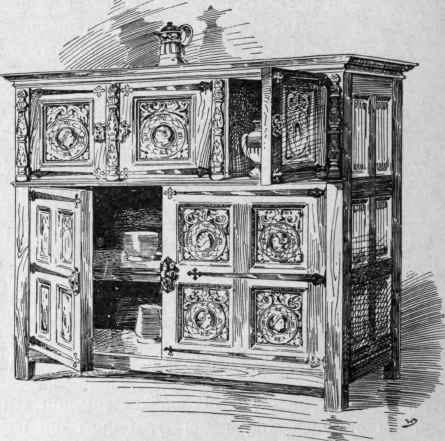
Henry-the-Eighth Armoire (Now in the possession of Mr. J. Seymour Lucas, R.A.) (See below for reference).
It is not, however, my present intention to go back to so early a date. Our study will seriously commence with the style prevailing at the end of the reign of Elizabeth, with the period when what has become known as the "Elizabethan" was at its zenith, and almost on the eve of that transition which finally resulted in the evolution of the "Jacobean."
Continue to:


My Books

