


Mixing Concrete. Part 5
Description
This section is from the book "Practical Concrete Work for the School and Home", by H. Colin Campbell. Also available from Amazon: Practical concrete work for the school and home.
Mixing Concrete. Part 5
Concrete Work Done In Cold Weather
One other condition of protecting concrete work should be referred to-that is, protecting such work when it is done during cold weather. Many persons are not aware that successful concrete work can be done when temperatures are low. All that is necessary when working under such conditions is to observe a few simple precautions. These consist principally of heating the sand and pebbles or broken stone and mixing water so that when the concrete mixture has been made, it will have a temperature of at least 80 degrees, then quickly placing this mixture in the forms so that none of the heat will be lost and covering or otherwise protecting the work so that this heat will be retained in the concrete until early hardening has been completed. Usually this can be arranged for by observing a few simple measures.
Briefly, the essentials of success in concrete work done in cold weather are the following:
Sand and pebbles or broken stone must be free from frost or lumps of frozen materials, otherwise they must be thawed out before being used in a concrete mixture. As cement forms but a relatively small bulk of the materials in any batch of concrete, it need not be heated. Mixing water should always be heated.
Although adding common salt to mixing water will prevent freezing of concrete that has not hardened, provided the temperature does not go too low, salt simply lowers the freezing point of the mixing water. It does not supply what is most needed-heat and warmth. It delays instead of hastens the hardening of the concrete. If too much salt is used, it will affect the final strength of the concrete.
Sand and pebbles or broken stone and mixing water should be heated so that the concrete when placed has a temperature of from 75 to 80 degrees.
Some sands are injured by too much heat. The same applies to certain kinds of pebbles and broken stone. Usually if they are heated' to 150 degrees, this will be high enough and the materials will not be injured.
Place concrete immediately after mixing, so that none of the heat will be lost before placing in the forms.
Warm metal forms and reinforcing before placing concrete. See that forms are free from ice and snow. Forms can be warmed by turning a jet of steam against them or by wetting with hot water.
Protect the concrete immediately after placed. Canvas covering, sheathing, housing in the work, or hay or straw covering, will furnish the required protection for some kinds of concrete work. In addition, small oil or coke-burning stoves may be used in enclosed structures to keep up the interior temperature.
Temperatures that are not low enough to freeze concrete may nevertheless delay its hardening for a considerable time. Do not expect concrete placed when the temperature is low and remains low for some time afterward, to be safe for use as soon as though the work had been done during warm weather. Cover and protect any section of the work as soon as completed. In severe cold weather, keep it protected for at least five days.
Forms must not be removed from concrete work too early. This applies to work done at any season but is particularly important with work done during cold weather.
Concrete that has frozen sometimes closely resembles concrete that has thoroughly hardened. If struck with a hammer it will often ring like properly hardened concrete. Before removing forms, examine the work carefully to see whether it has hardened or simply frozen. Pour hot water on a spot or turn the flame of a torch, or direct a jet of steam against the concrete. If frozen the heat will soften the concrete by thawing the water contained in it.
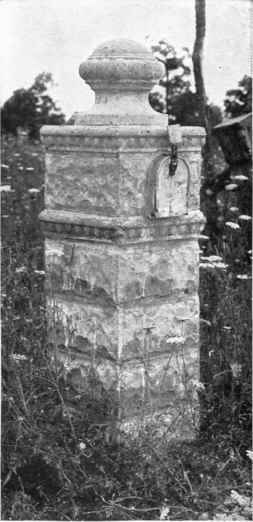
Column of concrete block made to serve as a container for the rural delivery mail box. This idea could be made a feature of concrete gate posts.
Continue to:


My Books

