


File
Description
This section is from the book "Woodworking For Beginners: A Manual for Amateurs", by Charles G. Wheeler. Also available from Amazon: Woodworking For Beginners.
File
The file is a piece of hard steel with rows of ridges or teeth cut obliquely on the surface. When cut in one direction only it is called single-cut, but when there are two oblique rows of teeth crossing each other it is called double-cut. These ridges incline towards the end or point of the tool, so that the file, like the saw, plane, and scraper, cuts when pushed forward. Files for wood have wider teeth than those for metal, so do not use a wood file on metal or a metal file for wood. The slab-sided shape (Fig. 524) is perhaps the most useful, if you can have but one file. A round " rat-tailed " file is also useful, and various other shapes if you can have a variety. For metal, the triangular, flat, the half-round, shown in Fig. 525, and the rat-tail are best. Files are very important for smoothing or rounding edges and curving surfaces.

Fig. 524.


Fig. 525.

Before beginning to file, be sure that the wood is firmly secured so that it will not slip and so that you can use the file with both hands. Hold the tool with the right hand, thumb uppermost, and steady the end with the left hand, thumb uppermost (Fig.
526), or with the fingers or palm. To file squarely across, push the tool steadily and evenly straight forward, without rocking up and down, and pressing only on the forward stroke.
In filing rounded surfaces, a rocking motion is often helpful and the way and direction in which to file in such cases must depend upon the shape of the work and the grain of the wood, as you will quickly learn. See Rounding-sticks.
Press lightly the first time you use a new file, until the fine edges of the teeth have been worn a little, as a violent filing on the first strokes may damage the cutting edges of the teeth.
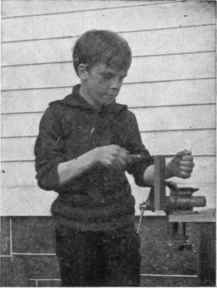
Fig. 526.
When a file becomes clogged with wood-dust or other substances, soak it in hot water a little while and then brush with a stiff brush. A file-card is useful. A piece of dog-fish skin, if you can obtain it, cuts somewhat like a file or coarse sandpaper, and is useful for curved surfaces where you wish to use the tools after smoothing.
Continue to:


My Books

