


Hand-Screws
Description
This section is from the book "Woodworking For Beginners: A Manual for Amateurs", by Charles G. Wheeler. Also available from Amazon: Woodworking For Beginners.
Hand-Screws
Hand-screws are of great use in clamping work that has been glued and for holding pieces in any required position. Wooden hand-screws are probably the most generally useful, but a couple (or more) of the simple iron clamps will be of great service at times, as they can be used more advantageously than the wooden ones in some kinds of work. Get medium-sized hand-screws rather than small ones if you can, as they will be generally more serviceable.
To open or close a hand-screw, hold it at arm's-length in front of you with a handle in each hand, and with a twirling motion revolve it toward or from you, as may be required, to increase or decrease the opening between the jaws. The screws should be greased or rubbed over with black-lead, soap, or bayberry tallow. To hold two pieces together with uniform pressure is of course necessary for gluing and various other operations, but a little practice will show you how to adjust the hand-screws so that the jaws will bear on the wood evenly. The main point to remember is to keep the jaws parallel. The final tightening is given entirely by the outer screw, so, in adjusting the screws, leave the jaws open a little at the tip as in Fig. 545, that when the final pressure is put upon the outer screw the jaws will bear on the wood with an even pressure (Fig. 546). If the jaws were adjusted to bear evenly before tightening the outer screw, the final result would be as shown in Fig. 547In clamping together finished work or pieces which could be injured by the pressure, always put pieces of waste wood between the work and the hand-screws. In case of delicate work, like carving or mouldings, a piece of soft 36 pine placed between the surface and the hand-screws or clamps will enable considerable pressure to be applied without injury to the work.

Fig. 545.

Fig. 546.

Fig. 547.
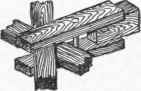
Fig. 548.
A simple home-made clamp, suitable for such work as temporarily holding in place parts of the frame of a boat, for instance, is shown in Fig. 548. See Clamps and also Figs. 66 and 647.
Continue to:


My Books

