


5. Sections
Description
This section is from the book "Bench Work In Wood", by W. F. M. Goss. Also available from Amazon: Bench Work In Wood.
5. Sections
Sections. In complicated drawings, the use of dotted lines to indicate hidden parts is more confusing than helpful.
In such cases it is customary to imagine the object cut, as if it were sawed asunder, and the surface thus produced exposed. Such a surface is called a "section."
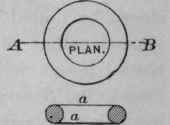
Complete sections show not only the surface produced by the cut, but the outline of other portions of the object which may be seen beyond. See lines a, a, Fig. 17.
Thus, section AB, Fig. 17, is that which would appear if the ring were to be cut on the line AB (Plan, Fig. 17), and the cut surface made to appear in elevation.
Section lines on a drawing show the location of sections. They are usually made in color (red or blue), or in dotted black, with a colored line on each side. Each section is designated by the letters of its section line.
Fig. 16
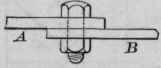
Fig. 17
Sec. A B
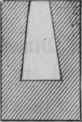
Cross-hatching is a term applied to the uniformly spaced parallel lines which are employed to indicate the cut surface of a section. See Fig. 18.
Different pieces of material appearing in the same section are cross-hatched at different angles, as in Fig. 19, which represents a cross-section of a lead-pencil; and different kinds of material are frequently indicated by cross-hatching in different colors.
Incomplete sections show only the cut surface, to the exclusion of all other portions of the object. It is common to place such sections on the section lines, and omit the letters. See Fig. 20.
A single view of a symmetrical object may be made partly in section, and partly in elevation, as in the drawing of the goblet, Fig. 21.
Fig. 18
Section A B. Fig. 15.
Fig. 10

Continue to:


My Books

