


Mortice And Tenonding
Description
This section is from the book "The Carpenters, Joiners, Cabinet Makers, And Gilders' Companion", by F. Reinnel. Also available from Amazon: The carpenters, joiners, cabinet makers, and gilders' companion.
Mortice And Tenonding
Under this head I shall endeavour to lay down some rules to be observed with regard to proportioning the parts of the mortice and tenon, so that they shall both be equally strong, or that the tenon shall not be more likely to give way than the cheeks of the mortice, for on this principle depends in a great measure the soundness of the work; and as what is laid down is formed from actual experience and practice, it will, if not always found quite correct, be in general a safe guide for the workman, and will prevent that frequent error of allowing too little substance for the tenon, for fear of weakening the cheeks of the mortice; and I may here observe that this subject is well worthy the attention of the ingenious mechanic, as well as the consideration of the mathematician, but as the latter is foreign to the purpose in hand, I shall proceed with the practical part, not without the hope that it will induce the workman to be more particular in general with regard to the proper proportioning the several parts of his work, so as to approach as near as possible to a maximum of strength with a given quantity of material.
Mortice And Tenonding.
Fig 1.
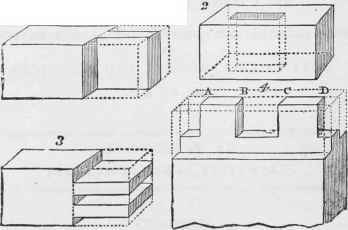
Figs. 1 and 2 represent a simple mortice and tenon; the dotted lines show the parts to be cut away; now to show the thickness of the tenon and consequently the width of the mortice, we have here one tenon and two shoulders, which is three parts, one part of which is to be allowed for a tenon and two for the shoulders; and this in general will be found the best proportion, for if the tenon is more than that, it will weaken the shoulders of the mortice, and if less, the tenon itself will be diminished in strength, and will be liable to break off, with a force that would not split or separate the shoulders of the mortice; now if we have, as is frequently the case, two tenons in one piece, as shown at fig. 3, as there are two tenons and three shoulders, which is five parts, which shows that each tenon must be one-fifth of the thickness of the stuff, and the shoulders are all equal to the tenons, and this rule may be generally observed, unless the tenon is at a considerable distance from the end of the stuff, and then something more may be allowed for the thickness of it, as the mortice in that case is not so liable to split; but it should in no case, however sound the timber or tough the material, be more than two out of four parts, that is, it would never be safe to make the tenon more than half the thickness of the stuff, and that only under particular circumstances, and when the mortice is near the middle of the scantling, or we should considerably weaken the piece in which the mortice is cut.
There is frequently in joiners' work, a shoulder at the bottom of the tenon, which fits into the piece in which the mortice is cut, as shown at fig. 4, and the tenon is divided into two parts as there shown, which, when the stuff is wide is a good method, as it strengthens the piece in which the mortice is cut without weakening, in the same pro portion as the mortice itself; and I would advise in this case, that the piece B C, cut out from between the tenons A B and B C, to be nearly, if not quite, one-third of the distance A D, as if much less, the piece left between the mortices will add but very little to the strength of the piece in which the mortice is made; and hence we should have the tenon stronger than necessary, in proportion to the morticed piece; and here I may observe, that if the width of the tenon is much more than four times its thickness, we shall gain additional strength from dividing the tenons into two or more parts, as shown in the figure, particularly if we allow a small piece at the bottom of the tenon as represented in this figure.
Continue to:


My Books

