


How To Assemble A Roof
Description
This section is from the book "The Carpenters' Guide", by Harvey Miller. Also available from Amazon: The carpenters' guide.
How To Assemble A Roof
We will use the same figure for this illustration that it may be easily understood, but the rules given in this roof have all the cuts for any regular roof. Though there may be a number of projections there will be no new cuts, but the method given will work on any rise or pitch.
In drawing an outline of a roof, take 1/4" scale to represent one foot. The diagram is 20'x24'. The length of the ridge is the difference between the width and length of the building, 4'. Measure 10' from the ends to ridge and 10' from the sides to ridge. This locates the ridge. Draw a line 4' for the ridge and a line for the hip rafters from the corners to the ridge. This outlines a hip roof. (Fig. 60.)
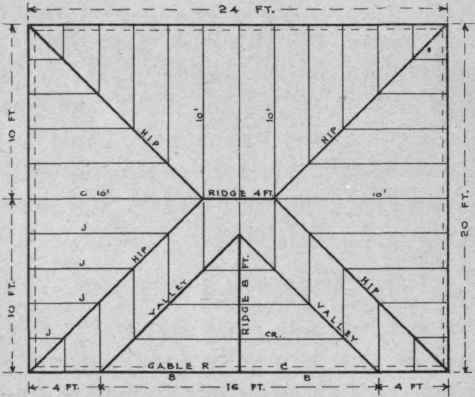
Fig. 60
The gable is 16', located in the center of one side of the building. The length of the ridge is 1/2 the width of the gable or 8' to meet the main roof. The difference in the height of the gable ridge and the ridge of the hip roof is 1/2 the difference between the width of the gable, 16', and the width of the main building, 20', or 2'. The valley rafter extends from the mark on the plate for the width of the gable, to the 8' mark on the ridge. (Fig. 60.) Spacing the rafters 2' on center. There are five common rafters in the main roof. They extend from the plate to the ridge. There are 28 jack rafters, that extend from the plate to the hip rafter. There are 4 cripple rafters that extend from the valley rafter to the hip rafter and 1 cripple rafter that extends from the gable ridge to the ridge of the hip roof. The two gable rafters that extend from the plate to the ridge are common rafters. Cut off lower ends of gable rafters 1/2 thickness of valley rafter on same bevel as cripple rafters. There are six cripple rafters in the gable that extend from the valley to the ridge. (See fig. 13.) Begin at the corners and space the rafters 2' on center. Measure from the corner 23" and 25" for the space of the first rafter and continue to space 2' from these marks. Follow this method around the building except the 16' span of the gable. Space the ridge of the gable 2' center, the same as the plate. Let the gable ridge extend 1 1/2" longer than the 8' mark to meet the valley rafter cut. Space the ridge of the main roof to correspond with the space on the plate. Allow 1 1/4" extension at both ends of the 4' ridge to meet the hip rafter, the center of the hip rafter to line with the 4' mark. Draw the rafters from plate to ridge, plate to hip, valley to hip and valley to ridge. (Fig. 60.)
All roofs are laid out with this method. Draw an outline of the roof before cutting the rafters and check the rafters on the plat as you cut them to know where you left off cutting and where to begin. It is practical to fasten a pair of gauges on the square at 12" base and the given rise to space and cut the rafters. It is as easy to cut a roof with 3", 5", 7", or any other rise as it is with 8" in this roof. Observe the methods. The common rafters have 10 base feet, 1/2 the width of the main roof. (Fig. 60.) Lay the square on the rafter at 12" base and 8" rise. Mark on the rise for the ridge cut, and make a check mark at 12" base. Move the rise of the square to this check mark and re-check as before ten successive times for the length of the common rafter. Then mark on the base for the plate cut. (Fig. 32.)
Shorten the rafter at the top one-half the thickness of the ridge. There are as many base feet in a jack rafter as there are number of feet on the plate from the corner to the center of the rafter. They are usually in pairs of the same length. Reverse the cuts on one to make a pair of right and left cuts. There are four pairs of jack rafters of the first length. They are 2' from the corner and have two base feet. Lay the square on the rafter at 12" base and 8" rise, two successive times. For the length of the rafter, mark on the base for the plate cut and on the rise for the perpendicular cut to meet the hip rafter. If a heel and extension is left on see rule for same. For the angular or face cut to meet the hip, take the number of inches from 12" base to 8" rise, which is nearly 14 1/2" on the square instead of the rise with 12" base. Lay the square on the top edge of the rafter at 12" base and 14 1/2" at the plumb line and mark back from the perpendicular line on the 14 1/2". This method is true in any pitch. (Fig. 35.)
Take the pattern and make four duplicate rafters of the reverse cut. Take one of the four and make three duplicate rafters with the opposite cut the same as pattern and you have four pairs' of rafters. There are four pairs of the second jack rafter. They are 4' from the corner and have 4 base feet. Follow directions for length and cut of first pair. The third rafter is 6' from the corner and has six base feet. There are three pairs and will require the square laid at the base and rise 6 successive times. For the length, use the same method as in the first pair for length and cut.
There are three pairs of the fourth jack rafter. They are 8' from the corner and have 8 base feet. Follow the same method as former pairs. By marking back from the regular spacing or perpendicular line, the center of the jack rafter will be shortened enough for the thickness of the hip.
The cripple rafter that extends from the valley rafter to the hip rafter has 4 base feet, the number of feet on the plate from the corner at the hip to the angle or center of the valley. Lay the square on the rafter at 12" base and 8" rise four successive times for the length of the cripple rafter. Mark on the rise for the perpendicular line for top and bottom to meet the hip and valley. Square across the rafter at the check mark for the valley and make the plumb line on the opposite side from the hip line.
The angular cut is obtained the same as for the jack rafter. The valley cut to be reversed on opposite side from the hip, the cuts running parallel. (Figs. 35 and 36.) The two gable rafters are common. They have eight base feet, 1/2 the number of feet in the width of the gable. (Refer to rule given for common rafter.) There are three pairs of cripple rafters that extend from the valley to the gable ridge. Every foot out on the ridge from the center of the valley at the intersection of valley and ridge lengthens the cripple rafter one base foot. The first pair of cripple rafters are set out 2' and have 2 base feet. The second pair is set out 4' and has 4 base feet. The third pair is set out 6' and has 6 base feet. (Fig. 21.) Lay the square at 12" base and 8" rise as many times as there are base feet in the rafter for the length. Mark on the rise for the ridge cut, and down on the rise for the perpendicular cut to meet the valley. The face cut to meet the valley. See rule for cripple rafter to meet the valley rafter. The cripple from the gable ridge to the ridge of the main building. Sets in 2' on the ridge from the hip and has two base feet. Obtain the length by laying the square at 12" base and 8" rise two successive times and cut square to rise as for ridge cuts. The base for the hip and valley rafter is 17". (Fig. 16.) The hip rafter has 10 base feet, 1/2 the width of the building. Then 17" base and 8" rise laid on the rafter 10 successive times gives the length of the hip rafter. Mark on the base for the plate cut and on the rise for the perpendicular cut to meet the ridge. The 'face cut to meet the ridge, take the number of inches from 17" base to 8" rise, which is nearly 18%" with 17" base and mark on the 18 3/4" for the angular cuts. This rule is good in any number of inches rise. There are as many base feet of 17" in the valley as there are number of feet in 1/2 the width of the gable. If the gable is 16' there are 8 base feet in the valley. Lay the square at 17" base and 8" rise, eight successive times for the length. Mark on the base for the plate cut and on the rise for the plumb cut to meet the ridge. The angular cut is the same as used in the hip rafter.
Continue to:


My Books

