


Beams supported at Both Ends
Description
This section is from the book "Elementary Principles Carpentry", by Thomas Tredgold. Also available from Amazon: Elementary Principles Of Carpentry.
Beams supported at Both Ends
187. "When the depth of a solid rectangular beam is uniform, the breadth will vary in the form of two triangles with their vertices at the points of support and their bases at the point of application of the load (Fig. 52).
Fig. 52.

Fig. 53.
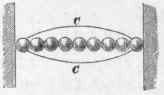
188. If the beam be loaded uniformly and the depth be constant, the breadth will vary in the form of two parabolas which overlap, and whose vertices are in the middle of the beam C, C (Fig. 53).
189. When the breauth of a beam loaded in the middle is constant and the top horizontal, the bottom edge will be in the form of two parabolic curves which intersect at the point of application of the load, and have their axes horizontal and their vertices at the points of support (Fig. 54).
Fig. 64.

Fig. 55.

190. If the beam be uniformly loaded the depth will vary in the form of a semi-ellipse, the top being horizontal (Fig. 55).
Note. - In the application of the Rules for calculating the Stiffness and Strength of Beams, it should be borne in mind that where the length is short in proportion to the depth, the load required to produce a deflection of 1/40th of an inch to a foot may exceed the safe load calculated by the Rules for Strength; and when the length is great in proportion to the depth there may be a deficiency of Stiffness, although the load may not exceed the calculated safe load to resist breaking: -
If F represents the usual factor of the Breaking Weight for Safety, a and c the constants for Stiffness and Strength, as in the foregoing tables, B and D the breadth and depth in inches, and L the length in feet. We have, when the beam is both stiff enough and strong enough,
D/L = ae/F gives c = 530, and if F be assumed = 5, we have -
Example. - For Riga fir, Table VII, gives a= .0115, and Table XIV.
D/L = .0115 x 530/5=6/5 nearly i. e. the depth should be 1 1/3 of an inch for every foot in length. When the load is distributed
D/L = 5 ac/4 F
Example. - Take the numerical factors as before, then -
D/L = 5 x.0115 x 530/4x5 = 1.52, or about 1 1/2 inch in depth for every foot in length.
Continue to:


My Books

