


Building Beams
Description
This section is from the book "Elementary Principles Carpentry", by Thomas Tredgold. Also available from Amazon: Elementary Principles Of Carpentry.
Building Beams
411. The method of building beams has already been considered in Section III., Arts. 203 to 206. It may not however be superfluous here to remark, that the position of the indents is not a matter of indifference. If two plain pieces were laid upon one another, and supported at the ends, the pressure of a weight applied in the middle would cause them to bend, and the surfaces in contact would slide against one another, the upper piece sliding towards each end upon reversed, as in Fig. 141, they produce scarcely any effect, and nearly the whole strain is upon the bolts.
* Art. Carpentry, ' Encyclopaedia Britanuica.' the lower one. This sliding is effectually prevented by indenting the surfaces, as shown in Fig. 140, when the pieces are bolted together; but if the same indents be
Fig. 140.

Fig. 141.
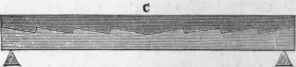
Wherever the principal strain on the beam may Lappen to be, to that point, as at C, Fig. 140, the indents should direct their square abutments; that is, towards the straining force. When the beam is uniformly loaded, the greatest strain is at the middle.
In drawings we frequently see all the indents put the same way, and sometimes as in Fig. 141, otherwise the preceding remarks would have appeared to have been unnecessary.
If the depth of the indents be too small in a built beam, they will not be capable of resisting the pressure; and if they be made too deep, the number of fibres will be diminished, and consequently the strength of the beam; therefore, there is a depth for the indents, by which a maximum of strength will be gained. Duhamel undertook to ascertain the proper depth by experiments;* and the general rule, given in Art. 205, Sect. III., agrees tolerably well with the case he tried.
' Transport des Bois,' p. 498.
Continue to:


My Books

