


Chapter VI. The Mitered Picture-Frame
Description
This section is from the book "Design and Construction in Wood", by William Noyes. Also available from Amazon: Design And Construction In Wood.
Chapter VI. The Mitered Picture-Frame
I. THE FRAMING OF PICTURES
The first thing to do in making a picture-frame is to select the picture, because such details as the use of a mat, the size, proportion, tone, and decoration of the frame, all depend upon the character of the picture. Furthermore, the picture should be one well worth framing. To select a picture that is not beautiful, is but to honor what should be ignored.
To be able to frame good pictures well, then, is the ideal to be kept in mind in learning to make picture-frames.
The suggestions here given are intended to apply only to the selection and the framing of comparatively small pictures, such as photographic and chromolithographic reproductions and Japanese color prints. In these days of cheap reproduction, good pictures of this class are inexpensive and readily secured. In the periodicals are to be found excellent reproductions of the work of some of the greatest living artists, such as Maxfield Parrish, Jules Guerin, John W. Alexander, Edwin Abbey, Frank Brangwyn, Gari Melcher, Pamela Colman Smith, and Jessie Wilcox Smith, to mention a few. Also Japanese color prints as well as photographic reproductions of universally recognized European and American masters may be procured at the best art stores.
For the novice, a sufficiently safe guide to the choice of good pictures, is to select from the works of these artists. However, a study of Prof. Arthur W. Dow's "Composition/' would go a long way toward enabling the student to select wisely his own pictures for framing.
When it is remembered that the frame is made for the picture and not the picture for the frame, then it follows that the frame is to be so designed as to set off the picture to the best advantage.
As to the adaptation of the frame to the picture, in the first place, the mat may properly be considered as a part of the frame. It, like the frame, is a device to give a setting to the picture. Whether or not a mat is to be included in the framing of the picture, depends somewhat on the location of the picture in the room, as well as the idea one has in mind in framing the picture, and the character of the picture.
In favor of the mat, it is to be remembered that an ordi-n a r y mitered frame by itself involves the necessity of having all the margins around the picture equal in width; whereas, by the use of a mat, this monotony can be avoided and a subtle and pleasing variety produced, as in Fig. 64. As to the size of the mat: If there is to be a mat it should be large enough to be effective. A mat that is only a little larger than a picture looks as tho it were a mere device for splicing out the picture to fit the frame. On the other hand the picture should not look lost in the mat.
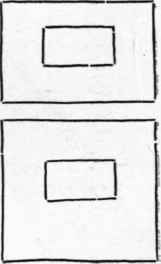
As to the width of the margins of the mat: one consideration to be borne in mind is the shape of the entire frame resulting from the introduction of a mat. As a general rule it is safe to say that the margins should not be such as to produce a square frame for an oblong picture. See Fig. 65. A little observation will show that squareness in either picture or frame is commonly avoided by artists. An oblong is less monotonous and hence more pleasing than a square, just as an ellipse or other varied curve is more pleasing than a circle. As to the proportions of the oblong, simple multiples are to be avoided; that is, the ratio of the short side to the long side should be not simply 1 to 2 or 2 to 3, but a more-subtle relation.
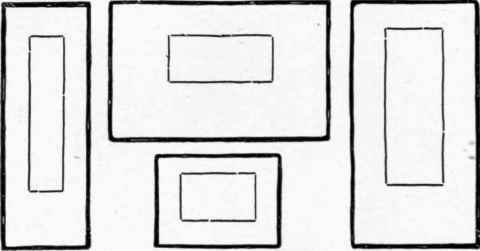
Fig-. 64. The mat makes possible the introduction of interesting proportions in the framing.
Continue to:


My Books

