


Chapter VII. The Candlestick
Description
This section is from the book "Design and Construction in Wood", by William Noyes. Also available from Amazon: Design And Construction In Wood.
Chapter VII. The Candlestick
Altho the essential features of this project set fixed limitations to its design, yet a great variety of forms and embellishments are possible; see Fig. 95. The success of the design depends, primarily, on the harmonious unity of the parts. If the design be good, the piece is worth much painstaking labor.
This project consists of two parts, the copper socket and pan, and the .wooden base supporting these.
I. The essential features to be fixed are:
1. The size of the candle to be used. (Common sizes are ¾" or1 ⅛"determines the diameter of the socket.
2. The pan, of such a shape as to catch the drip well. This is to be soldered to the socket.
3. A base, large enough to be stable. The construction suggested for this base is a cross-lap joint.
4. A convenient means of handling. This may be either a loop for the forefinger, Fig. 96, or a column to be grasped, Fig. 97.
5. The kind of wood. The piece does not require much material and is worth while making in wood of a good species and quality. Mahogany, black walnut, and sweet gum are not difficult to work, can be finished handsomely and their colors harmonize well with the copper parts.
II. The refinement of the proportions. The candlestick without the column may well be quite small, each member of the joint being Dot more than 4" or 5" long and 1½" or more wide.
With a column, Nos. 2, 4, 6, 8, Fig. 97, the size of the base will naturally increase; the higher the column, the broader the base. The candlestick must seem as well as be stable.
If feet are added, Nos. 2, 7, Fig. 97, the effect of stability will be increased.
III. Embellishments. These include modifications in outlines by modeling, Fig. 97, No. 5, chamfering, Fig. 97, No. 8, coving Fig. 98, No. 8, beading, Fig. 98, No. 1, or even carving, Fig. 96. Suggestions for such treatment are also given in other pictures. Whatever is done, the treatment should be harmonious thruout.
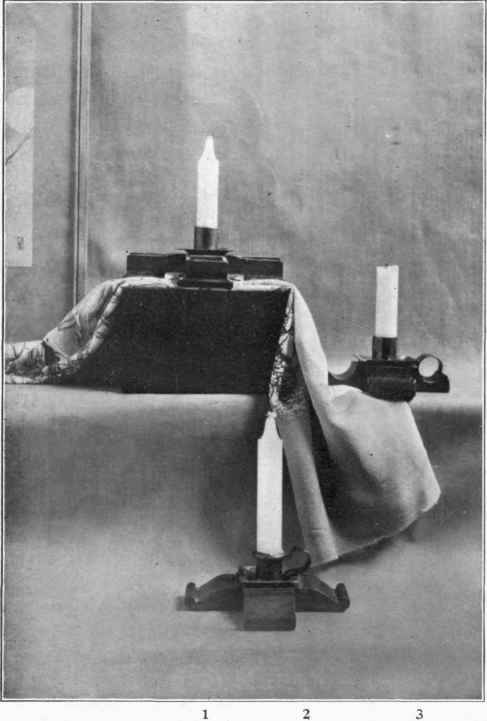
Fig. 96. Low candlesticks.
An appearance of lightness may be given to the column by constructing it as in Fig. 99.
The best finish for a candlestick that may be frequently handled and is liable to be smeared with wax or tallow, is boiled linseed oil, thoroly rubbed. If made of mahogany, the color may be darkened with bichromate of potash. See below, p. 92.
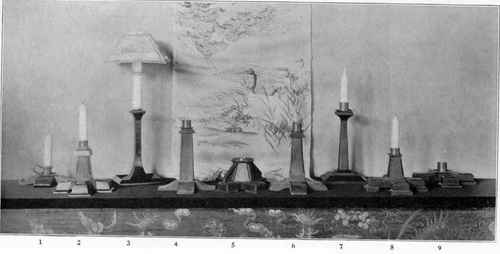
Fig-. 97. Column candlesticks.
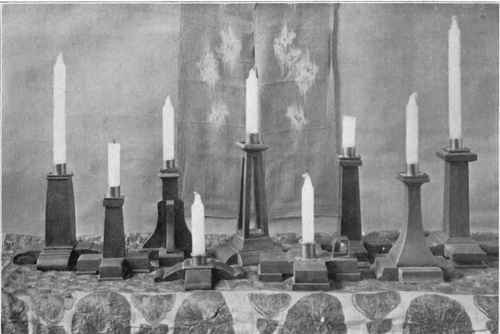
Fig. 98. Candlesticks, variously designed.
IV. Directions for making cross-lap joint. In order not to waste good wood in learning how to make the cross-lap joint, it is well to make first a practice joint of pine or other soft wood.
Select a piece of straight grained pine, and carefully plane it to the size, ¾"xl⅝"xll", finishing all surfaces. For the order of planing surfaces, (see Handwork in Wood, page 72.) Be careful that the piece is of uniform width and thickness thruout, and finish both ends clean and square. Mark a point 5" from each end of the piece, score with a sharp knife all around the piece at both these points, cut a little groove on the waste side of the lines, on one broad surface, (see Handwork in Wood, page 66, and Fig. 91), saw off the waste and trim the ends with the block-plane. Now make the half-lap joint as described in Handwork in Wood, page 155.
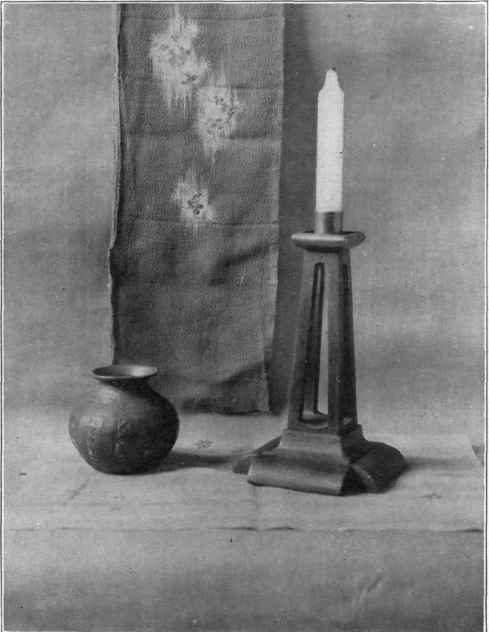
Fig-. 99. Column of candlestick lightened.
Directions follow for making the candlestick shown in Fig. 100. The materials required are, mahogany or black walnut:
A. I piece, ⅞"x1¾"XII
Continue to:


My Books

