


Appendix A. Key To The More Important Woods Of North America
Description
This section is from the "Educational Woodworking For Home And School" book, by Joseph C.Park . Also see Amazon: Educational Woodworking For Home And School.
Appendix A. Key To The More Important Woods Of North America
[The numbers preceding names refer to the List of Woods following the Key].
Directions For Using Key
It is rather difficult at first to use a key of any kind. One must have some practice before accuracy is acquired in the collection of data used in the key. In the use of the following key one should work at first with a few samples of wood accurately named and large enough to show pith and bark and wide enough to show cross section. Do not use polished woods, but clean fresh specimens. After working with a few woods that are known so that the use of the key is understood, take several specimens of wood that are unknown and determine the kind of wood. For a close study of a specimen it is well to moisten the wood and cut off a thin, small section with a sharp knife, and put the bit of wood between two pieces of thin glass for study under the microscope or by holding to the light. After a few trials the value of the key will be understood and it will create much interest in woods.
1 The following key is taken from "Timber," Bulletin No. 10, U. S. Dept. of Agric, Division of Forestry.
I. Non-Porous Woods
Pores not visible or conspicuous on cross section, even with magnifier. Annual rings distinct by denser (dark colored) bands of summer wood (Fig. 234).
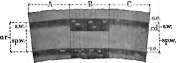
Fig. 234. "Non-porons" woods. A, fir; B, "hard" pine; C, soft pine; ar, annual ring; o.e., outer edge of ring; i.e., inner edge of ring; s.w., summer wood; sp.w., spring wood; rd, resin ducts.
II. Ring-Porous Woods
Pores numerous, usually visible on cross section without magnifier. Annual rings distinct by a zone of large pores collected in the spring wood, alternating with the denser summer wood (Fig. 235).
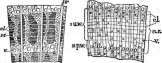
Fig. 235. "Ring-porous" woods. White oak and hickory, a.r., annual ring; su.w., summer wood; sp.w., spring wood; v, vessels or pores; c.l., concentric lines; rt, darker tracts of hard fibers forming the firm part of oak wood; pr, pith rays.
III. Diffuse-Porous Woods
Pores numerous, usually not plainly visible on cross section without magnifier. Annual rings distinct by a fine line of denser summer-wood cells, often quite indistinct; pores scattered through annual ring, no zone of collected pores in spring wood (Fig. 236).
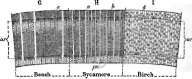
Fig. 236. "Diffuse-porous" woods, ar, animal ring; pr, pith rays which are "broad" at a, "fine" at b, "indistinct" at d.
Note. - The above described three groups are exogenous, i.e. they grow by adding annually wood on their circumference. A fourth group is formed by the endogenous woods, like yuccas and palms, which do not grow by such additions.
Continue to:


My Books

