


Wood Fastenings (Dowels, Pins, Cleats, Keys, And Wedges)
Description
This section is from the "Educational Woodworking For Home And School" book, by Joseph C.Park . Also see Amazon: Educational Woodworking For Home And School.
Wood Fastenings (Dowels, Pins, Cleats, Keys, And Wedges)
Dowels are important fastening devices. They are turned wooden pins varying in diameter from 3/16" to 1". They are made from different wood, white birch being the kind of wood that is used most. In cabinetwork the 1/4" dowel pin is used most. They can be bought in bundles (500 in a bundle) and in 36" lengths.
Dowel pins may be made by driving a small piece of wood through a hole in a "dowel plate." A dowel plate may be made by drilling holes, say 1/4", 3/8", and 1/2" in diameter, through a cast steel plate that is from a 1/4" to a 1/2" in thickness.
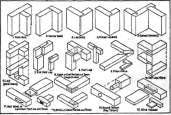
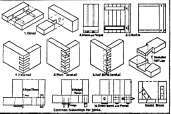
Fig. 148. Common joints and wood fastenings.
As to the method and use of dowel pins, pins, cleats, keys, and wedges, see Fig. 148, page 147.
In designing joints and fastenings in wood construction Rankine has given five principles to be observed. They are: -
1. "To cut the joints and arrange the fastenings so as to weaken the pieces of timber that they connect as little as possible".
2. "To place each abutting surface in a joint as nearly as possible perpendicular to the pressure which it has to transmit".
3. " To proportion the area of each surface to the pressure which it has to bear, so that the timber may be safe against injury under the heaviest load which occurs in practice, and to form and fit every pair of such surfaces accurately, in order to distribute the stress uniformly".
4. "To proportion the fastenings so that they may be of equal strength with the pieces which they connect".
5. "To place the fastenings in each piece of timber so that there shall be sufficient resistance to the giving way of the joint by the fastenings shearing or crushing their way through the timber".
Continue to:


My Books

