


Number XXXII. Turned Molding
Description
This section is from the "Elementary Turning" book, by Frank Henry Selden. Also available from Amazon: Elementary Turning.
Number XXXII. Turned Molding
Sometimes it is necessary to make circular pieces of molding to be used at rounded corners or at semi-circular ends. This is done by turning a complete circle, and then cutting from it such segments as are required.


Fig. 258 Turned Molding.
Fig. 259. Blank for Turned Molding.
Fig. 259 shows a piece of 7/8-inch board secured to a face-plate. No attempt has been made to make the blank a true circle before placing it in the lathe, for the rough corners of this octagonal shaped piece of soft wood can be cut away quite easily in the lathe. As the diameter of the circle is greater than the
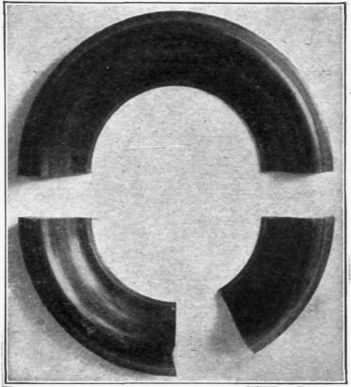
Fig. 260. Molding Segments.
diameter of the iron face-plate, a wooden facing is attached, so that the screws will enter the part of the wood that is to become the molding. If the screws were to enter the waste material, you could not finish the inner edge of the molding.
Adjust the rest, and turn the outer edge as in working the rosette (Lesson 30). Turn the inside of the circle, as in making the frame (Fig. 235).
After the molding has been finished, as in Fig. 258, it may be cut into such pieces as are required.
Fig. 260 shows one section for a rounded end, one for a rounded corner, and one to connect parts at an angle of sixty degrees.
Continue to:


My Books

