


Clamps
Description
This section is from the "Elementary Woodwork" book, by Frank Henry Selden. Also available from Amazon: Elementary Woodwork for Use in Manual Training Classes.
Clamps
Probably the old-fashioned wooden hand screws shown in Fig. 145 will never be entirely displaced. For most work they are better than any other style. Care must be taken to keep the jaws quite or nearly parallel, for if they are not parallel one or both of the screws may be broken.
In using them first tighten the screw which is nearest the center of the jaws. This screw is called the shoulder screw. The other screw near the end of the jaws is called the back or tail screw and is tightened last. Be sure that the shoulder screw is so tight that when the back screw is tightened the jaws will be parallel. Be very particular to see just how the jaws are pressing on the work. This may sometimes be determined by grasping the back screw between the jaws and pulling sidewise. The point on which the jaws turn is the point of greatest pressure. Sometimes it is necessary to use wedges between the work and the clamp.
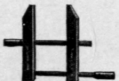
Fig. 145. Wooden Hand Screw.
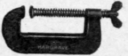
The iron clamp shown in Fig. 146 is better for some places than the wooden hand screws. These clamps are made in a variety of styles. Some are supplied with quick adjusting devices. They all require wooden blocks to be placed between them and finished surfaces. For some work this is quiet troublesome. For clamping glue joints a very strong clamp is necessary. The one shown in Fig. 147 is a very good style. Common iron bench screws may be secured to a similar piece and when properly fastened make excellent clamps. Whatever style of clamp you are using, remember that it may be overstrained or broken. A little experience and use of judgment will enable you to know when the strain has reached the limit of safety. Do not be afraid of using too many clamps on work that requires great pressure. Some pieces are best clamped by using as many clamps as may be placed in position on the piece. For directions in clamping see Figs. 58, 77, 78, 79, 118.
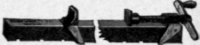
Fig. 146. Iron Clamp.
Fig. I47. Bar Clamp.
Continue to:


My Books

