


Sharpening Planes
Description
This section is from the "Elementary Woodwork" book, by Frank Henry Selden. Also available from Amazon: Elementary Woodwork for Use in Manual Training Classes.
Sharpening Planes
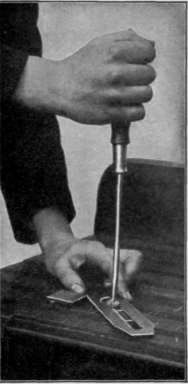
Your planes should be sharp and ready for use when you get them and you should become quite familiar with these tools and be able to set them nicely before attempting to sharpen them in any manner. The first step in sharpening is to learn to whet the bits on the oilstone. To remove the bit, grasp the cam lever as shown in Fig. 173 with the thumb and finger and lift it upwards. This will loosen the bit. Be very careful to see and remember just how every part appears when in proper position. Lift the loosened parts from the plane and with a screwdriver loosen the screw as shown in Fig. 174. Either remove the cap iron or slide it to the top end out of the way.
Observe carefully the angle at which the iron has been ground and hold it on the oilstone so that the oilstone will make a slightly blunter angle, as shown in Fig. 143, A being the angle at which the erly be used and which by practice you will discover. You should use only a simple forward and backward movement at first. The essential points which must ever be kept in mind iron was ground, and B the angle at which the iron is to be whetted. Use a sufficient amount of oil on the stone to cause it to cut freely. Rub the bit forwards and backwards, keeping it at the same angle. Hold the bit very firm as shown in Fig. 175. As you become more accustomed to using the oil-stone you will give the tools a somewhat circular motion, varying the amount accor-ding to circumstances. There are a great variety of motions which may propFig. 175. Whetting a Plane Bit. A chisel is whetted in a similar manner.
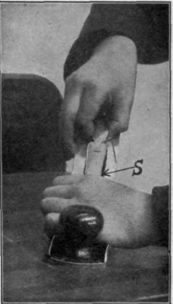
Fig. 178. Lifting the Cam Lever. S - The screw which holds the cap and iron in place.
Fig. 174.. Loosening the Cap Screw.
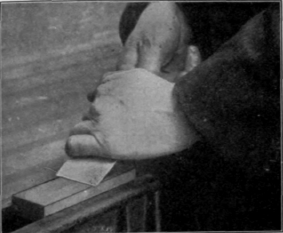
are to use the stone over its entire surface so that it will wear down evenly, and to keep the plane bit at the same angle during the entire process of whetting so that the surface will be definite and not rounded in the least as examined from the edge, the same as the chisel (Fig. 143, B and C).
There is always a tendency to whet the corners short, making the cutting edge rounding as shown in Fig. 176. This will do no harm if not too much. In fact, for beginners it is better to have at least one of the planes, usually the jack plane, quite rounding so that it will cut only a narrow shaving and consequently not require so much strength to use it. As you become more skillful in using the planes you may whet them more nearly straight across until they are almost straight except very near the corners. After bringing the bit to an edge it is often necessary to turn the bit over and lay it flat on the oilstone to remove the wire edge, as in sharpening the chisel (Fig. 144). Generally it is necessary to reverse the bit several times before the rough edge will come off. After the wire edge has been removed the bit should be stropped on a bit of leather as the chisel is stropped (Fig. 202).
Replace the cap iron, bringing it to about one thirty-second of an inch from the cutting edge, and tighten the screw. Place the parts in the plane and adjust them as described on page 168. After the plane bits have been whetted several times they should be ground as described in the general directions for grinding under the topic Grindstone.
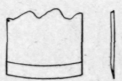
Fig. 176.
Rounded End of a Plane Iron
Continue to:


My Books

