


75. Double Mortised Joint
Description
This section is from the book "Elements Of Construction", by Charles A. King. Also available from Amazon: Elements of construction.
75. Double Mortised Joint
Double Mortised Joint. Fig. 140.
Material:
1 piece, 12" X 2" X 7/8". 1 piece, 7"X 5" X 7/8".
A. Comparison of a wide and double mortised joint: Where wide rails are used, such as the middle and bottom rails of a large panel door, a single mortise would cut away too much wood, and make a tenon of too great width. The middle of the length of a mortise long enough to receive a very wide tenon, would have little strength, as the wood would all have been cut away, and that on each side of the mortise would not be stiff enough to give the joint the strength and rigidity it should have. By making two tenons instead of one, the shrinkage of a wide tenon is distributed, and the liability of breaking the glue connection is much decreased. In driving the wedges, they should be driven as at a; not beside the tenon, as at b, though this is the method usually followed upon common work.
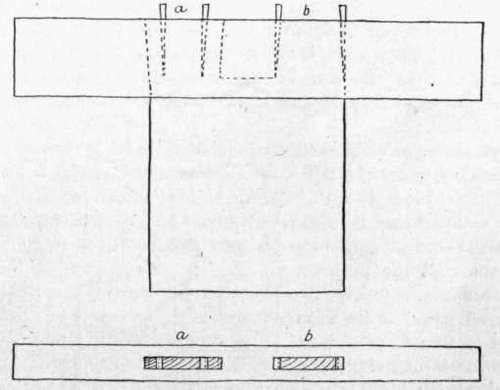
Fig. 140. - Double Mortised Joint.
B. Blind, or fox, wedging: Upon the best grades of work, the wedges are frequently entered as shown in Fig. 141, which is called "blind," or "fox," wedging. In this, the mortise is cut longer at the bottom than at the joint, and when the tenons are forced into their places by the clamps, the wedges are pushed into the cuts made to receive them, thereby spreading the tenon and forming a dovetail, which makes a very strong joint. This joint is often used upon the best grades of outside doors, as the end of the tenon is not exposed to the weather. Good judgment and careful work are necessary to make this joint well.

Fig. 141. - Blind, Or Fox-wedged, Mortised Joint.
Continue to:


My Books

