


Tools. Part 9
Description
This section is from the book "Elements Of Woodwork", by Charles A. King. Also available from Amazon: Elements Of Woodwork.
Tools. Part 9
(B.) The ratchet bitbrace (Fig. 70) differs from the ordinary brace only in the ratchet attachment. It is an indispensable tool to an up-to-date workman, as it may be used in many places where an ordinary brace would be useless; for gen eral work, however, being heavier, it is less conven ient than the plain brace. 52. The screwdriver (A.) is one of the most important tools in a carpenter's kit, and to be of use should be of finely tempered steel, for if too soft, it will turn over, and if too hard, it will break. The edge should be as thick as the slot of a screw will allow, in order to have as much strength as possible.
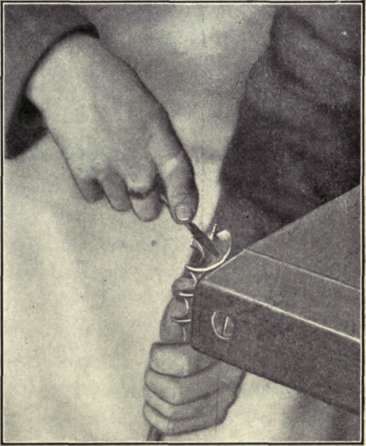
Fig. 69 . - Filing an Auger Bit.
(B.) A round-handled screwdriver is not so satisfactory as one with an elliptical or polygonal handle, as it is im possible to obtain as good a grip upon the former as upon the latter; a round handle, planed flat upon the two opposite sides, is quite commonly used.
(C.) Ratchet screwdrivers are useful in many places where it is difficult to use two hands, and there are patent quick-action screwdrivers on the market which are suitable only for certain kinds of light work, as what is gained in speed is lost in power. The screwdriver bit is a short screwdriver blade, tanged to fit a bitbrace; it is essen tial in doing economical work, as screws may be driven much more rapidly than by hand, and it is also valu able on account of its greater leverage in driving heavy screws.
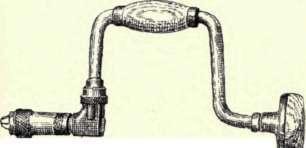
Fig. 70. - Ratchet Bitbrace.
53. Compasses, or dividers (Fig. 71), are used to draw circles and curves, and for spacing and scribing, by which is meant the process of fitting a piece of wood to an uneven surface. Calipers (Fig. 72) are used to measure the out side of a round or oval object. Those shown are known as "outside" cali pers; "inside" calipers, or those used for measuring the inside of a hole, have straight legs. These tools ordinarily are not considered a part of a carpenter's kit, as they are generally used upon work requiring more exact measurements. Wood-workers' tools are graded to sizes, generally nothing finer than 16ths of an inch; hence, the ordinary methods of measuring will usually give sufficiently accu rate results.
54. Pliers. - (A.) These are indispensable little tools (Fig. 73), and every workman should own a pair. Those combining several tools are most useful; cheap tools of this sort are usually worthless. (B.) Nippers (Fig. 74) are made to cut wire, but not to pull nails. Being tempered for cutting, those of good quality are hard and brittle, lacking the toughness necessary to pull nails, for which work a cheap pair of nippers may be purchased.
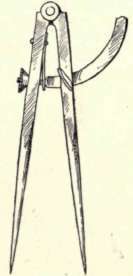
Fig. 71. Compasses.
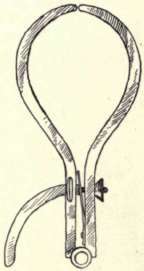
Fig. 72. Calipers.
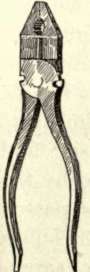
Fig. 73. Pliers.
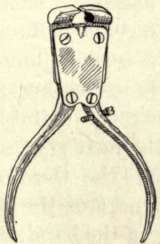
Fig. 74. Nippers.
55. The scraper is one of the most useful tools in the kit of the carpenter who works upon hard wood. This tool may be purchased, or made of a very hard saw; it must be of hard, tough steel, or the edge will not last. A scraper should be about 3" x 5", which is a convenient size for grasping with the hand. Many workmen make handles for their scrap ers (Fig. 75, A and B), but cabinet makers, and others who use them con tinually, generally prefer to use them without handles. If a large sur face is to be scraped, it is well to have a handle of a leather palm (Fig. 75, C). This is a piece of leather of suitable size and shape to protect the hand from the heat generated by the action of the scraper in cutting; the thumb is passed through the hole, and the broad part of the palm hangs between the scraper and the thick of the hand. For scrap ing floors, a scraper plane (Fig. 75, D) will be found val uable, though if much of this work is to be done, it will be the best economy to purchase one of the forms of floor scraping machines.
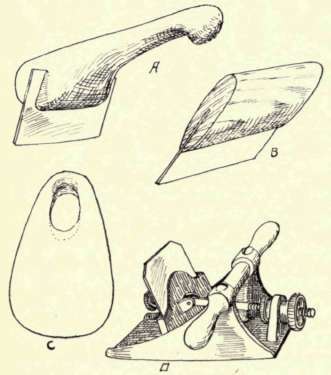
Fig. 75. - Scraper.
A, B, handles for scraper; C, leather palm; D, scraper plane.
56. Edges. - There are two forms of edges used in sharpening scrapers, - the square and the beveled edge; in sharpening either of these, the edge should be filed, whetted, and turned with a burnisher, which imparts a wire edge, indicated in Fig. 76, A and B, which shows enlarged views of the two forms of edges of scrapers. If the eye glances along the edge of a properly sharpened scraper, the edge will appear slightly curved; this edge must be given it by filing. After the scraper is filed, each corner which is to be turned must be whetted to a perfectly keen edge upon an oilstone, as the object of sharpening a scraper is to "turn" this edge at an angle with the sides of the scraper.
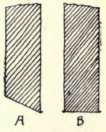
Fig. 76. Edges of Scrapers.
A, beveled edge; B, square edge.
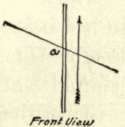
Fig. 77. - Angle of Burnisher with Sides of Scraper.
By "turning" the edge of a scraper is meant pushing the particles of steel which form the corner over so that they will form a wire edge which will stand at an angle with the sides of the scraper. When the edge has been skillfully turned, it will cut like a very finely sharpened and adjusted plane, and will work either with or against the grain without tearing the wood. Notice carefully the angle of the burnisher with the sides of the scraper, as at a, Fig. 77, and as in Fig. 78, which indicates approxi mately the angle at which it should be held across the edge when seen in the view illus trated of either a square or beveled-edge scraper, the vertical lines indicating the scraper. The stroke must be from the bottom, up, as indicated. At A, Fig. 79, is shown the top view of the burnisher as it makes each of the strokes in turning the edge of a square edge scraper; notice that the burnisher swings in an angle of about 15°, one stroke only being made at each angle.
Continue to:


My Books

