


Exercise 22. - Laying Out And Cutting The Dovetails
Description
This section is from the book "Exercises In Wood-Working", by Ivin Sickels. Also available from Amazon: Exercises in Wood Working.
Exercise 22. - Laying Out And Cutting The Dovetails
Material. - Front and back pieces of the dovetailed box. Work. - Marking and cutting the mortises.
The pieces are marked with a sharp pencil on both sides and edge 5/8" from the ends, as at a, a, b, b, Fig. 1. Or the pieces are brought together and points marked on both at the face-edge, by which the lines a, b, Fig. 1, are squared. It is very necessary to square the lines from the face-edge, otherwise the joints are likely to be open on one side or the other.
On these lines mark the places for the dovetails as indicated in Fig. 2. This may be done in either of two ways: the measure may be carefully made on a cardboard and transferred from it to each of the lines with a sharp point; or the marking-gauge may be set at each measure and its point used to mark the distance on the lines.
In Fig. 2, one end is shown full size with the measures; on the line from a to b each space has its value; while from c to d each point is measured from the face-edge, and any inaccuracy given to one of the points is not continued along the line. This latter method is truer, but more difficult. Having marked the points, the slanting sides of the joints are marked with the knife along the T-bevel set to a certain angle. This angle, an arbitrary one, is shown in Fig. 3. On a board with a true edge measure 5/8", b, c; from b draw the line a b with try-square; lay off on this line a point 3" from b; join this last point and c; adjust the T-bevel to this line, a c. The bevel is applied to the ends of the pieces in marking the lines g, g, and i, i, and the marks across the ends h, h, completed with the try-square and knife.
In cutting out the mortises, it would be well to shade the parts to be removed, then saw, observing the rule in regard to the saw-kerf, as in Fig. 4. The pieces are cut out as directed in Exercise 14. In finishing the cuts, use a small chisel grasped by the right hand resting on the piece (Fig. 5), so that the hand acts both as a power and a guide or check to prevent the tool cutting beyond half the depth. The cut should be as near as possible straight across, but rather hollow than round, as at d, Fig. G. In testing use a small steel square (Fig. 8, Plate A).
Ex. 22.

Fig. 1
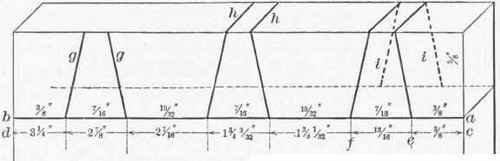
Fig. 2


Fig. 4

Fig. 5

Continue to:


My Books

