


Explanation Of Figure 23
Description
This section is from the book "Exercises In Wood-Working", by Ivin Sickels. Also available from Amazon: Exercises in Wood Working.
Explanation Of Figure 23
1. Dorsal aspect of the head of Zopherus Mexicanus: I, labrum; p, palpus; c, clypeus; e, eye; a, antenna.
2. Inner face of the Iabrum: 6, fringing bristles; m, insertion of muscles; h, deep hinge, with insertion of muscles joining to clypeus.
3. Ventral aspect of the head: I, Iabrum; p, palpus; md, mandible; li, labium; mx, maxilla; mt, mentum; a, antenna; th, thorax.
4. Ventral aspect of the left maxilla with its palpi: ep, external palpus; ip, internal palpus.
5. Inner face of the labium: b. bristles of tongue-groove; m, insertion of tongue-muscles; h, hinge, connecting the labium with the mentum.
6. Longitudinal-vertical section of the head: th. thorax; c, clypeus; I, Iabrum; md, mandible; ft, labium; mm, muscles of the mandible; mh, muscles moving the head on the thorax; o, oesophagus.
7. Ventral aspect of the right mandible: e, cutting edge; cd, double-headed pivot or condyle; mm, insertion of the muscles.
8. External lateral aspect of the right mandible: h, the hinge; c, the condyle; 1, 2, direction of cutting movement.
From the Journal of the New York Microscopical Society, July, 1888. 4 weevil we are indebted for the worm-eaten appearance presented by old carved-oak furniture. So often, indeed, are these borings regarded as an evidence of the antiquity of furniture, that many European dealers have been known to imitate their presence by a charge of fine bird-shot.
The large Roebuck beetle, or Horn-bug (Lucanus dama,

Fig. 27. - Saw-beetle.

Fig. 28. - Horn-bug.
Fig. 28), is fortunately at present rather uncommon; the grub attains the size of a man's thumb after a six years' life spent in boring forest trees.
Another large borer is the common brown Saw-Beetle
(Prionus unicolor), named from its saw-like feelers. It infests pine-trees, and may be taken as the type of the destructive saw-beetle family.
Besides the beetles nearly every other order of insects has members more or less destructive as borers. Among wasps, for example, we are surely all familiar with the large Carpenter - Bee (Xylo-carpa Virginica). so common about the posts and railings of our country porches, which bores a gallery for its young large enough to admit a finger.
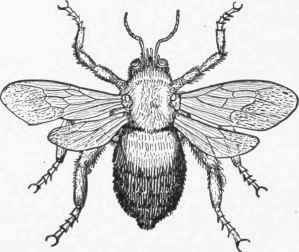
Fig. 29. - Carpenter-bee.

Fig. 30. - Carpenter-moth.
As another example we may mention a moth, not uncommon about the city, whose caterpillar lives in the hard yellow locust, the Carpenter-Moth (Xyleutes robinice).
Before closing, it would perhaps be of interest to say a few words of the relation of insects to knarls or burls. These knotty outgrowths may occur on any tree, both on branch and trunk, but become valuable only when of a size suitable for cabinet-work or veneer-cutting. The wood in such cases is abnormally hard, is dark and mottled in color, and usually presents a curled, wavy grain.
The origin of burls has as yet been but little studied. It is, however, usually conceded that these deformations, like the well-understood galls, were originally produced by insects; that the young grubs feeding upon and irritating the most delicate tissues, have caused the plant to form the irregular accumulation of new wood-cells, both in and about the injured part. That this formation will go on for ages after the cause has disappeared seems to have been well established, and it is often found that in after-years the burl may fail to exhibit the slightest trace of its insect origin.
As in the formation of galls, the insects that cause these deformations are not confined to an isolated group, but belong to a number of families in no less than five different orders. The beetle-larvae, namely, Buprestids and Weevils, are usually regarded as the typical burl-formers.
Continue to:


My Books

