


Timber-Borers
Description
This section is from the book "Exercises In Wood-Working", by Ivin Sickels. Also available from Amazon: Exercises in Wood Working.
Timber-Borers
From the outer bark to the innermost heart-wood, all trees have enemies, more numerous if not more destructive than man. If we go to the nearest saw-mill or wood-pile, almost the first thing we notice is the worm-eaten appearance that so many timbers present. If, now, we stop and examine one of these logs with a little care, we may make out the directions of the borings, and probably find the cause of these depredations in the form of a small, white-bodied grub. A little further study of the various woods in the neighborhood will show us:
1. That borings in the same log may be made by different kinds of grubs.
2. That special kinds of borers infest certain kinds and conditions of woods.
3. That the softer parts of the tree, such as sap-wood or wood in decay are far more frequently infested than the harder parts.
4. That, on account of the more porous structure, the grub is apt to follow the grain of the timber, rather than pass through a number of more compact rings of growth.
We have thus far been considering the case of wood in the green state, but we may find that these principles of borers may be applied as well to seasoned woods, save that this class is not usually attacked until decay has commenced. Any method of softening the wood, as heat, cold, or moisture, aids its destruction by insects. The destruction of timbers under water such as wharf or bridge piers, or ship-bottoms, is hardly a part of the present theme. It may be noted, however, that what the insect does on land, the mollusk, boring sponge, and marine worm accomplish in salt water; and that such destruction is apt to be most rapid near the low-water mark.
Thus far we have seen where the borings occur; let us now consider the insect itself, and its method of work.
Probably all the borings we have so far seen have been the work of beetle-grubs. We must remember that beetles, like butterflies, and like nearly every other insect, must pass through a series of changes or transformations before they become what we regard as beetles. The egg laid by the adult beetle on the proper food-supply hatches into a minute grub. This grub, or larva, sets at once to feeding, grows continually, and sheds or molts its outgrown skins until it attains a limit of size. Thence the insect passes into a curious, mummy-like pupa stage; and it is from this dormant state of transition that the beetle finally emerges. Keeping in mind this life-history, we may see how from the egg in some crevice of bark the grub has steadily eaten its way inward to its proper food-supply, whether in sap-wood or heart-wood, and has there grown and prospered. As the period of this feeding life in many borers extends over years, we may understand how much damage is apt to be done. The grub spends its time feeding and resting, frequently retracing its way to the outer opening, and enlarging its gallery whenever necessary. A large amount of the waste sawdust, sometimes freshly cut, sometimes glued into pellets by the insect's secretions, is continually being pushed out of the boring and allowed to drop to the ground, whitening the bark of the tree and readily revealing the insect's whereabout. When about to transform into the pupa the grub usually fills up the outer opening with drippings, stuck together, in order to conceal itself from enemies, especially from the sharp-eyed woodpecker. Sometimes, instead of this method of protection, the insect will inclose itself in a strongly made cocoon of chippings; but in either case the glue-like matrix is readily dissolved by a secretion of the escaping insect.
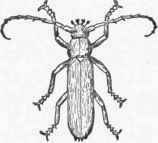
Fig. 20. - Oak-pruner.

Fig. 21. - Its larva.

Fig. 22. - Its pupa.
The way in which the grub is enabled to bore into the hardest woods is certainly of singular interest, and gives another example of the wonderful muscular development of the insect, more wonderful than the leg-muscles of the grasshopper or even than the wing-muscles of the humming-bird moth. If we take any common beetle, whether perfect or in the grub stage, and examine for a moment the mouth parts, we may readily make out a pair of short, thick jaws, or mandibles, moving sidewise, reminding us of the tinsmith's shears, protected by flap-like lips, one in front and one behind. It may be seen, from the way the lips are hinged at their bases, that they may serve to hold the object to be cut, and that they are aided in this by a pair of small, jointed appendages inserted near the under lip. The mandibles themselves, if more closely examined, will be seen, like the shears, to press their cutting edges together as they meet side by side, but we must note that the cutting edges are short and curved, somewhat like the edge of a gouge. The pivot on which the jaws rotate is located at the extreme outer margin of the mouth, and the heavy muscles which start from the back of the insect's head are attached solidly to the movable jaw between the pivot and curved, or gouge-like cutting edge, so as to gain an immense leverage. The boring is in reality a process of countersinking, the insect frequently changing from a right to left motion, to one from left to right, and it is by some believed that in this change the jaws are sharpened. As a rule it may be stated that the jaw of a hardwood borer has a short, strong, cutting edge, and that the particles of wood cut are exceedingly minute. So nicely are the cutting powers adjusted that instances are recorded of the boring of sheet-iron by an escaping beetle. A Central American wood-beetle (Zopherus), kept alive this winter in a glass jar at college, found no difficulty in cutting its way out, of an evening, through a covering of sheet-lead one sixteenth inch thick.

Fig. 23. - Mouth-parts of Zopherus Mexicanua.
Of the common borers we may name a few of the more important. The Buprestids and the related beetles are well recognized as among the most destructive and most numerous; a number of species, represented in Fig. 24 by Buprestis Virginica, living in pine timbers. The grub of the handsome Painted Clytus, so common among the flowers of the golden-rod, infests locust-trees, that of the Clytus speciosa is destructive to maples. Although the Weevils are usually spoken of as the fruit and grain destroyers, their reputation seems equally bad among timbers. One of the most common of beetles, represented by numbers of species, we find them infesting every kind of tree from bark to heart-wood, and especially destructive to felled timbers. It is to a species of
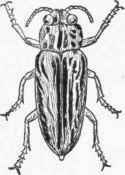
Fig. 24. - Buprestid.
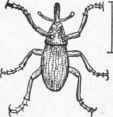
Fig. 25. - Pine-weevil.

Fig. 26. - Clytus.
Continue to:


My Books

