


Parasitic Plants
Description
This section is from the book "Exercises In Wood-Working", by Ivin Sickels. Also available from Amazon: Exercises in Wood Working.
Parasitic Plants
The forms of plant-life destructive to living trees and lumber belong to the higher orders of the group Fungi. These are parasites - that is, they do not possess chlorophyl (the green matter common to the higher orders of plants), and therefore do not assimilate or digest food for themselves, but live on the digested and structural material of others. They are developed from minute spores, grow and decay very rapidly, and contain a large amount of nitrogen in their composition.
The structure of these fungi consists of two portions - a tangle of thread-like filaments having somewhat the appearance of the root-hairs in the higher orders of plants, and which have for their function the absorbing of nutritive material for the fungus; and a denser portion composed of straight filaments, which form on their extremities the spore-bearing cells.
In developing, the fungus starts from the spore, which corresponds to the seed of the higher orders. This spore sends out a long filamentous tube which, as it progresses, gives off branches, and these in their turn branch until the tangle of filaments called the mycelium is formed. This mycelium may have long and separated filaments, as in the underground portion of mushrooms, or it may have the filaments massed together, as seen in some polyporous fungi under the bark of trees. When the mycelium has absorbed sufficient nourishment to produce spores, it sends out the straight branches usually into the light. The mycelium is about the same in all the different fungi; the variations in the form and color of the spore-bearing portion, and the characteristics of the spores, giving to each kind its place in classification.
The exact conditions which cause the spore to develop a mycelium are not known, but it may be generally stated that it must find a resting-place containing nutritive elements peculiarly suited for its growth, and, as accompanying conditions, warmth, moisture, ammonia, and an absence of strong light.
Some of the fungi obtain their food from the contents of the living cells of the plant, so that the mycelium destroys by entering and depleting the sap-wood of the tree. In others the mycelium secretes a peculiar juice, which has the power of decomposing the lignin of the heart-wood, and converting it back into cellulose, which is dissolved and absorbed by the fungus. The latter destroys by removing those elements which give to wood its strength, and causes a condition in the tree or lumber known as decay or rot.
In the heart-wood the vessels and cells facilitate the growth of the fungus in the direction of the grain, while its progress across the grain is comparatively slow. In passing to adjoining cells the filaments of the mycelium may go through the pores, or by the solvent action of its secretion make openings for itself.
The extent to which these fungi will grow depends on the supply of food material, so that, once established in the stem of a tree, they may spread until the entire structure is consumed. If their filaments pass through the soil, like those of some of the toadstools, many trees may be affected and destroyed by one fungus. The innumerable mass of spores given off by the fungus would seem to predict the entire destruction of timber-trees, but fortunately this is prevented by the difficulty of satisfying the peculiar requirements necessary for the development of the spores.

Fig. 17. - Mycelium of fungus piercing wood-cells a, filaments; b, holes formed by fungus.
Among the parasitic fungi those which are especially destructive to wood belong to the group Hymenomycetes, or those having naked spores growing on exposed surfaces. In the agarics, or toadstools, these surfaces are thin, flat plates, called gills. In the polypores, or tree-fungi, the spore surfaces are tubes whose openings constitute the pores. In Merulius, or tear-fungus, the spore surfaces are shallow cavities.
The toadstool (Agaricus melleus) is very destructive to many trees, including the firs, pines, beech, and oak. Its mycelium consists of long, dark filaments several inches below the surface of the ground, that gain access to the wood by attacking the roots and sending its filaments up into the stem. The spore-bearing portion is frequently seen in the autumn at the base of dead trees; it is yellowish, and has the gills extending partly down the stem, on which is a well-marked ring. Besides scattering its spores, the danger from this fungus consists in its power to send filaments through the soil from one tree to another.
The tree-fungus (Polyporus annosus) is very destructive to the pines and firs. Its mycelium is white, silky, and forces its way through the bark of the roots into the living cells, and from them into the heart-wood. The spore-bearing portion may appear on the lower part of the trunk or upon the roots underground. The porous surface is turned upward and the spores transported by insects or burrowing animals from root to root. The Polyporus sul-phurus is one of the best known of the destructive fungi, and attacks almost every kind of tree. Its mycelium develops from spores which lodge in the stump of broken or sawed branches, and passes downward into the stem consuming the tissue as it goes. Its sporing portion is bright yellow on the under or porous side and red above, usually projecting from the decayed stump of the branch or in advanced cases from the side of the stem.
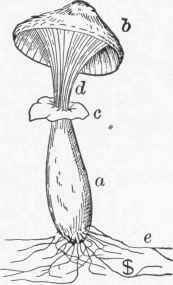
Fig. 18. - Toadstool, a, stem; b, umbrella top; c. ring, attached to the top before it expands; d, gills; e, filaments forming the mycelium.
P. pini is similar to the P. sulphurus, and is a wound-parasite on the pines.
P. fulvus is also a pine-tree fungus, peculiar in its action, in that it does not dissolve the lignified parts of the cell, but the thin membranous substance which unites the cells, thus setting the cells free. P. dryadeus acts in a similar way in oak-trees. Merulius lacrymans affects pine and spruce timber in houses, and especially the ends of joists and beams in contact with damp brick or stone walls. Its mycelium penetrates the end wood, causing dry rot and forms on the surface of the wood and adjacent brick-work a fiat, moist mass which develops on its under side shallow spore cavities. All fungi contain large quantities of water, but the lacrymans frequently holds an excess which exudes in small drops from its spore surface.
The Daedalia is closely related to the Polyporus, and is parasitic on white cedar and cypress.
Among the higher forms of fungi the Dematium gigan-teum is very destructive to oak; noted cases of its ravages being the destruction of oak piles along the sides of the Canal du Midi, Toulouse, and the destruction of the Foudroyant, a sixty-gun vessel, in two or three years.
The moist condition of standing timber adapts it to the attacks of the fungus mycelium. In cut timber, warmth and moisture, with bad ventilation and imperfect seasoning, all favor the growth of the fungus. An examination of the wood, as the mycelium progresses, shows at first a darkening, usually of a brown tint, due to the action of the fungus secretion on the wood. Then the wood becomes yellowish, with black spots surrounded by white masses of cellulose, derived from the decomposed lignin of the cell-walls. This cellulose is slowly absorbed by the mycelium, the wood assumes a light-brown color, and is very soft and brittle. When the thin membrane which unites the cells becomes dissolved, then the wood loses its form and breaks down into a brown powder, leaving a hollow trunk.

Fig. 19. - Polypore growing on a living locust-tree.
Continue to:


My Books

