


Part First. Structure Of Wood
Description
This section is from the book "Exercises In Wood-Working", by Ivin Sickels. Also available from Amazon: Exercises in Wood Working.
Part First. Structure Of Wood
If we examine the stem of a young plant, we find three distinct tissues composing it: On the outside is the bark or protecting tissue (a, Fig 3); inside there is a soft material, made up of many-sided, thin-walled cells, which constitute the living portion (6, Fig. 3); and arranged in a circle in this soft tissue are several fibrous bundles (c, Fig. 3), giving to the stem its strength to support the branches and leaves. Because of differences in the character of these bundles, we separate stems into three classes; and the pine, palm, and oak may be taken as types of each.
In the pine and oak the bundles are similarly arranged, and consist of an outer portion called bast (d, Fig. 3), and an inner portion called wood (e, Fig. 3); between these is a thin layer of active cells, which multiply by division to form the bast and wood; this layer is called cambium (f, Fig. 3), and adds each year to the size of the bundle. In the palm the bundles arise from active cells at the growing point of the stem, and continue down the stem, sometimes becoming smaller, but retaining a rounded form.
As the stems grow older and larger, we find, in the pine, that new and branching bundles appear between the first ones, forming, during the season, a circle of bundles, which constitutes the first annual ring. This ring is interrupted by plates of tissue communicating between the pith, on the inside of the ring, and the soft tissue on the outside. In a crosssection of the stem these plates are seen as lines, called medullary rays, radiating from the center toward the bark. At the

Fig. 1 - Diagram of a stem with a cambium layer. A, section cut across the bundles; B, section in the direction of the bundles; 1, 2, 3, first, second, and third annual rings; a, a, pith; 6, 6, pitted vessels; c, c, wood-cells; d, spiral vessels, found only in the first annual ring; e, cambium-cells; f, g, h, layers of bark ; i, i, medullary ray. (After Carpenter.) end of the season growth stops, to be resumed again in the spring. The slow and condensed growth of summer, and the rapid, open growth of spring, give rise to a peculiar mark in the bundles which indicates each year's increase, so that by counting these marks or the annual rings we may ascertain the age of a tree.
The last few rings formed are engaged in transporting or storing up nourishment, and give rise to what is called the sap-wood. The rings inside of the sap-wood serve only for support, and make up the heart-wood of the tree.
In the palm, new bundles arise, placed irregularly in the soft tissue or pith, and by tracing these bundles throughout the plant we see that they extend, usually without branching, from the apex of the leaf to the small ends of the roots, so that for each new leaf there will be in the stem new bundles.

Fig. 2 - Diagram of a palm-stem. A, cross-section; B, longitudinal section; a, a, soft tissue; 6, 6, vessels or tubes with pitted sides: c, c, wood-cells or fibers; d, d, vessels with spiral markings. (After Carpenter;
In the oak we have the same appearance regarding the annual rings and medullary rays as in the pine:

Epidermis ......a.. | bark. | |
Active cells... b | pith. .g. | |
medullary ra,y..h. | ||
cambium../. | ||
Fibro-vascular bundle ...... c | wood......e | vessels, |
cells, | ||
fibers. | ||
bast-cells..d. | ||
Fig. 3. - Section of stem.
Examining more closely these wood-forming bundles, we find them composed of cells with a variety of forms and walls of varying thickness and peculiar markings. In the pine group the cells are long, with pointed ends, and walls marked by characteristic elevations called bordered pits (Fig. 4). These pits arise during the thickening of the cell-wall, which can not take place on the thin circular membranes (Fig. 10, c), through which the sap passes, but forms arches with open tops over them, and thus gives the bordered appearance. In the heart-wood these thin membranes have broken down, allowing a free passage of air or water through the cells. In spaces between the wood-cells there are, in most of the pines, canals containing resin dissolved in turpentine. The thin plates of tissue forming the medullary rays are composed of small cells, with thin walls in the outer annual rings, but in the heart-wood with walls very much thickened.

Fig. 4.

Fig. 5.
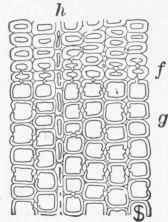
Fig. 6.
Fig. 4. - Section of pine-wood cut parallel with the medullary plates, a, spring growth, with large bordered pits: 6, summer growth, with smaller bordered pits; c, medullary tissue.
Fig. 5. - Section at right angles with the medullary plates, d, bordered pits; e, medullary tissue.
Fig. 6. - Cross-section of the same. f, summer growth; g, spring growth; h, medullary ray.
The isolated bundles of the palm are composed of various elements,some of which simply support, as the bast and wood fibers; others support and conduct, as the vessels and wood-cells; these latter convey air, and water charged with mineral matters absorbed by the roots.
The bast-fibers are on the outside, surrounding the bundle, and are very long, narrow, many-sided cells, with pointed ends, the walls very much thickened and marked with oblique pores. The wood-fibers are on the inside of the bundle, similar to the bast-cells in every respect, except that they are shorter, and occasionally used for conducting and storing up nourishment. The vessels or tubes are large and few, and present varied markings; the larger are pitted, the smaller either ringed, spiral, netted, or ladder-form. The wood-cells are like those of the pine group, but with simple in place of bor-dered pits. There are present, also, sieve-tubes with clusters of small perforations in sides and ends, and a group of long, thin-walled cells similar to the cambium-cells of the pine and oak. Frequently in the vicinity of the vessels are found thin-walled cells with blunt ends, separated from the vessels and surrounding cells by membranous pores; these cells, which are somewhat similar to cambium-cells, serve the purpose of conducting and storing up the organic materials formed in the leaves.

Fig. 7. - Palm-bundle, a, a, bast; 6, pitted vessel; c, wood-cells; d, smaller vessels; e, soft tissue.

Fig. 8. - Bast-fibers.
In the oak group the wood is composed of compact bundles made up of the same fibers, cells, and vessels found in the palm, with the exception of the bast-fibers, which are formed outside of the cambium zone and constitute the inner bark. In the spring growth the vessels are large and numerous; in the autumn they are much smaller, and in some cases may be absent. By this variation in the size and position of the bundles the annual rings become distinctly marked. The medullary rays in the heart-wood vary in thickness, and in many of the woods the cells composing them become solid.

Fig. 9. - Pitted vessels.
Continue to:


My Books

